Our MRI department has contracts with all health insurance companies.
Ordering
You can make an appointment for an MRI in person, by phone or by e-mail.
- in person: in building C - first door on the right next to the reception desk
- by phone: +420 311 745 200 (weekdays 7.00 a.m. - 3.00 p.m.)
- by e-mail: rezonance@nember.cz
If you wish to make an appointment by e-mail, you need to send a scan of the request form (voucher) for the examination and also provide a contact telephone number.
MRI examinations are carried out on weekdays and late afternoons. Non-urgent appointments are also available for Saturdays, Sundays and holidays. Urgent examinations are always ordered by the referring/treating physician in consultation with the MRI radiologist.
We have some of the shortest appointment times in Prague and the Central Bohemia region, as well as in the country. We perform MRI examinations on the basis of a medical referral (request form) issued by the referring physician or a general practitioner on the basis of a clinical examination.
As a standard, medical descriptions for MRI examinations are made and delivered to the attending physician within 4 working days. If you have a scheduled appointment with your referring physician for an MRI within these 4 days, please contact the physician to verify that the description of the examination has already been received by your physician.
Image data from the MRI scan is provided on a flash drive if needed.
Location of the workplace
The MRI department is located on the ground floor of Building C of the Rehabilitation Hospital Beroun, prof. Veselého 493, 26601, Beroun.
Instrumentation
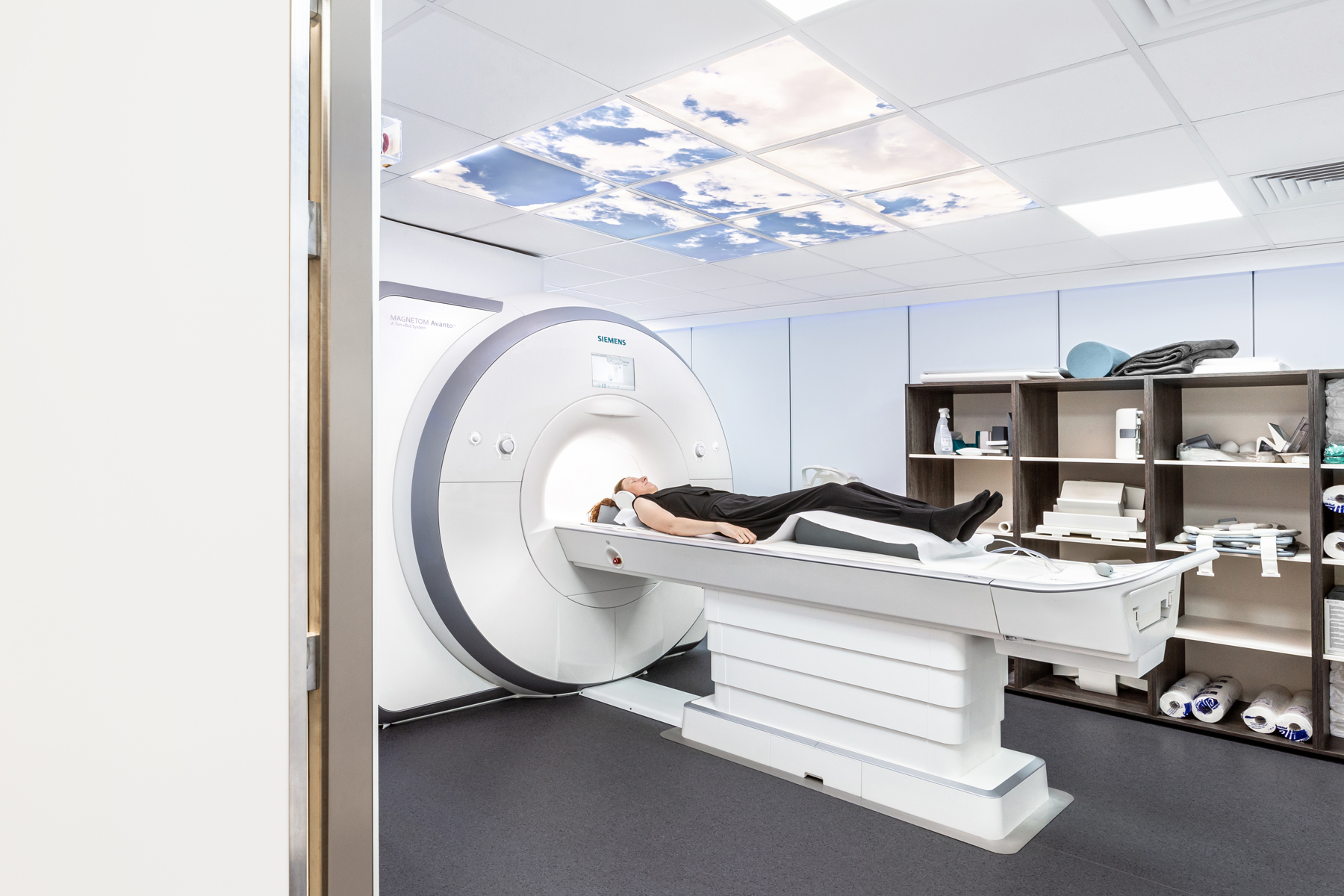
The examination is performed on Siemens Magnetom AvantoFit devices with magnetic field strength of 1.5 Tesla. The diameter of the gantry of MR devices is 60 cm and the maximum load capacity of the table is 160 kg.
The device is placed in a separate examination room, shielded from radiofrequency signals from the outside environment by a so-called Faraday cage.
The average time of the examination itself can vary from 15 to 30 minutes, depending on the type and method of examination.
Instructions to patients
During an MRI scan, it may be desirable for the patient to have a contrast agent injected into a vein. The purpose of its application is to show abnormalities, disease states that are either not detectable at all or very poorly and unreliably without its administration.
Before the planned MRI examination, it is desirable that the patient does not significantly restrict fluid intake so as not to be thirsty. It is advisable for the patient to arrive 20 minutes earlier than the scheduled time of his examination.
We do not perform MRI in the RNB
- MRI of the heart
- MRI of the TMJ (temporomandibular joints)
- MRI of the prostate
- MRI of the breast (mammary)
- children under 10 years of age
- patients under general anaesthesia
- arthrography
When it is not possible to undergo an MRI scan (contraindications)
Patients cannot undergo the examination:
- with an implanted pacemaker or defibrillator
- who have electrodes left after removal of the pacemaker or defibrillator
- with electronic implants ( cochlear implant, insulin pump, neurostimulator, etc.)
- with vascular clips in the brain ( unless the neurosurgeon confirms that the material used is compatible)
- metal foreign objects in the eye ( splints)
- the examination is not normally carried out in the first three months of pregnancy
Other restrictions:
- breastfeeding mothers can be examined on MRI, but should discontinue breastfeeding for 24 hours if contrast agent administration is necessary
- patients with joint replacements, metal clips in the body, artificial heart valves or screws or splints may undergo an MRI scan if these items have been in the body for more than 6 weeks
- diabetic patients who use a sensor for immediate blood glucose monitoring can only have an MRI scan after the sensor has been removed (it is therefore preferable to schedule the scan according to the expected sensor replacement)
- patients with claustrophobia or severe pain may be examined after premedication, which should be arranged with their physician
What to take with you for an MRI scan
- a referral form from the referring physician for the MRI scan
- yourhealth insurance card
- a copy of the findings of previous examinations, if the patient has undergone them at other institutions
- medical imaging documentation from another healthcare facility stored on a flash drive or sent electronically using the ePACS system
- comfortable clothing without metal parts
Preparation for the examination
It is advisable to maintain adequate fluid intake, i.e. the patient should not arrive for the examination dehydrated.
Special preparation is required for certain examinations (MRI - liver, pancreas, kidney, enterography):
1. MRI of abdominal organs (liver, pancreas, kidneys)
On the day of the examination: approx. 4 hours before the examination, not to eat, 2 hours before the examination not to drink
2. MR enterography (bowel examination)
Day before the examination: light breakfast and lunch excluding meat (only meat broth is suitable), dairy products and foods containing fibre (e.g. vegetables, cereals). Drink 1.5 - 2 litres of still liquid between 12.00 and 20.00.
On the day of the examination: take regular medication, otherwise do not eat, drink or smoke. Arrive 80 minutes before the appointment at the MRI department. Drink approximately 1.5 litres of fluid with Mannitol within 60 min before the examination. Due to the medication (Buscopan i.v. - causes eye accommodation disorders), driving, operating machinery and working at heights is prohibited after the examination until normal vision is restored, i.e. in about 12 hours.
It is necessary to accompany the patient on the way home!
Other examinations - no special preparationis required, you can take your usual medication unless your physician advises otherwise. We recommend that you do not eat 2 hours before the examination.
Informed consent for the MRI scan
- Arrive approximately 20 minutes early for your appointment to familiarise yourself with the pre-MRI instructions and to be briefed about the planned MRI scan
- You can download the informed consent HERE
- If you have any concerns or questions, please communicate them to the staff prior to the actual examination
- As part of the briefing, we will ask you to give your informed consent for the MRI scan, which will be confirmed by your signature. By agreeing, you confirm that you have been informed about the procedure, risks and contraindications
- In the case of contrast agent application for examination of minor patients under 18 years of age, an informed consent form must be signed by both parents (legal guardians), the document can be brought with you
Magnetic resonance imaging examination
After signing the informed consent, you will be ushered into a cubicle where you will be asked to remove your clothing according to the area to be examined (a disposable gown will be provided to cover you if necessary) and any metal objects that must not be in the magnetic field: dentures, hearing aids, prosthetic devices, underwear that includes metal, belts, wigs, hairpins, tweezers, pins, clips, metal coins, keys, watches, credit cards, glasses, cell phones, and jewelry. It is advisable to leave valuables at home. This also applies to your escort if they will be with you in the examination room.
The radiology assistant will then usher you into the examination room with the magnetic field, place you in the examination position on the bed, and guide you into the machine so that the area to be examined is always in the center of the MRI ring.
During the examination, lie still and breathe regularly (any movement may invalidate the examination).
In addition, you will be asked to hold your breath at various intervals during the chest and abdominal examinations.
Throughout the examination, you will have a balloon (bell) in your hand which you can use to summon the operator. The MRI staff will communicate with you via a microphone.
The examination itself is completely painless.
The MRI machine makes an intense noise during the examination. You will be given earphones to wear before the examination begins.
The length of the examination varies according to the area being examined, most often lasting between 10 and 30 minutes.
The post-MRI scan mode
After the examination, you can normally engage in any activity without restrictions.
If you are administered a contrast agent, wait in the waiting room for 10 minutes after the examination is finished, due to a possible allergic reaction to the contrast agent. In the following 24 hours, drink sufficiently to ensure that the contrast medium is eliminated from the body more quickly.
Breastfeeding mothers should discontinue breastfeeding for 24 hours after the examination with contrast medium application.
During the bowel examination - MR enterography, you will be given Buscopan (to calm intestinal peristalsis). After its administration, you may experience disturbances of eye accommodation or dizziness. In such cases, you must not drive or perform other potentially dangerous activities (operating machinery, working at heights) until normal vision is restored, which may take approximately 12 hours. In these cases, we recommend accompanying the patient.
Results of the examination
(release of image documentation on a flash drive on the day of the examination until 19.00, older examinations on weekdays until 15.00)
The original medical findings are always sent to the referring physician.
A copy of the medical report is issued on the basis of proof of identity (ID, passport, power of attorney) free of charge on weekdays until 15.00.
A copy of the medical imaging documentation on a flash drive is issued at the request of the physician or patient. The fee is 200 CZK.
The patient or referring physician may request that the image medical documentation be sent to another healthcare facility electronically free of charge via the ePACS system .
When requesting a healthcare facility to send image medical records electronically, the request must be sent to b.mr@nember.cz
We follow the recommendation of the Radiological Society of the Czech Medical Society J.E. Purkyně according to the following link: http://www.crs.cz/media/File/pdf/RizikaaKIvysetrovaniMR.pdf
Detailed information regarding MRI examinations can be found here:

 Česky
Česky