Česky
Česky


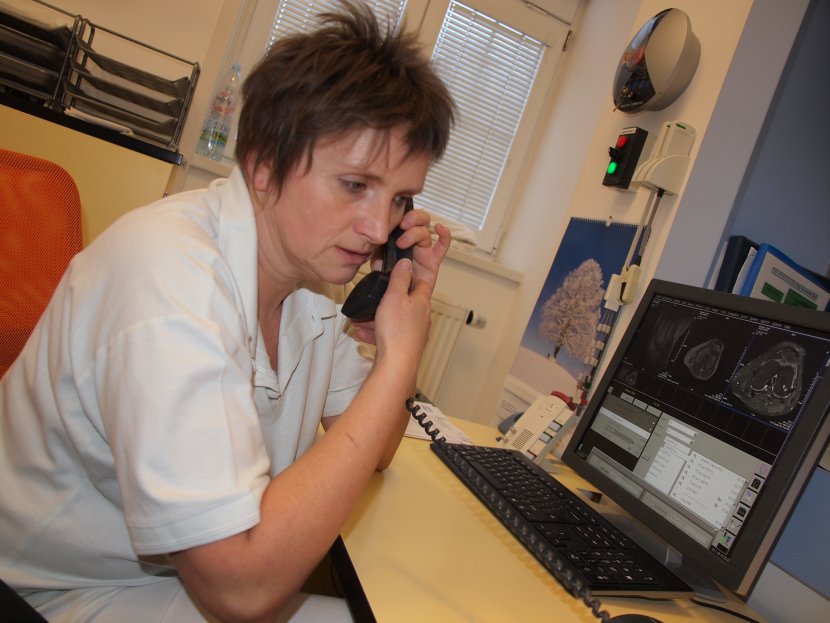
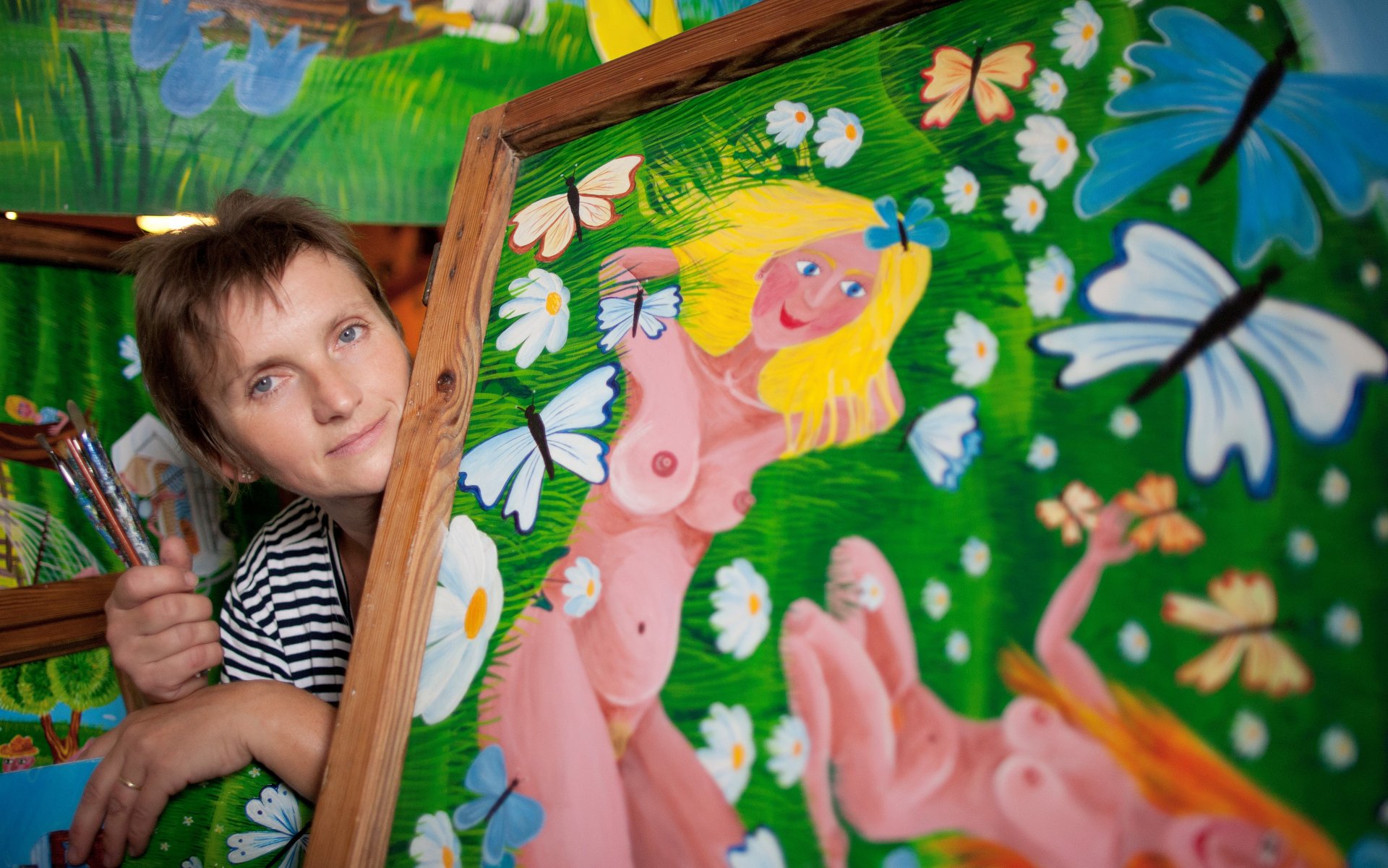
How challenging is it to combine the roles of mother, wife, lab technician, painter and photographer? Which of the previous roles do you identify with the most?
I have acquired all these roles gradually in my life, so I combine them naturally and fluently. At the age of 13 I got a camera of the brand Směna and started taking pictures at a cottage near Týřov. The first negative was taken during the flood in 1981, when our cottage was flooded. Since then I have never taken the camera off my shoulder. So it naturally grew on me. Just as a smoker always carries his pack of cigarettes, I carry my camera with me.
At eighteen, I fell in love and got my object of desire to photograph, which I have been photographing for thirty-two years. At that time I was studying medicine at Karlak University in Prague, and when Tomáš gave me oil paints for my birthday, I started to become a painter. While studying, I came to a different state, and I went from being a student to a wife and then a mother. I took pictures all the time and developed them myself in the basement photo room. The best birthday or Christmas present for me was photo paper, which no one could understand. But the stopping of time on celluloid always appealed to me. The moments in life that don't repeat themselves, the light and shadow that shines in your eyes until your vision goes blank, never left me cold. Photographing St. Nicholas as a little baby was something I enjoyed every day. He was joined a year and a quarter later by Hubert. And there was more and more to photograph. It was fun. I tried to preserve their childhood and our life in pictures. After maternity leave, I joined a law firm and worked as a secretary, as it was called in the early nineties. But I didn't want to leave medicine, so I enrolled in a long-distance study at the Higher Vocational School at Alšova nábřeží in Prague, majoring in radiology laboratory technician, where I graduated just as Mikuláš was finishing his first year. At that time I was already organizing exhibitions of my paintings. In January 1998, I started working at the RDG in the Beroun hospital and smoothly became a laboratory secretary.
Sixteen years after Mikuláš, we had a third boy, Jáchym, who is now ten years old. I came to all my roles as a photographer, painter, wife, mother, secretary and lab technician quite naturally and they all play the same role in my life. I think I try to do everything with love and to the best of my ability. I enjoy them all equally and try not to cheat any of them.
When did you start painting? What inspired you to adopt a "naive" style?
I used to paint straight A's in primary school, and because I've always been an altruist, in one drawing class I could easily draw three drawings, but they were signed with a different name. The children who didn't know how to draw were standing in line at my desk and begging "Lucy, please draw me that tank (factory, lilac, according to the celebration that was going on) too, so I don't get an F". I had to change each one a little so that the "comrade teacher" wouldn't recognize it. I also went to a club, but we did linorite for six months and I ended up getting my favorite sweater dirty, so I stopped going. It was too long a process for me with unpleasant results. I never dreamed I would ever pursue painting on a professional level, and neither did my parents because they naively thought I would become a lawyer like them.
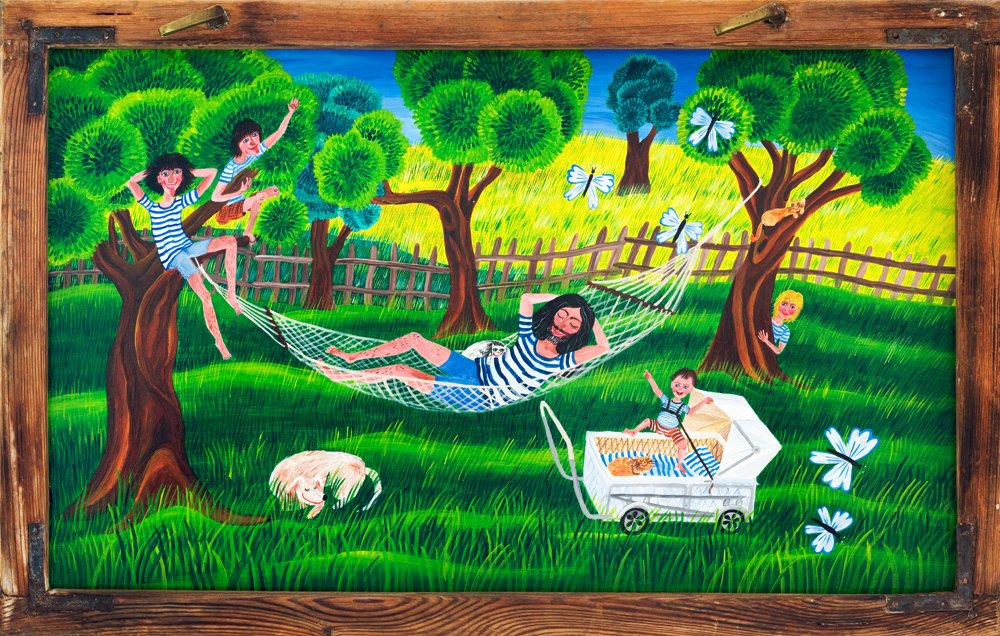
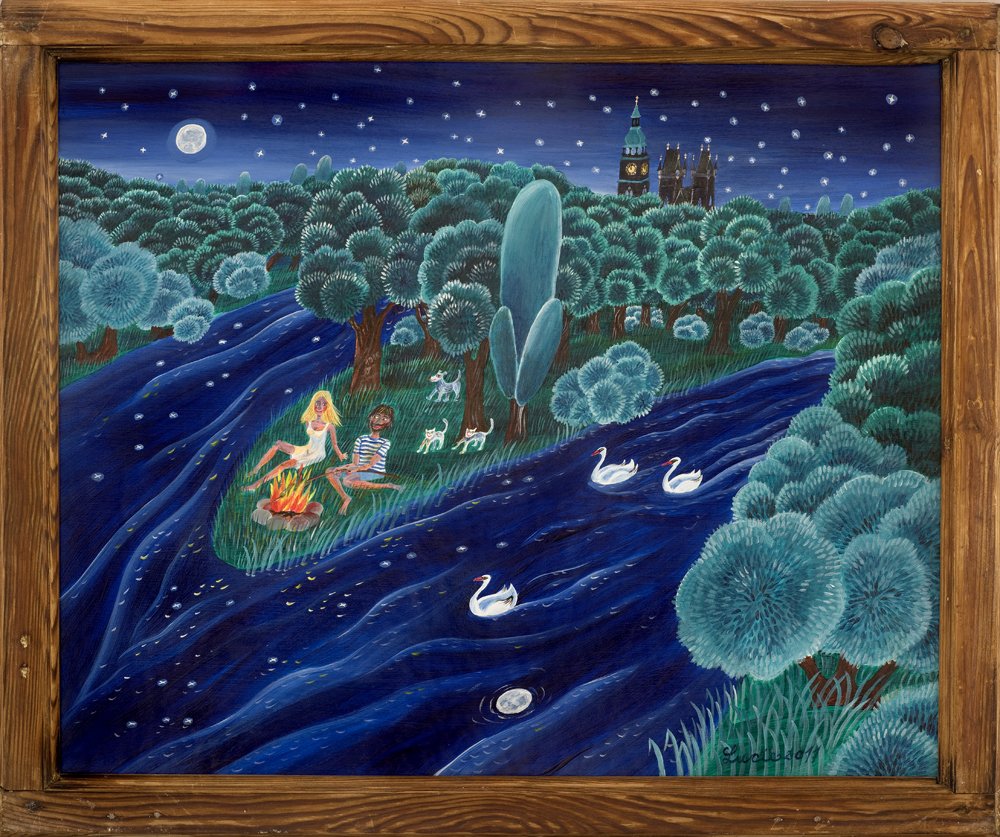
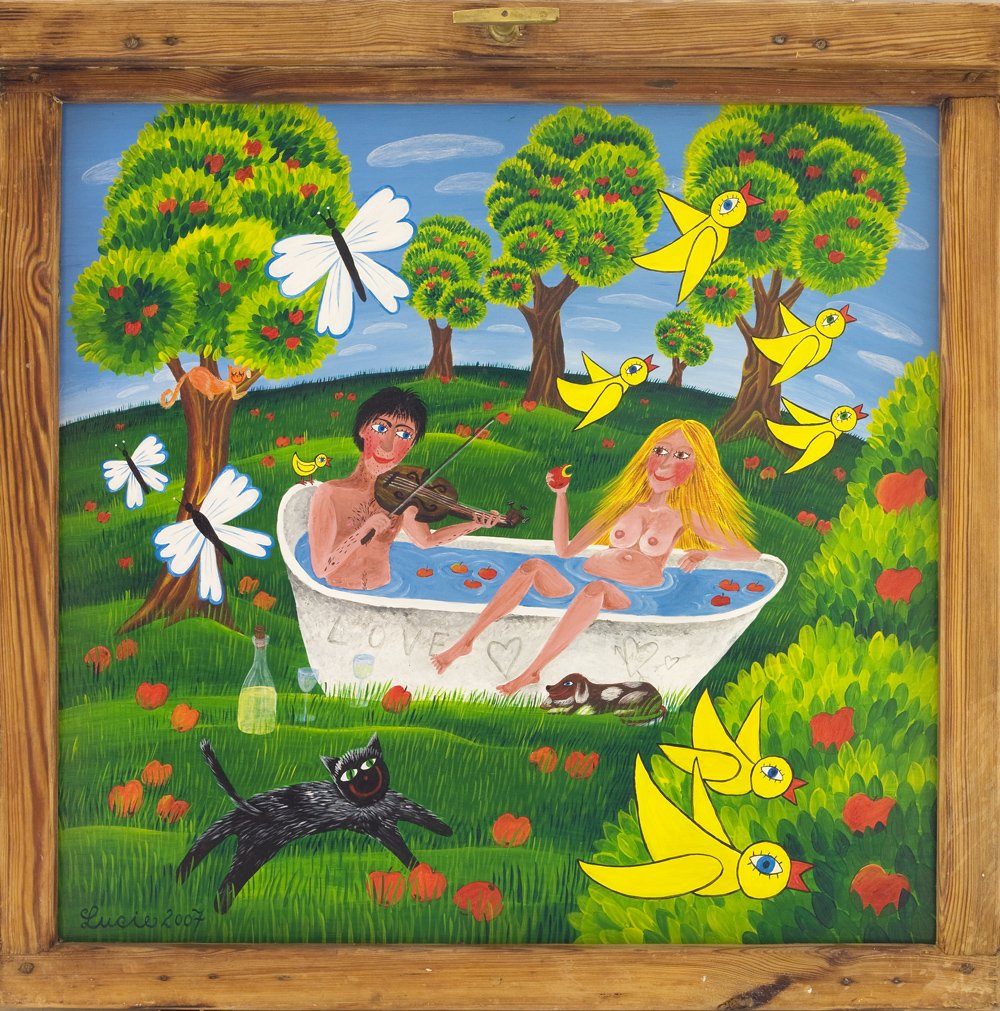
I also started painting because one day in 1988 we saw an exhibition of Emma Srncova's paintings and her pictures were so beautiful that I wanted to have them all. But when Tom found out their value, he got me some paints and, like Přemek Podlaha from Receptarium not only on Sundays, he gave me some good advice. And so I set about repainting them myself. I haven't stopped loving it and painting since then.
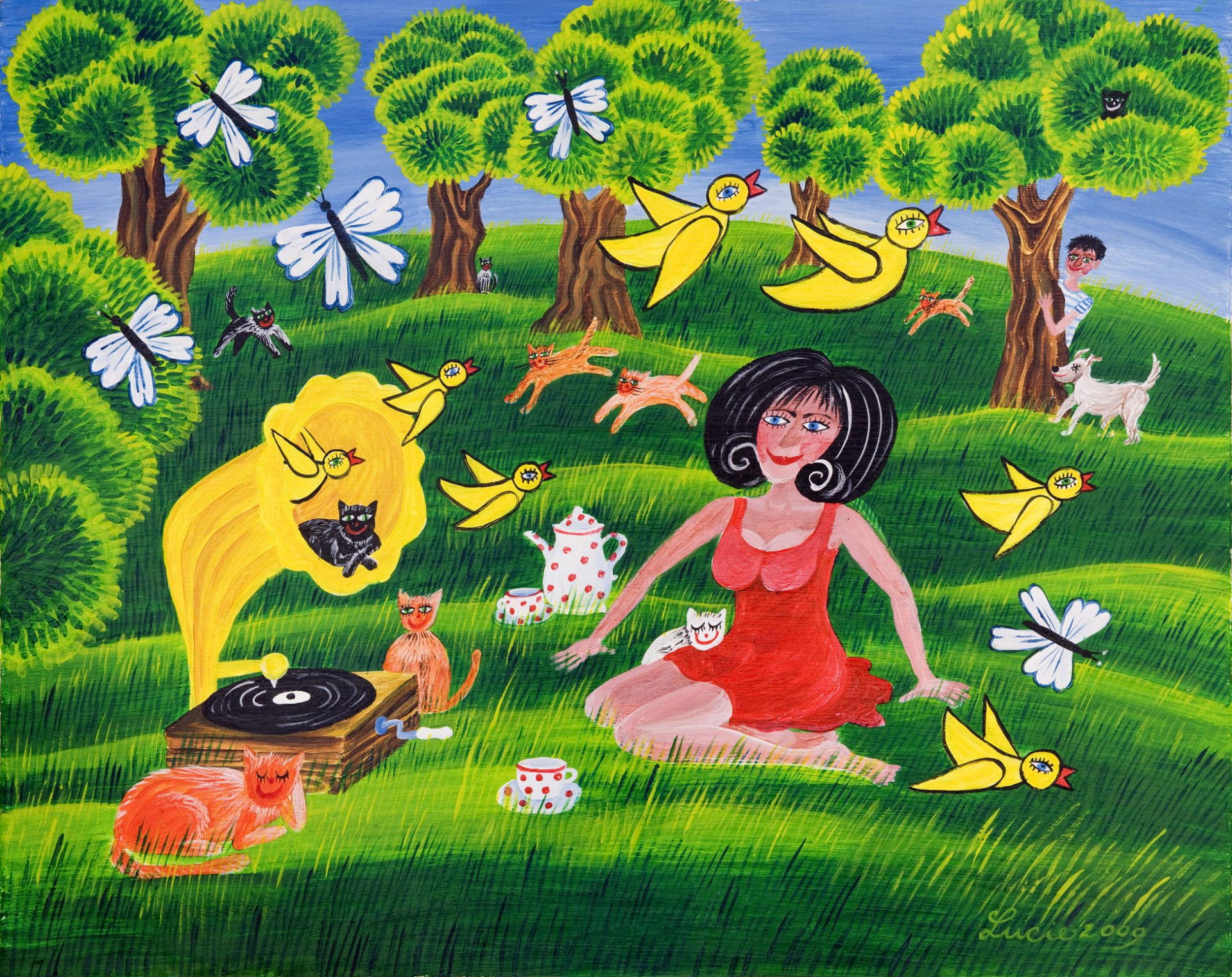
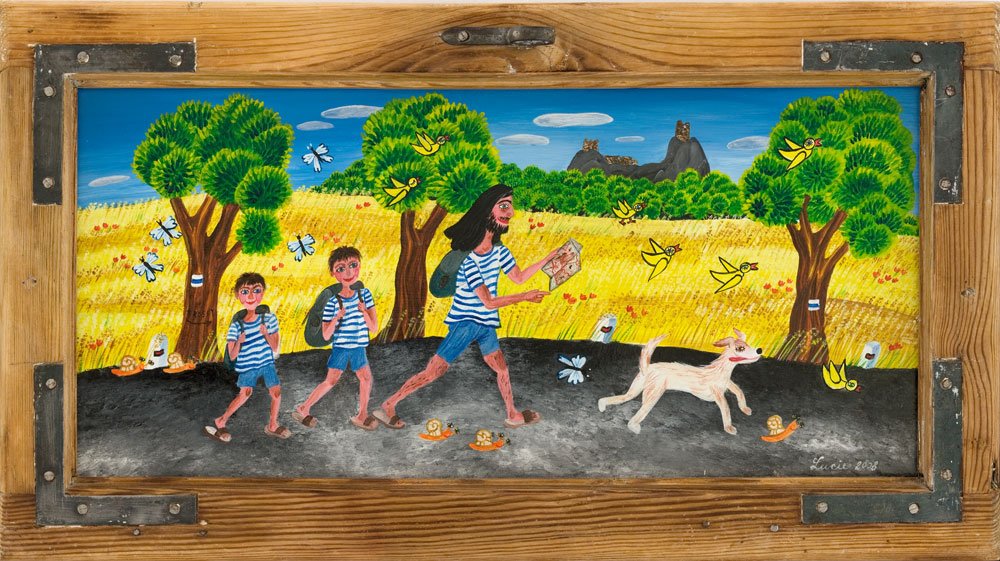
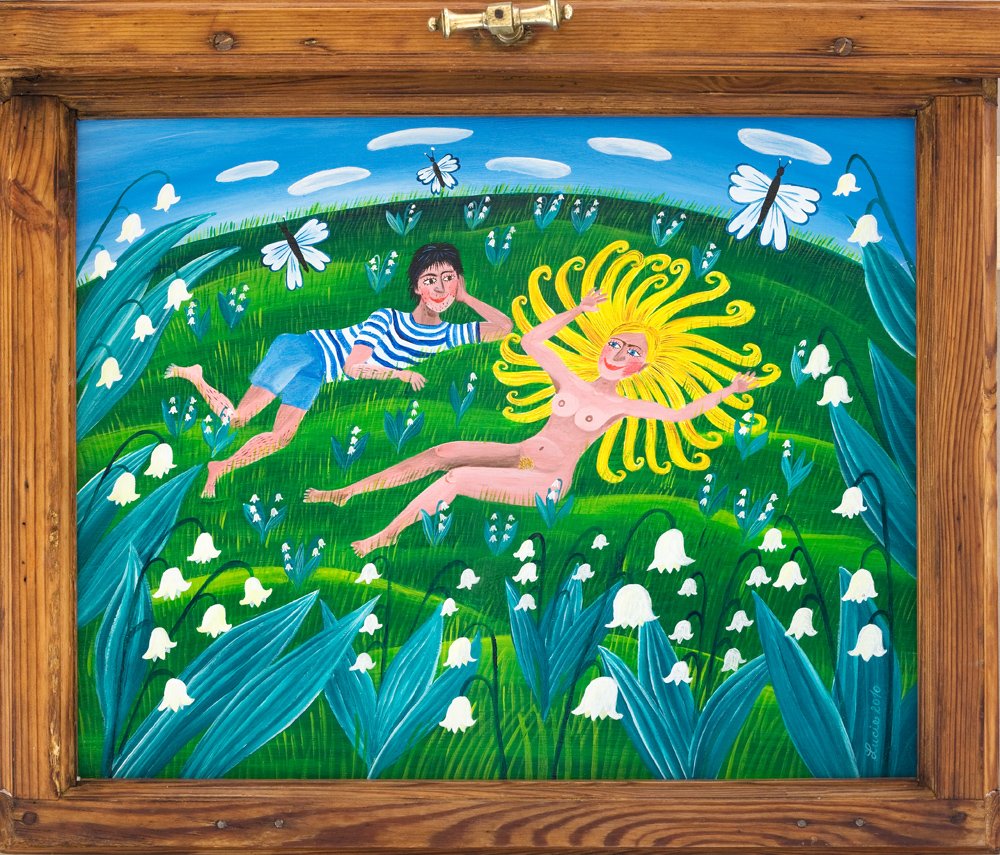
I switched from oil paints to acrylics. I also paint pictures with crayons, ink, aniline and gouache. He plays guitar or harmonica for me and I still love going to his concerts just as much. He has a band called Mr. Semtamtyuk's Socks, where he invents music and lyrics, and also a band called Těžká Pára, with which he plays old Prague songs and has travelled all over the world. These bands accompany me at the openings of my exhibitions, of which I have already organised fifty-two all over the Czech Republic. Since 2010, I have also been doing lithography, which is a graphic technique where you print layers of colour one by one from a stone on which you paint the whole image layer by layer. You get an original with a limited number of copies. Since then I take a holiday once a year and go to the lithography workshop of the academic painter Martin Bouda at Újezd in Říční Street in Prague, Kampa, where I have already made 46 prints. In 2014 and 2015 I also printed lithographic calendars of 13 pictures each and 7 pictures for the book "Pictures from under Týřov", which I wrote and painted in 2015 when my mother died. It depicts my childhood, which I spent with my parents in a cottage by the Berounka river. In 2007, 2010, 2011, 2012, 2017, 2018 I also created large wall calendars for companies, one family wall calendar for Patagonia publishing house, a 2008 Lunar Calendar and two planning calendars for 2017 and 2018. In 2013 I published a children's book "MUJ!", which I wrote about our youngest son Jáchym, illustrated it and used partly the technique of coloured photographs.
How did you get into photography? What do you like to photograph?
When I was a kid, I loved looking through the photos in my shoebox and a few albums hidden in the closet. I liked the photos and they smelled awfully nice. We had my grandfather's old enlarger in the basement at home, which my dad dusted off when I was about 13. He built us a photo booth under the basement stairs and taught my sister how to develop photos. Then I learned it from her. I got a camera in elementary school. A bakelite box that gave me a lot of joy.
The photos were gray at first, but I got better at it over time. I took pictures of everything. I had one film for a fortnight and dreamt that if I blinked, a photo might come out of the back of my head. Which basically came true with the advent of digital cameras, which, ironically, I resisted for a long time. I still take pictures with an analog camera, though. I develop and enlarge the photos myself. I shoot with a Nikon F100, F60 and a digital D 5200, and what I used to shoot in a fortnight, I now shoot in an hour.
Around 1998 I started submitting photos to Photo Life magazine contests and won several prizes. Thanks to this, in 2001 I met Jan Šroubek, who brought together people who were into photography and founded the "Berounští Fotorici" photography club, with whom I have been holding joint exhibitions since 2002, where I regularly exhibit. Besides that, I have also organized several solo photography exhibitions over the years. "Children, comedians and fools", "In the run" and "How beautiful it is by the river", with which I have travelled to many cities in the Czech Republic. I am crazy about photography.
I mainly shoot documentaries. My life as time goes by, at home and on the road, in the woods and on the water. I take pictures where I walk. I always see something. I take pictures of my family, because they're cool models who have been used to me since they were in diapers. My husband's bands and the musicians around him. I've had my periods of naked women and pregnant girls. My main street where I shoot is Na Ptačí skále, the place where I live. Outside our front door, where our kids and the kids next door still play. Three times I also held an outdoor exhibition there called "To and from the Top" which I installed on our neighbors' fences and walls. The opening was in the garden restaurant Na Černý vršek, followed by a happening in our garden where I had an outdoor photo studio where everyone could leave with an extraordinary photo. I still have a few nice ones at home.
What led you to pursue a career in health care, specifically choosing to work as a laboratory technician?
As a child, I used to go with my parents to a cottage near Týřov by the Berounka River. There were a total of fifteen cottages there, where the cottagers came, which I liked very much. In six of the cottages there was a doctor. A district surgeon, a skin doctor, an x-ray specialist, an internist, a pediatrician and a dentist. They were fun and I found them all so nice that I looked up to be like them and threw myself into studying medicine after high school. But I didn't finish that. I came to a different state and had two boys fast behind me. I worked in a law firm, but I didn't enjoy that. My mom would have preferred me to be a lawyer, but I ended up doing distance learning and became an X-ray assistant. I wanted to have something to do with medicine, and since photography is my passion, I decided to translate that into my work life as a radiology technician. You should do what you enjoy in life and what brings you joy. The imaging room becomes a studio, only the photos capture the view of a person from the inside. So you literally get under his skin. Positive photos show you the outside. But I like them to show what's in your soul.
You've been working at the hospital in Beroun for about two decades. How would you assess its transformation in recent years? How is it reflected in your workplace?
I joined the Beroun hospital on 15 January 1998. I was trained by a lab technician, Jiřina Sestániová, who was already retired at that time and who was a really good photographer. But time flies, and it doesn't even occur to you. And it's true that when I take out the old photos I took in the hospital at that time, in the X-ray room, the operating theatre, the outpatient clinics and outside in the park, that those areas have changed quite substantially. Only our x-ray room is still the same and the machines in it have aged with us like wine. Lubosek, our associate, hasn't changed much either. We all feel the same here. I think it's the white clothes.
I went on maternity leave with my third son in 2007, right around the time the hospital changed hands, and in the three years I was on maternity leave it changed like magic. Some wards disappeared, some were newly created and all of them expanded substantially.
Rehabilitation, which was behind the door of our X-ray day room, consisted of four miniature rooms where the examination beds were hidden behind a curtain. The physiotherapists were a scant six or seven. Now there's a whole pavilion in the hospital. I remember a time when the rehab girls used to daydream about what it would be like if they had an expanded facility. That there would eventually be about sixty physiotherapists, or how many, I don't know, was never in their wildest dreams. The rehab was enlarged to include an inpatient area and new gyms were built. And it's nice that the staff can use them too. Personally, I call it going to "Heaven" to exercise, because from the gym equipped with all sorts of exercise machines, the view of the whole of Beroun is like a heavenly cloud. Luckily, I have co-workers who get me out of my chair sometimes, so I go there to do something for my health, which is great!
Our building has also been renovated, the rooms don't compare to what it used to be. Patients are excited as soon as they walk in the door because the buildings have a new coat. The brick red and apricot plaster make people feel at ease and calm. But most of all, patients can't get enough of the staff. The nurses on the ward, the physiotherapists from across the hall, and us radiology lab technicians in the MRI and our Lubosek from X-ray. I think we are a good bunch and it shows. When a patient sees happy and smiling medical staff, it makes the difficult moments they experience in the hospital more pleasant.
There are also lots of photos everywhere in the corridors and rooms, which I really like. Nobody has such an exhibition hall as the one of Dr. Jan Calta, who died last year and was involved in the expansion of the rehabilitation part of the hospital. I envy him, although I'm not that envious. The ability to develop and display such a large number of photos and to be sure that people look at them and it brings them joy is not something any photographer can do right away.
Before the hospital was owned by our landlord, I also had a small exhibition of my images in our RDG department. And the patients mostly liked them. They walked, limped, often arrived in a wheelchair, and enjoyed the images while waiting for the picture to be developed in the chamber. Some told me and my colleagues admiringly and insightfully that we had Srncová, Hlinomaz or Hüttner hanging there, which always pleased me, as they were the leading Czech naive painters.
The park has also changed beyond recognition. My old photos show a 60-year-old forest with tall trees. I was attracted to it myself. The linden avenue that ran around the road to the park. Choroses on their trunks. The park was mysterious, even spooky to some. Now it's been landscaped, nicely pruned, paths for patients have been created around the meadow, the bushes have been replaced by outdoor exercise machines. It has also filled in with sandstone sculptures over the last two years, which I think is fine. I like the sculptures by academic sculptor Prof. Kurt Gebauer and his son the best. There are a lot of patients with crutches running through the park, which was previously out of the question.
Does the working environment inspire you in your artistic activities or does it stress you out?
Of course it inspires me. Just the names of some of the patients are so sonorous or funny that they evoke all kinds of imagery in me. I also take pictures in the hospital now and then. Not just x-rays. Co-workers, the hospital inside and out. When I'm on twenty-four-hour duty, I sometimes take my camera and there are no patients in the corridor, I sometimes run out to the park, or open the window of the imaging room and take some pictures in the backlight. The only problem is that I have a huge archive of both negatives and photos on my computer, I just don't have time to process it so that the photos see the light of day. The other downside is that it's also a very expensive hobby.
Often someone will also tell me something during the examination, and even that can be translated into some kind of art or writing. After I made a bibliography with lithographic prints "Images from under Týřov", I developed it into a larger whole and wrote a whole book, which I am now preparing for publication. I also have another children's book ready in my drawer, but I need to rework that one and I don't quite have time for that, so I'm waiting for the right moment to come.
You have three sons, you are involved in a number of activities (exhibitions, events especially at the Černý Vršk in Beroun, etc.), where do you get the energy for all this?
I was lucky to choose a partner with whom you can do all sorts of things. Firstly, he thinks of them himself and secondly, he is happy to help me with the implementation of my ideas. He started arranging and arranging exhibitions for me and he loves to come with me to prepare them, hang them and then in the evening at the opening he entertains the guests with his band. He likes the pictures and photos I make and I like his songs, wooden puppets and statues he carves. In the many years we have known each other, we have done various events. For example, four editions of the "Podtýřovskou matračka" race, a six-kilometre ride on inflatable mattresses from the island below Týřov to the "U Rozvědčíka" pub, where the winner won my picture. Three times I organized a photographic exhibition "To and from Vršek" for the neighbours and passers-by, so that they could finally see themselves in the photos they had previously chased me for, and seven times the Mardi Gras on Černý vrch, where people from far and wide came. Our boys attended all of these events with us. It depends on what kind of family you are born into. We like to canoe down rivers. I've participated in the "Berounka River Marathon" seven times. You have to cover 58 river kilometres in a time limit of eight and a half hours. Each time I finished within the time limit and once we were second in the veteran mix category. The boys, Nicholas and Hubert, participated in these events with us because they are our children, so they had no choice. Now they are both adults and their younger brother Jáchym has taken over their baton.
Where do I get the energy for this? I don't know myself, but every time we finish an event, we are so happy about it that it recharges us again. The truth remains that one has to do things with joy and be happy oneself to accomplish such things. Otherwise, there is no point in forcing yourself to do something, because then everyone will know and you yourself are not happy with the result, and in fact you can't even implement it. And most importantly, when you think of something and say you will make it happen, you have to have a deadline. That's the only thing that will make you get things done.
What upcoming event would you like to invite us to?
In February I'm taking an old holiday and going to the lithography workshop to print new lithographs.
I'm preparing an exhibition of paintings for my lame birthday at the City Gallery in Duslo's Villa. The opening will be on the 2nd of May 2018 and I cordially invite you all there. Then in November there will be a guided exhibition of paintings and photos at the Excellent Woman in Pilsen. And on November 29, I will have another opening of my paintings in Beroun at the Museum of the Bohemian Karst on Husovo náměstí, which will last the whole of December and will be "Angel's". So this year it will be really "busy" in Beroun.
I am also preparing another wall calendar and I would like to finish the book from my childhood. Over the summer I should be exhibiting photos for the Pohoda Foundation employing people with disabilities in their café Bílá crow in Prague's Smečky. I really wish I could do it all this year.
You can see Lucie Sucha's pictures at www.luciesucha.com