Česky
Česky


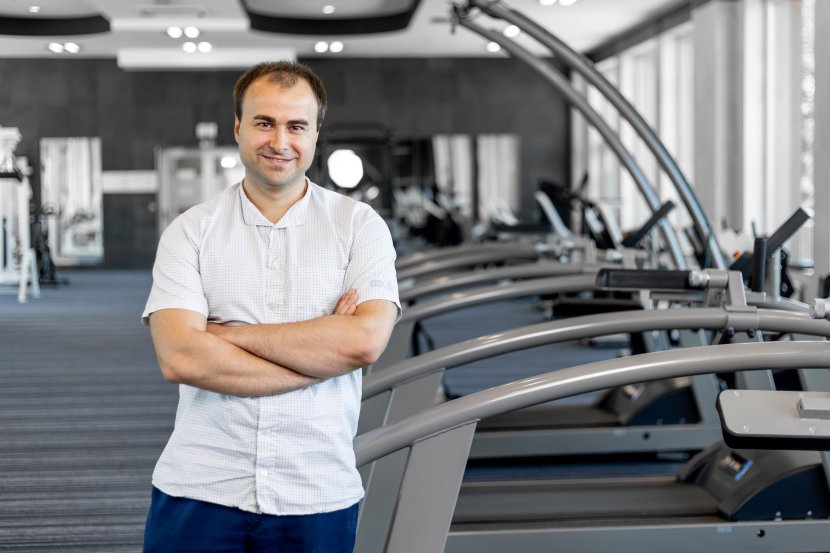
Doctor, last year, you became deputy chief physician of the rehabilitation centre. What does that mean to you personally?
It is a great challenge for me and a natural step in my development, both medical and human. Our centre is undoubtedly the largest in the Czech Republic and has a great name. My main vision, together with the wider management, is to maintain and further develop this quality so that patients and colleagues know that they are in the best hands with us.
When you look at your priorities for the coming months, what keeps you most busy?
Rehab essentially provides a service for other disciplines, so our plans are closely linked to the whole hospital. Our main focus right now is to admit patients for rehabilitation as soon as their condition allows after surgery. We are also preparing to work more closely with the Ict Centre at our sister hospital, Hospital Hořovice, which means that stroke patients will come to us sooner. And of course, I am trying to make our outpatient operation more efficient, because the demand for our services is still growing.
"We don't just think of the patient as a 'TEPka' or a 'back', but as a whole"
Medicine today is changing a lot. How does this shift manifest itself in the Beroun centre? Are they still the classic long stays we remember before?
Not so much anymore. The trend is clear: patients come to us much earlier after operations or injuries and spend less time with us. But the care has to be all the more intensive. We put a huge emphasis on individualisation. We don't just look at a patient as a "TEP" or a "back". We always try to see the whole person. We address his or her other illnesses, family background and options. We are also increasingly using modern diagnostics, such as ultrasound. Training the patient in self-therapy is also key.
You mention seeing the patient as a whole person. I guess that requires a pretty broad team of people around you as well, right?
Exactly, it wouldn't work without a team. We are in contact with physiotherapists and occupational therapists almost constantly, dealing with things operationally on a daily basis. But psychologists, speech therapists, nutritionists and orthopaedists are also part of the puzzle. We meet regularly in conferences to confirm that the care is continuous and safe for the patient.
"A patient after heart surgery is often afraid to even cough. Our job is to remove that block in the head."
One of your key themes is the cardiac rehabilitation programme. Why is it important for patients not only with cardiac problems or after heart surgery to remain physically active?
We all need movement at every age, with every diagnosis. It's also a lot about the psyche. Patients after heart surgery are often expressly afraid of movement. They feel like their chest has been cut open, they are afraid to cough, let alone move more actively. He is afraid of hurting himself. Our job is to remove this block in his head. We want to show them that their body can function again, and help them find those new, safe limits.
What does this "finding limits" look like in practice?
Everything is done under the strict supervision of experts, and thanks to modern instruments we have accurate data in our hands. The patient can see that even if their heart rate jumps up, we are there and in control. It's incredibly reassuring. In addition, this programme is not just for bypass patients, but also for those struggling with metabolic syndrome, obesity or high blood pressure. Even a pacemaker or defibrillator is not an obstacle, as long as the patient's condition is under regular medical supervision by a physician.
Do you have any specific plans for the future in this area?
I would like to bring in more of physical medicine. I'd like to do targeted stress testing on patients, such as spiroergometry, to target that care even more precisely. And for selected patients, I'd like to add individual sessions with a physiotherapist to the gym sessions.
In addition to being a physician, you're now a team leader. What kind of leadership style are you comfortable with?
I'm betting on humanity and open communication. I believe that most problems can be solved with a simple conversation. Having developed personal relationships with many of my colleagues makes many things easier for me. I try to empathise with others and look for solutions that work for everyone.
"I try to understand my colleagues, their needs and take them into account as much as possible."
How do you motivate the other physicians in your team?
I try to approach them as a colleague, not just as a supervisor. I myself have been through various departments in Beroun and Hořovice, from internal medicine to surgery, neurology to AICU. I know exactly what the job entails and how difficult it is to schedule your time. Every physician has different needs, motivations, dreams and goals, and I try to take these individual needs into account.
You are originally from Prague, but you have lived just outside Beroun for years. What brought you here?
Sport. I've been playing floorball since I was young, I played in the league for Sparta when I was a student and then my paths led me to the club in Králov Dvůr. Thanks to sport, I have always perceived how closely movement is linked to health, and this actually led me to my profession. Now I play more for the "B" team, but the connection to the region has remained.
And how do you rest when you're not in the hospital or on the field?
My daughters keep me busy at home, so there's not much time left. But when I do, I go for a run on the treadmill, skate or go into the countryside. And for a complete shutdown? I like to watch a Nordic crime drama or a reality show on TV, it's a great way to relax.
Do you have a life motto that you follow?
I don't think I have a motto, but I like to use movie catchphrases. I sometimes regale patients and colleagues with quotes from The Cribs, the film My Fair Village or a slight rip-off of Cimrman. And when it comes to medicine, I like to quote some colleagues: "There is no cure for age." But at our centre we do everything we can to replace the medicine with the right movement ( laughs).