Česky
Česky


Doctor, what led you to medicine and then to the specialty of neurology?
I "inherited" medicine from my mother, also a doctor. Unfortunately, my mother is no longer alive. Her sister, her son, my cousin and his wife are also doctors. Both their daughters are studying medicine. At home, medicine was often discussed, friends from that background came. So medical school came naturally. Already during my studies I was determined to pursue a non-surgical field. It has to do with the style of work and life, which in my opinion is much more difficult for a woman in surgical fields. On the other hand, I have always enjoyed "doing something with my hands" and I like the longer-term contact with the patient, which also allows me to establish a human relationship. I have also had some experience of working for people with disabilities. I liked the rehabilitation I am doing now. However, at that time it was a super-specialty. Ironically, my husband, a graduate of the Czech Technical University, advised me to take up neurology as the best preparation:-)). The very interesting and enjoyable neurological internships during my studies probably played a role as well. By the way, one of my lecturers at that time now also works at the hospital in Beroun. I still find neurology and its connection with other related fields fascinating. The functioning of the human brain is an area where there is always something new to discover and it will probably be a long time before science will be able to declare that it really understands it...... if it ever does.
How did you get into the subject of Huntington's disease and what do we even mean by the term?
I got into Huntington's disease thanks to my colleagues from the Neurology Clinic and the Centre for Clinical Neuroscience at the 1st Faculty of Medicine of the Charles University in Prague, where I worked many years ago. Now I am studying here in the PhD program under the supervision of Hana Brožová, MD, PhD. and Prof. Jan Roth, MD, CSc., who is the main soul of the Huntington's disease team.
How does the disease manifest itself and how many people does it affect?
Huntington's disease is a genetically determined, inherited neurodegenerative disease. It manifests as a gradual loss of the ability to control one's movements, speech and swallowing disorders, progressive dementia, personality changes and mood changes. As a result, it leads inevitably to full disability and dependence on 24-hour care. There is currently no known therapy capable of curing the disease. There are only treatments aimed at influencing the symptoms. However, even this has only limited possibilities. The genetic information leading to the disease is carried from birth. Clinically, the disease most often manifests itself around the age of 40, although there are known juvenile forms that begin at a very young age. Until then, a person lives a completely normal life. The prevalence of the disease is 1:10-15000. In our country, therefore, there are currently around a thousand patients. From the beginning of clinical symptoms to the full development of the disability, on average, about 15-20 years pass.
If the progression is inevitable, how does rehabilitation of such patients help?
Since there is currently no known way to stop or cure the disease, there are only a few things that medicine can offer patients. Rehabilitation is one of them. We do not have the ambition to return patients to full health, we are aiming to improve or at least maintain their functional state, self-sufficiency, and prevent preventable complications for as long as possible. Often young people, parents of young children, working and active people come. We want to help them to live the time they have to live with their illness as well as possible.
How many other rehabilitation facilities in the country are dedicated to Huntington's patients?
On an outpatient basis, patients can attend the rehabilitation clinic of the neurological clinic of the VFN, there are several physiotherapists trained in this field. Unfortunately, however, this applies to only a fraction of patients from the surrounding area. As far as I know, we are the only inpatient rehabilitation department in the country with a comprehensive programme for this diagnosis.
What does it mean for physiotherapists to work with such patients?
Individual professionals working with Huntington's disease patients must, of course, have sufficient theoretical knowledge of the nature and character of the disease. However, equally important is practical experience and familiarity with some of the specific phenomena of the given diagnosis, peculiarities in movements, behaviour, reactions, risks associated with it. The moment one is able to anticipate and understand why the patient reacts in this way, communication and work for both parties is much easier. There is also a certain shyness or fear of working with this type of patient, which, unfortunately, we sometimes encounter.
What should they know and how does this contact affect their psyche?
The diagnosis of Huntington's disease is by its very nature very serious and in many ways extremely challenging for the patient and those around them. Even as healthcare professionals, we are not immune to the often desperate situations in which patients and their families find themselves. We are human beings. For a healthy person, it is hard to imagine what family members of those affected with this "family curse" experience. In my opinion, even a health professional who is working on the issue does not and cannot have the same point of view as a parent, partner, sibling or child of a sufferer. He or she is in a completely different role.
I am a doctor, but I am also a mother of two children, and I have some experience of the difficulties that both child and parents have to face if the child has a disability. In our case, it is an incomparably less serious diagnosis than Huntington's disease. Nevertheless, the struggle with ignorance, the health system, the education system, etc. is often exhausting. That is why the patients and their family members have my deep respect when I see how bravely they are coping with the situation and how kind and helpful they can be. But these are also the reasons why working with these people makes sense to me, and I am glad that I can contribute to improving their overall situation in some small way.
Try to give us a brief overview of your grant...
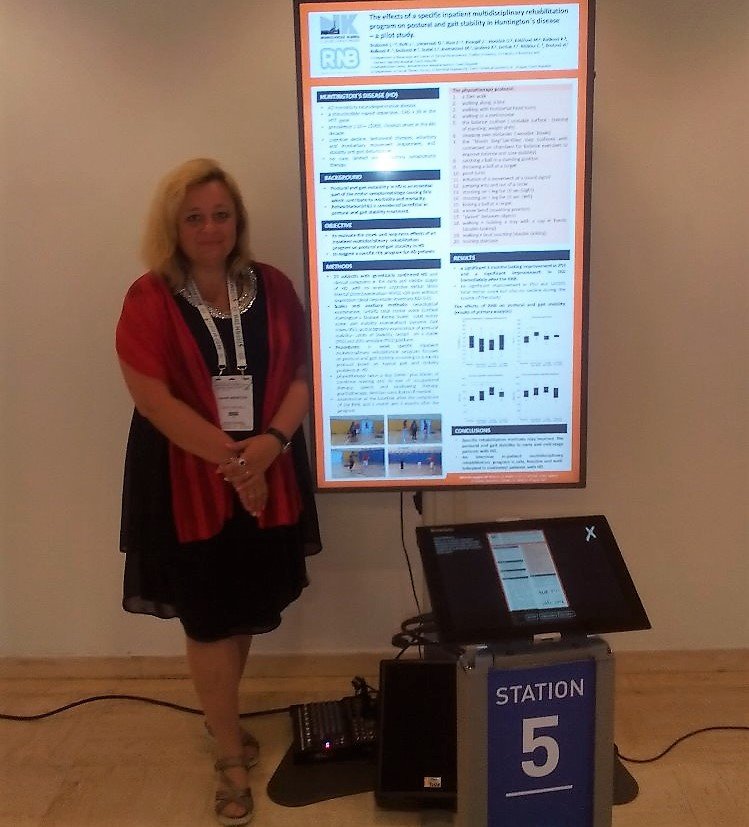
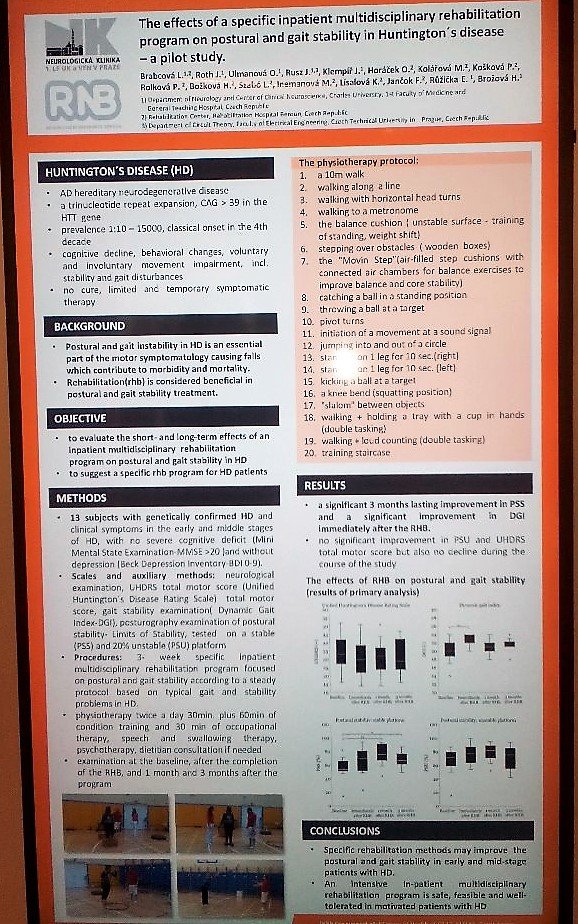
In 2014, we were successful in obtaining a three-year grant from the Charles University Grant Agency for research on the effect of rehabilitation methods on motor manifestations of Huntington's disease. We have been preparing the whole study project since 2011 and it is still ongoing. The results so far have been compiled and now the final touches are being made to the article to be published in a foreign peer-reviewed journal. The results have also been presented several times at national and international conferences. Most recently in July 2018 at the Congress of the World Organization of Rehabilitation and Physical Medicine (ISPRM) in Paris (see pictures in the photo gallery).
How far has research progressed regarding the prevention and treatment of this disease?
Prevention in the true sense of the word may not exist for this disease. A huge advance for patients and people at risk of developing the disease (relatives of patients who may carry the genetic information) is the possibility of assisted reproduction, which allows even people with the genetic mutation to have a child of their own who is no longer at risk of developing the disease. Great hopes are currently being pinned on genetic engineering. Research in this field has been going on for many years, but clinical use is probably still a long way off.