Česky
Česky


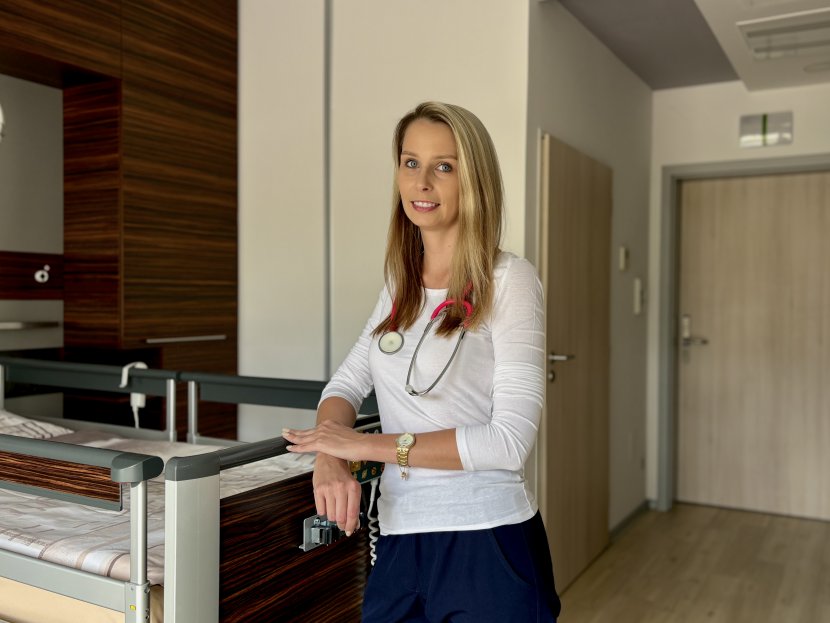
Doctor, why did you choose rehabilitation medicine?
I have always been fascinated by movement and its effect on human health. For many years I have been involved in modern gymnastics, stage dance and now I am involved in Latin American dance. These experiences have made me realise how essential it is to take care of the musculoskeletal system, especially when returning to full function after injury or illness. For me, rehabilitation is a combination of medicine and an active approach to health, and this is where I see a deep meaning.
Where did your first steps lead after your studies?
After graduating from the 1st Medical Faculty of Charles University in Prague, I joined a rehabilitation clinic in Prague, where I gained experience in aftercare and completed an internal strain as part of my specialisation training. After completing it, I decided to further my professional growth and moved to the Rehabilitation Hospital in Beroun, which impressed me with its professional level, its excellent credentials, the variety of diagnoses and opportunities for further development. Two years ago, I passed the certification in rehabilitation medicine and I am currently completing my education in the additional field of physical medicine.
As the head physician of one of the inpatient wards, you see a variety of patients. Which diagnoses predominate?
We encounter the whole spectrum of diagnoses, from neurological patients to patients after surgeries, transplants or amputations to orthopaedic cases after major joint replacements. It is this diversity that I enjoy so much about my work; you don't stay in just one area, but are always learning something new and gaining a broader perspective on your field.
Which specialists do you work with?
Our team is truly multidisciplinary. We work with physiotherapists, occupational therapists, doctors, speech therapists and other specialists according to the specific needs of the patient. This enables us to provide comprehensive and targeted rehabilitation care that is appropriate to the diagnosis, current condition and individual capabilities of each patient.
In addition to our staff facilities, state-of-the-art instrumentation is also available. Which ones do you use specifically?
For example, we use devices for electrotherapy, magnetotherapy, ultrasound or robotic systems for gait training and functional limb training. We also have equipment for fine motor skills, coordination, virtual reality or cognitive-motor stimulation. Our goal is always to support the patient's return to self-sufficiency and the highest possible quality of life.
But the Beroun Rehabilitation Centre offers even more - for example, swimming pool, occupational therapy, electrotherapy or fitness. What benefits does this bring?
Concentrating these services in one place allows for efficient, coordinated care. Physiotherapy helps restore mobility, occupational therapy helps restore self-sufficiency, and electrotherapy relieves pain and speeds healing. The swimming pool expands therapy options for patients with limited mobility, while fitness helps in the final stages of rehabilitation or long-term training. With all services available in one place, we have a better overview of the patient's progress and can flexibly adjust the rehabilitation plan.
Physical medicine: medicine in motion
You said that you are also studying physical medicine. What does this field entail?
Physical medicine studies the effect of exercise on health. It helps not only athletes to optimise performance and recovery, but also the general population to improve their health through appropriately timed physical activity. It includes preventive examinations, load diagnosis, stress testing, nutritional counselling and treatment of injuries or overuse injuries.
What other types of patients can physical medicine help?
For example, those with cardiac problems. Based on the examination, we will recommend a safe level and type of exercise, for example after a heart attack or with high blood pressure. Regular and controlled exercise improves physical fitness, reduces the risk of complications and improves quality of life. At the same time, we also try to motivate patients to change their lifestyle. In addition, this branch helps in the care of cancer or pre-operative patients. It assesses their physical fitness, response to stress and ability to cope with treatment or recovery. We use medical history, ECG, spirometry, stress tests and functional tests of the musculoskeletal system.
How could the collaboration of sports medicine with other disciplines ideally work?
Collaboration with rehabilitation, cardiology, pulmonology, oncology or general practitioners is essential. Physical medicine should provide recommendations on appropriate exercise, while other specialties are involved in the treatment of specific diseases. By joining forces, we can ensure safe and effective care for the patient. Linking directly with rehabilitation will bring a more holistic view of the patient, from diagnosis to active treatment. Again, the result will be more effective therapy, better outcomes and a wider range of services.
Are you also planning to work with a local arthroscopy centre, for example? What could screening of patients after arthroscopies look like?
Yes, this would be very appropriate and beneficial for patients. The screening would include a clinical examination, strength, mobility, balance and joint function tests. Based on the results, a rehabilitation plan can be set up, potential complications identified and the patient's return to normal or sporting life monitored.
Could you describe appropriate movement for different age and health groups?
For children we encourage mostly playful activity, for adults a combination of aerobic training and weight training. For seniors, we emphasise safety and stability. For patients with health limitations, we often recommend swimming, rehabilitation exercises or Nordic walking; it's very individual. We always take into account health and personal capabilities. Patient motivation and gradually increasing the load so that the activity remains safe and provides health benefits is also essential.
What challenges do you face in building a comprehensive physical medicine department?
Assembling a multidisciplinary team, securing instrumentation, coordinating care, and obtaining financial and professional support will be key. These are challenging tasks, but mastering them can mean a major shift in the quality of care.
A Sports Medicine Clinic is also currently being opened at the AKESO POLICLINICE in Prague's Nové Butovice. How will your department cooperate with this clinic?
We definitely welcome the future cooperation with the Sports Medicine Clinic at AKESO POLICLINICE in Prague's Nové Butovice. I believe that by combining the expertise and services of both departments - in Prague and Beroun - we will once again take the level of care for our patients a step further. Thanks to this cooperation, it will be possible to provide more comprehensive, more efficient care, which will be beneficial not only for top and recreational athletes, but for all those who want to actively take care of their health.
The Sports Medicine Clinic
Our Sports Medicine Clinic at AKESO POLICLINIC offers comprehensive care for athletes of all ages. We provide preventive and compulsory sports check-ups (e.g. for sports school students during the admission process and during their studies) to assess their fitness for sport and help prevent complications. In the case of musculoskeletal injuries, we provide rapid diagnosis and treatment. We also offer expert advice on training, recovery and good nutrition. Basic and advanced stress testing and laboratory tests are available for a personalised approach to each athlete.
HOW TO MAKE AN APPOINTMENT
Orders are accepted via email:
fiserova n@akeso-poliklinika.cz
+420 727 838 993
www.akeso-poliklinika.cz
AKESO POLYCLINIC
Coral Office Park, Building A
Bucharova 1281/2
158 00 Prague 13 - Nové Butovice