Česky
Česky


Your research focuses on robot-assisted rehabilitation. How did you get into this topic?
During my occupational therapy studies I did various internships and placements and started gravitating towards robotics. I chose the effect of robotic-assisted therapy on upper limb function in patients with acquired brain injury as the topic of my PhD thesis. At that time it was still rather rare, so the topic intrigued me. Today it is a commonly used therapeutic approach.
What did you find in your research?
In a sample of forty patients with acquired brain injury, I compared two therapeutic approaches: a unimanual (single limb involvement) and a bimanual (both limbs involved) approach using robotics. The results showed that the bimanual robotic-assisted therapy approach was demonstrably more effective. However, it should be added that this is still a small sample of patients, so it would be appropriate to expand it further, which is the subject of a current ongoing international multicentre study where I am an author of the protocol.
How should we imagine such a robot?
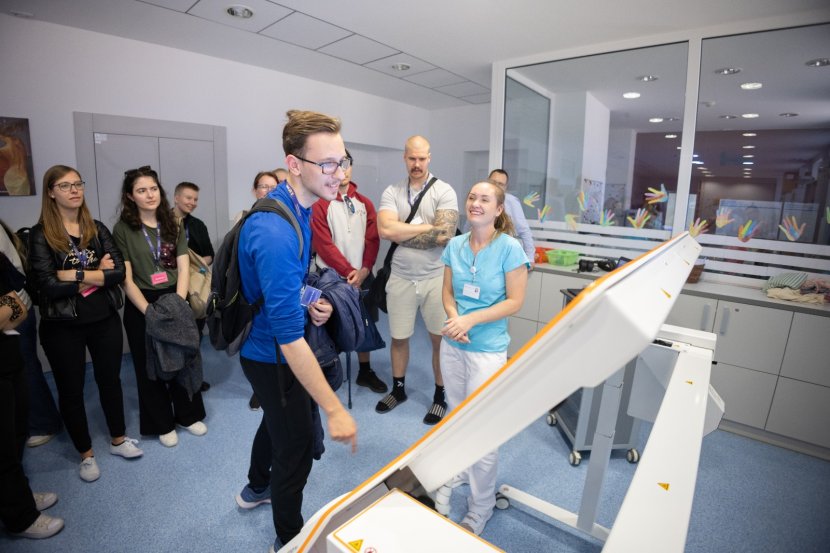
If we focus directly on the upper limb, in simple terms it is a design that replicates the anatomical structure of the upper limb. It is in fact an artificial arm that encircles the entire upper limb, replicates the individual bones and joints, and allows different ranges to be performed within the joints. The robot also has sensors that give therapists feedback on speed and range of motion as well as other information. The therapist can set the robot to either guide the patient completely passively, or the patient can actively perform a particular movement on his or her own, and when he or she can no longer do so, the robot will complete the movement to its full range or relieve the patient.
Do patients miss the human factor in this rehabilitation - physical contact or the opportunity to talk?
This is currently the subject of great debate, because the human factor is important in any therapy. However, robotic therapies are at least remotely supervised, so the patient is not completely alone in the room. But the big benefit is clearly that the robot saves the therapist's hands and back, especially for obese patients or those with severe injuries.
You mentioned that you're now part of an international research...
For some time now I have been working with the European School of Robotics, where I am one of the lecturers. Under the auspices of this organisation, I had the opportunity to represent our Rehabilitation Hospital Beroun at the World Congress of Rehabilitation in Vancouver, Canada, and to present the aforementioned international multicentre protocol for a new study that focuses specifically on the use of robot-assisted rehabilitation in patients after stroke. During the lecture, I also discussed the strategy of implementing robotic rehabilitation into routine clinical practice, which is still problematic not only in the Czech Republic but also in the world.
Is there any other technology being discussed in the field that could change the field of rehabilitation even more?
Augmented reality and various types of other realities are being mentioned a lot now, and the market is already seeing this trend. Wearable sensors are also being used, where the individual is wearing sensors that sense and monitor them. Personally, my research is into transcranial brain stimulation, where the brain is stimulated using an electric current. The patient puts on a special cap which contains electrodes through which the current passes. This stimulates certain areas of the brain that need stimulation. However, it is important to combine this type of therapy with conventional therapy, so the patient is stimulated and rehabilitated at the same time.
Since April, you have also been working at the Beroun Rehabilitation Hospital. What activities do you perform here?
I work as a coordinator for rehabilitation, science and research and also as an occupational therapy methodologist. From my point of view, you cannot do research in rehabilitation without clinical practice, so I work in the outpatient clinic and in the aftercare beds where I work with patients. At the same time, I focus on the development of rehabilitation strategy, analysis of effectiveness and also on the implementation of new devices in practice. At Rehabilitation Hospital Beroun we want to maintain a high level of rehabilitation, so monitoring trends and the market is extremely important.

PhDr. Kristýna Hoidekrová, Ph.D.
She graduated with a master's degree in occupational therapy at the 1st Faculty of Medicine (1st Faculty of Medicine) of Charles University, and received her doctorate in kinanthropology at the Faculty of Physical Education and Sport of Charles University, where she also defended her rigorous thesis. She received awards in the research projects section of the Scientia Movens conference in 2017 and 2019. During her studies and clinical practice, she completed a number of internships (e.g. in Israel, Sweden and Denmark), actively lectures at Czech and international conferences and publishes professional articles and book chapters in the field of neurorehabilitation. She works as an assistant professor and lecturer at the 1st Faculty of Medicine of Charles University. Since April, she has held the position of coordinator for rehabilitation, science and research at the Rehabilitation Hospital Beroun.