Česky
Česky


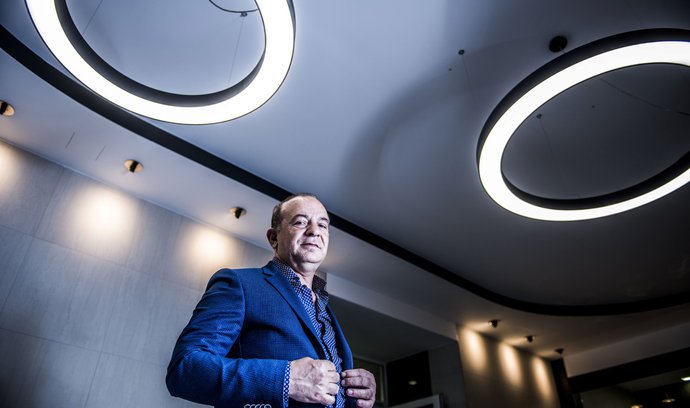
Among the twenty or so companies he owns, the oncology centre in Pardubice or hospitals in Hořovice and Beroun stand out. It is there that he is building a luxury clinic for the mentally ill for CZK 1 billion, but he is fighting with the Ministry of Health for a subsidy. "Our mistake is that we want to do something that does not match the average," says Sotirios Zavalianis.
You want to build a Mental Health Rehabilitation Centre on the premises of the Beroun hospital. Why?
Czech society spends a lot of money to treat the physical side of a person. Psychiatry has not been at the forefront at all. There are outdated medical facilities, not enough psychiatrists. When we heard that there was a reform of psychiatry and the concept of community centres, we thought it was a great thing.
How did you get from the concept of small community centres to your Mental Health Rehabilitation Centre, which is going to have a cinema, a swimming pool, a tennis court...
A network of community centres is an excellent idea. Many of the people who are in psychiatric hospitals might not be there anymore. But some of the patients will still need inpatient care, albeit for shorter periods. We have therefore proposed a hospital for consistent psychiatric rehabilitation. There is no similar quality facility. It is to function as an auxiliary to the mental community centres that would be established in Prague and parts of the Central Bohemia region. Our only mistake was that we wanted to do something that was not up to the average. We want to create a facility that corresponds to modern times. Not to put ten people in one room with toilets in the corridor, as is still common in the Czech Republic. We wanted to get closer to a five-star accommodation standard. Such an investment requires a billion crowns. Payments for psychiatry are quite low in the Czech Republic, so the project could hardly be self-financing. That's why we have applied for a subsidy of about 40 percent of the investment under European programmes.
Such a psychiatric centre would not be able to earn enough to run itself?
This project is not profitable. It can't be if we want to make it of adequate quality. We have promised to subsidise the operation with 30 to 40 million crowns a year. But the Czech Republic would rather support pizzerias on the Vltava River than give money to a project that would raise the level of health services. Ministerial officials are trying to prevent this project at all costs.
How?
All the members of the evaluation committee voted against our project. They have three reasons. In their opinion, the project does not fall within the concept of psychiatry because it exceeds the standards. They also object to the fact that it would require a large number of staff, which officials say we can't get. The last reason is that such a facility should be built either in the city to integrate patients into society or on the grounds of a teaching hospital. We are not meeting that. Politicians have taken European money as their spoils, which they divide among themselves, and are looking for proxy reasons to throw others out.
So is it just because you are a private investor?
The health service is divided. On the one hand, there are state and regional hospitals. All the other operators are on the other side, prisoners of the system. Politicians arbitrarily allocate subsidies to their hospitals, thereby covering up their own inability to manage them. Sometimes we are perceived as a private sector when we are part of the public health system. We just have to fund everything from our own resources and do a better job. That is the only difference.
Have any of your facilities ever received subsidies?
Only once did the comprehensive oncology centre in Pardubice receive a European subsidy for equipment. In other calls, the criteria were such that we couldn't get it. But officials talk about the effectiveness of the subsidy. When other projects are an order of magnitude cheaper than yours, they prefer to send funds to several places. There's money for that. The Czech Republic did not spend more than CZK 100 billion from the previous European subsidy programme.
Will you build the centre without the subsidy?
Yes. Instead of being built in three years, the completion time will be six or seven years, because we will have to finance it from our own resources. The project is ready, we have a building permit for it. We have already invested eighteen million crowns in the preparations.
Why are you pursuing a project that you know will make a long-term loss?
Why does a man work? To buy an expensive watch? A luxury car? A man should pursue his vision. Sometimes he has to pay for it.
Is there anything in your group today that's a long-term loser?
Of the 18 companies we have, none is in the red. We're in the black, even though the standard of healthcare is higher here. The Beroun hospital has been in the red for many years. Last year it finished slightly in the black.
How did you achieve this?
Our strength is efficiency. We perform twice as many operations per operating theatre as other hospitals. Our people work significantly more than the staff at other facilities. Yet we have worse unit payments from health insurance companies. In the last ten years, we have invested over two and a half billion crowns from our own resources. The only thing holding us back is our exhausted capacity. We have a six to eight month waiting list for some procedures.
Are you thinking of acquiring or adding on?
There's no need to have ten half-empty hospitals. I'd rather have two or three first-class ones. The Mayo Clinic in the United States is also only one, and it's world-renowned.
Have the other big players in healthcare gotten used to not selling their hospitals?
They were interested. But then they realised that our philosophy is different. They look at the profitability of each department. But the bottom line is not an end in itself. For example, an internal medicine department may be losing money for a long time, but I can't close it down because of that. Without it, there can't be a good hospital. There are great facilities, intelligent, educated, creative people. The only people who are holding back the development of this country are the politicians. They don't want people to see that a hospital can be good, that patients can be happy in it, and it doesn't have to be a loss-making hospital. How would they then explain that they cannot do that in the hospital they run?
Do you see anyone in the Czech Republic who has a vision for healthcare?
Not many people would know how to do it. Professors, experts. Politicians are only interested in making sure someone doesn't write about healthcare in the newspapers. Do they offer to move the country forward? I don't see that. One promotes the substandard to keep their constituents dependent on welfare. The other wants to lock everyone up because he says they're all stealing.
Don't they steal from the health care system?
It's not true that everybody steals. The greater evil is incompetence. When someone steals from something, they make it work so they can keep stealing. But in hospitals, there's nothing to steal. Over half the costs are salaries. Other essential expenses go to heating, electricity... There's a few percent left over. Yes, it's big money. But it's not the basic problem of health care.
What are your group's economic results for last year?
The after-tax result was about 200 million crowns, the trend is slowly increasing. We have no internal debts, we don't expect significant investments in renovations for the next twenty years. We are considering investments in expansion. People will say, if the hospital is of good quality. That's why ours are packed.
Health insurance companies hear that?
No. Our level of service is not contingent on what the health insurance companies will pay us at the moment.
If you keep expanding, will you pay for it again?
Yes, we will. We normally perform 120 percent of the procedures compared to the previous period, and the health insurance company will only fully pay 103 or 106 percent. What's over the limit, it only pays partially. On the other hand, I understand. If there was no regulation by the health insurance companies, the system would collapse.
But in such a situation, it is not worth building a reputation and improving quality.
The economic aspect is only one thing. You also want to be proud of what you do.
There are hospitals in your area that don't have good economic results...
I don't want to talk about the Kladno hospital, which has a loan of over two billion and the region pays 90 million in interest every year. On top of that, it has a loss of CZK 180 million and has received tens of millions in subsidies. The county hasn't given us a penny. Sorry, once they gave us 200 000 crowns. In short, their services are more expensive than ours, and I don't think they are better.
What's the difference?
We're stable. When a new director comes to run a regional hospital, he doesn't know if he'll be there for a year or three. By the time he gets his bearings, he's fired for political reasons. If I come up with something, it takes five or six years to get it up and running. Regional hospitals are decided from the position of the region by people who do not understand healthcare at all.
What does the Czech health system need?
Much more money should be invested in prevention. Large outpatient facilities should be built. And hospital care should be concentrated in fewer hospitals. I am in favour of a greater concentration of manpower, technology, erudition. The standard of care would be higher. The Czech Republic does not have so many specialists that we could have a quality hospital every ten kilometres.
Sotirios Zavalianis (51)
Originally from Greece, he came to the Czech Republic in the 1980s to study, settled here and started a family. In the 1990s he built a distribution company called StarFoods, which he then sold. He has been in the healthcare business for twenty years. In 2007, he bought the hospitals in Beroun and Hořovice from the Central Bohemian Region. His group includes over twenty companies, including Multiscan Radiology in Pardubice, which is part of a comprehensive oncology centre. The group's total turnover is approximately CZK 2.25 billion.