Česky
Česky


Chief, what was your path to medicine?
My path was relatively simple and quick, because I come from a medical family. My father, my grandfather, my uncle, my cousin and my cousin are all internists. So from about the age of ten, I didn't think about anything else but doing medicine.
Did you also know from the beginning that you wanted to be a surgeon?
Not really, surgery came into my life kind of by accident. It was because of the role model in my family, where everyone was an internist, that I first became an internist. My dream was originally cardiology or sports medicine as well. So I started my first job, in the internal medicine department of Mulac Hospital in Pilsen. But after a month I found that I was definitely not enjoying it and I started looking into surgery. I did my internship and I was clear! I met great colleagues in the surgical department, especially Dr. Kizman, whom I still see as my teacher and mentor. He enriched me professionally and we are still friends to this day.
Every doctor usually remembers his first service. How do you remember it?
I remember it too, of course, because I joined at a time of a staffing crisis. It was after about three weeks that I became a surgeon. The surgical department at that time included trauma surgery and I had to repone a patient's wrist. Like any fresh doctor, I was terrified of getting it right and it turned out well (laughs). Fortunately, I was able to do it.
What qualities should a good surgeon have?
Certainly he shouldn't be a complete stressman, he must be able to think rationally when a complication arises and be able to make a quick decision. At the same time, he should not overestimate himself and maintain a certain humility. It is also very important to be able to put yourself in the shoes of a patient who is going into a procedure under stress and to be helpful to them during this difficult period. That is disappearing a little today.
"We are still expanding the surgery. A big advantage of our centre is the favourable appointment times."
Last year you became the head of day surgery at Beroun Hospital. What does your department offer?
Currently, we focus on laparoscopic gallbladder and hernia operations, varicose vein operations (using both laser and conventional methods), as well as smaller procedures such as the removal of skin tumours or fat cells. With the opening of the new seventh room, we are also expanding our surgical services to include coloproctology, specifically hemorrhoids and fistulas. We also cooperate closely with our indication outpatient clinics, especially in AKESO POLICLINICE in Prague's Nové Butovice, as well as with AKESO outpatient clinics in Pilsen and our sister hospital in Hořovice. Every patient can contact us with or without a referral. We also have the advantage of relatively favourable appointment times, usually within six weeks, and individual arrangements are also possible.
Is same-day surgery suitable for every patient?
Almost yes. The exceptions are patients with comorbidities that could make an early return after surgery difficult or impossible. However, for the vast majority of patients, this option is appropriate. The family environment, to which the patient can return almost immediately, plays a major role in successful recovery.
But what to do if the patient suddenly becomes unwell after discharge home?
This is where I see the great advantage of the Beroun Day Care Centre, because it has a direct link to its sister hospital in Hořovice, where they take care of everyone day and night, seven days a week. Therefore, the patient does not have to worry about being left without help in case of complications after discharge.
What are the current trends in day surgery?
The trend, and it's a worldwide trend, is to expand it to as wide a spectrum of surgeries as possible. Both to those already mentioned coloproctological operations, as well as bariatric operations, for example. This type of surgery is economically advantageous for both parties, i.e. the health system and the patient, who can return to normal life and work more quickly. This saves everyone.
"I was introduced to robotics in Chicago back in 2001. It was still science fiction here."
Now, modern technology and robotic systems are booming. Do you plan to use them in day surgery in the future?
Yes, we plan to. Either with a robotic assistant or with the robotic system that our colleagues in Hořovice are working with now. I once encountered robotics in same-day surgery during my visit to private clinics in Chicago back in 2001. Back then it was still science fiction here, but today, of course, we are in a completely different place. But it must be added that even the best robot will not help you if complications arise. It is always necessary to have enough staff for the safety of the patient, the human factor must always be present.
In addition to being a doctor, you are also a father of four children. How do you spend your free time?
I put my free time on the back burner (laughs). I devote almost all my free time to my family, my eldest son plays football for Viktorka Plzeň, so our schedule is very busy. But if I do have a moment to myself, I like to play sports. In medical school I played handball and basketball, but nowadays I play any sport for pleasure and recreation.
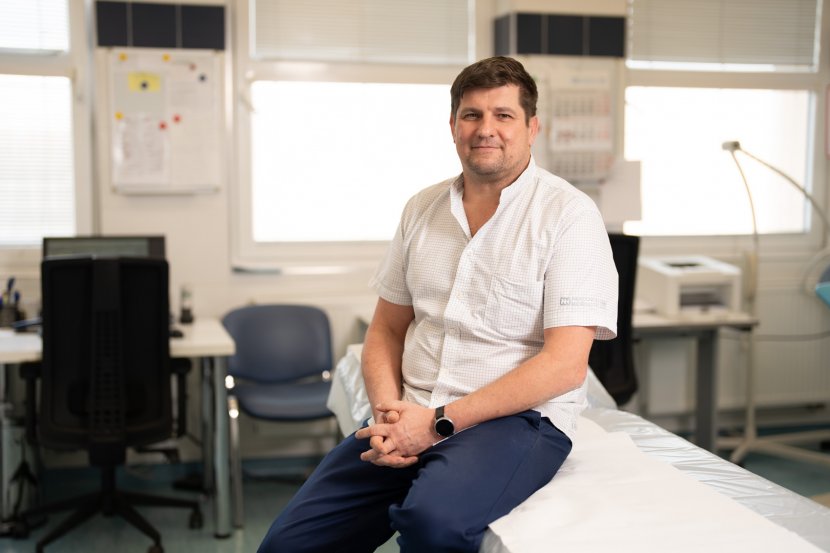
MUDr. Petr Zeithaml
He comes from Rokycany from a medical family. After graduating from the Faculty of Medicine in Pilsen, he worked as an internist and then as a surgeon at the Mulac Hospital in Pilsen. Since 2011 he has been working at the surgical department of Hospital Hořovice. He lives with his family in the Beroun region and in his free time he enjoys sports. He is also a recipient of the Angel among Healthcare Professionals 2024, which annually honours doctors, nurses, paramedics and other healthcare professions for their demanding and dedicated work.