Česky
Česky


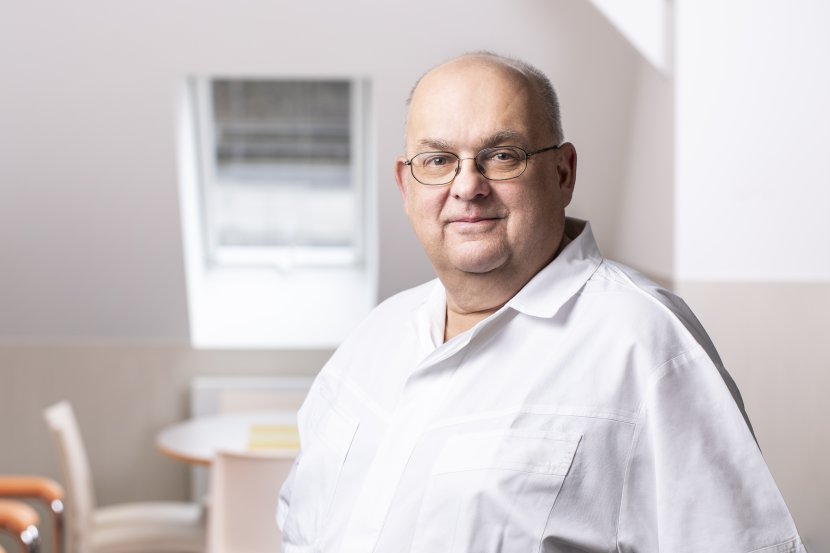
Mr. Chief, can you briefly describe what the work of a doctor in the Aftercare Department entails?
It's like any other ward - to properly diagnose the patient, determine the treatment, rehabilitation and individual treatment plan that is beneficial to the patient. We are a specialty specifically belonging to internal medicine, dealing mainly with polymorbid and elderly people, who have their own specificities in both diagnosis and treatment, especially pharmacological treatment, and of course also in their social needs, because their ability to take care of themselves is sometimes reduced.
What is the main mission of your department?
The main mission and our great effort is to give patients back to life. And I would say that we are succeeding above average. People are often coming back from us with much more rationally constructed treatments than they were used to and than they had been doing up to that point. In general, polypragmasia, a condition where a patient takes too many drugs prescribed by different doctors, is a big problem with our patients and the elderly. Not only that, but patients are even exchanging medicines between each other, obtaining them without a prescription and even buying them on the Internet, and this creates a very complex situation with a negative outcome. The side-effects of 'treatment' are multiplied and can cause considerable ill-will or even impaired health and so on. Therefore, the moment we take them off the medication that is inappropriate for them and give them appropriate treatment, they usually get better in a few days. Our job is to get the patients out of the unfavourable situation. We try our best to lead them to healing ad integrum, which is not possible in some cases. Then we try to get them to a state where they can live a reasonable life with a rational treatment.
What type of patients are most often hospitalized with you?
These are mostly elderly people, although we also have patients who have not yet reached retirement age. These patients most often suffer from multiple diseases, have very often had injuries, and are also people who have not taken much care of their health and are now surprised to find that a lifetime of smoking or excessive alcohol use is taking its toll on them. We see patients whose ill-health was largely preventable and then patients who refuse to admit that they have aged, are not ready and neither are their families. Some of them are also under-diagnosed. Women also predominate because they live to a much older age and with age comes polymorbidity.
How is the treatment and recovery of patients in your department? What can you offer patients compared to other facilities?
I would say that compared to similar facilities, we can offer patients enhanced services, especially in the area of rehabilitation, which is very superior. We provide patients with an individual rehabilitation programme, in which they can use the state-of-the-art gym in our ward. Within the hospital, we have almost immediate access to Holter examinations, ultrasonography, magnetic resonance imaging, we use the consular facilities of our partner hospital in Hořovice, we can quickly reach CT scans, etc. Our patients are diagnosed very quickly, I would say that we are at the absolute top in the Czech Republic and people appreciate it.
What other specialists do you cooperate with most often?
In our practice we cooperate with a wide range of professions. From physiotherapists to nurses, nutritional therapists to social workers. I have to stop at those because they are truly professionals, as much as I respect my other colleagues. But my colleagues in the social ward provide social services from the very beginning of the hospitalisation and take care of patients who are completely helpless at that moment. They also provide many above-standard tasks, which take a great deal of the burden off the patients and their relatives, such as complex administrative tasks that are often impossible for a healthy person to navigate, let alone a patient in a difficult life situation.
What challenges do you encounter in your daily practice?
It is definitely the psychological burden that is evident in all employees. For nurses and junior medical staff, the physical burden is added, which is why I appreciate and admire their workload immensely. The nurses also withstand the daily stress and work under a great deal of overload. As for us doctors, we have to educate ourselves throughout our lives because geriatrics and internal medicine are fields that are extremely demanding and training a doctor in this field takes years. Of course, the biggest challenge of all is reaching out to new colleagues.
I understand that young doctors and health professionals may not find this field very attractive.
Exactly, unfortunately.
How do you think that could be changed?
A future doctor needs to be motivated before he or she starts medical school. It seems to me that medicine is no longer an attractive field today because it is underfunded. Especially young doctors find it difficult to start and support a family unless they have significant support from their family. We need to restore prestige to medicine and healthcare in general and, above all, from a society-wide perspective, pay healthcare workers an adequate wage and treat them better. We need to change the system of postgraduate education, which is inflexible and excessively complex. In the meantime, I fear that we will constantly be faced with a profound shortage of staff. In our field, this is doubly true. However, our hospital's approach is proving to be positive, for example, by building nursery facilities, quality factory meals, contributions to retirement savings and other benefits.
Let's go back to the challenges. How does the collaboration with patients' families work?
That's just another more challenging component. Because modern times also bring with them an inability or unwillingness to care for their seniors. People are different, some show a lot of activity and a positive attitude towards the patient, but there are also those who are not interested in the fate of their relative at all. But sometimes they do manage to bring the family back together...
Tell me...
We had a patient who didn't have an ideal relationship with his family. They hadn't seen each other for a long time, they hadn't communicated, and the family had a strained relationship with each other. And here, after some time, a certain amount of helpfulness, social work, the work of the doctors, my conversations with the family and the patient, the situation was largely settled. In the end, three of the patient's descendants and other relatives came to visit the patient, and the man had somewhere to return to after his recovery. And by that I mean not only to his home, but especially to restored family relationships.
That's certainly satisfying. What else fulfills you about this work?
As any physician, of course, when we manage to heal a patient, not only physically but also socially, and to ensure that they live a good, biologically active and mentally vigorous life. So that he lives the quality of life that a senior can live, that he does not suffer, that he still enjoys his hobbies, his retirement, his activity, his family, and that he returns to the state he was in before his accident. Medicine is very good at this today.
How do you see the development of aftercare in the Czech Republic? Is anything changing?
Of course. The population is getting older and yet geriatrics, aftercare and related fields are still underdeveloped in our country, they are still waiting for their development. And society is still passive to some extent, lagging behind the needs. I remember what care in the LDN looked like 40 years ago. Many places looked like a waiting room for death. Fortunately, that is no longer the case today. Once, in the 1990s, I met a former emeritus primary school principal in Canberra, Australia, who was teaching my son English at the time. And he confided in me that the people here are terrible, they just lie there and die. He said, "Here in Australia, people are having fun, playing games, visiting their families and living a completely different life." And I said to him: "Gary, it will get better one day, I believe it".
And it did, didn't it?
Yes, but capacity is still inadequate here. There is a lack of long-term preparation for old age. We need a new type of facility to provide care for older people that meets their changing needs. I can imagine that a person who starts to feel the decline in strength and can no longer cope with living independently in their own flat will move to a facility where they can have their own living accommodation, garage parking, and gradually move on to more support. For example, over time, he or she will start to make more use of communal meals, see a doctor at a local outpatient clinic, and eventually move naturally to an aftercare unit. There he should be provided with everything he needs, with decent conditions and space for family visits. However, there are still desperately few such facilities in our country.
You must have seen a lot in your time. Can you share an experience or a memory with us?
I have been working in the health sector for forty-five years and I have experienced a lot. But my first experience - which I will never forget - was when, as a medical student, I was interning at a hospital in Decin, which at that time was, by the way, very well run, and I saw my first patient in surgery with a lower limb amputation. I remember his name, the course of the disease and I will always have him in front of my eyes. And I have another strong memory from the same hospital where I attended my first birth. That was a real challenge for me at the time because I was totally dependent on an experienced doctor to teach me in that situation. And because there was a huge storm that day, eight women gave birth in that ward by that morning and I was there for all of those births.
You were an expert by then.
I wasn't an expert, I was a scared student who was shaking like a rattlesnake in the morning (laughs). Fortunately, everything went smoothly. The old, experienced doctor who was on duty that night invited me for coffee in the morning and said: "This is medicine too. You'll get used to it," and nodded his head.
And how did your journey to the field of geriatrics go?
This field chose me. I'm a lifelong internist and I've been through different departments, doing metabolic work, hepatology, sonography. One day a situation came up where the Aftercare Department was without a chief. I was then asked to temporarily take on the chief of that department in addition to my work here in internal medicine. So I agreed to run it for a while until a new chief took over the department. Well, it's been thirteen years now.
MUDr. Miloš Stoilov, CSc.
He was born in Strakonice, but spent most of his life in Prague. In 1981 he graduated from the Faculty of General Medicine of Charles University in Prague, now the 1st Faculty of Medicine of Charles University. After one year of compulsory full-time military service in Hradec Králové, where he worked as a physician, he joined the 2nd Internal Medicine Clinic of the 3rd Faculty of Medicine and the Vinohrady University Hospital in Prague, where he worked as a postgraduate student, assistant professor and senior physician. He is a member of several professional societies. He has been working at the Rehabilitation Hospital Beroun since 2008 and as the head of the Department of Aftercare since 2012.
His hobbies include swimming, classical literature and classic American country music, especially from the 50s - 60s. In addition, he describes himself as an avid amateur fisherman. He enjoys shooting and is a member of a shooting club. He lives with his family in Jesenice near Prague and is very involved with his nine-year-old granddaughter Karolínka, with whom he regularly visits the library in Stará Boleslav: "I borrow books on her season ticket, that's common knowledge about me," laughs the headmaster. In conclusion, he would advise everyone to cut down on TV and social networking and pay more attention to real life.