Česky
Česky


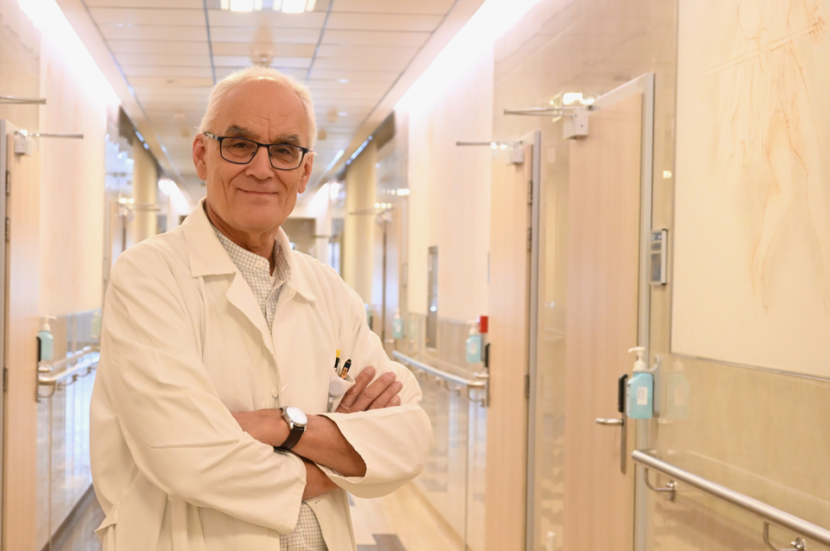
Doctor, how do you remember your early days in medicine?
It was quite interesting, sometimes adventurous. I started as a doctor in the early 1980s, exactly in 1982 I joined the neurology clinic of Motol University Hospital. At that time, the possibilities of medicine were not nearly as advanced as they are today. Magnetic resonance imaging was not yet available at all, and CT scans were difficult to obtain. We didn't have computers yet, and we wrote reports only on typewriters, something that young doctors today can no longer imagine. There were no emergency admissions in hospitals back then, so the ambulance service brought patients straight to the ward, and it was only in the outpatient department that you had to decide for yourself whether the patient belonged in the neurology department or rather in the internal medicine department.
Such a school of life hardens one...
And imagine that weekend services looked like that, I came to the hospital on Friday morning and was there all Friday, Saturday and Sunday and left on Monday afternoon. On this service I was in charge of a 50-bed ward myself and on top of that I was handling all the neurological consults in the hospital over the weekend. And no time off after duty! Young doctors today can hardly imagine that either. It was quite rough, but as you say, it was an excellent "school". Because you really learnt the most on the job. In hindsight, though, I like to remember it. And I must also remember with gratitude my then Chief of Medicine, MUDr. Martin Bojar, who taught me the basics of neurology with great dedication, from which I still draw.
So you came to rehabilitation through neurology?
Yes, exactly. In our clinic in Motol, some of the patients needed physiotherapy and I was interested in this work. It was also here that I first encountered manual medicine, which was done by Chief Bojar, and he educated us a bit in this area. After working in neurology for 4 years and after I passed the first certification in neurology, I worked for some time in the neurological outpatient clinic, taking courses in manual medicine and other courses in rehabilitation. Later I decided to devote myself fully to rehabilitation and in 1999 I passed the certification in this field, then called "physiotherapy, balneology and medical rehabilitation". Then I worked for 11 years as a chief at the Rehabilitation Clinic, where Prof. Pavel Kolář was the head. I must point out that my neurological training has always been very useful in my rehabilitation practice, because a large part of patients coming to rehabilitation suffer from neurological disorders.
"Without any ado, as we knew him and without beating around the bush, he asked, "Doctor, would you like to come to Beroun to be a primary care physician?" We looked at each other for a moment, I wondered what he had to offer, and I promised him I would come and see."
So which way did your journey to Beroun lead?
That was very interesting (smiles). In Motol, at that time, my office was right next to Professor Kolář's office, and one day before noon someone knocked on the door. I opened the door and there stood Dr. Calta (MUDr. Jan Calta, after whom the Beroun rehabilitation centre is named - editor's note), holding a book he had brought from Prof. Kolář, which he had co-authored. He asked, "Doctor, would you like to come to Beroun to work as a chief physician?" We looked at each other for a moment, I wondered what the place had to offer me, and I promised him I would come and see. Dr. Calta showed me around, gave me a lot of attention and I was interested. The environment was nice, pleasant, and I ended up high-fiving him. I have to say that I never regretted it, and further developments made me think that I made the right decision and I've been here for fifteen years.
How do you remember Dr. Calta?
He was a tremendous person, a very experienced, honest and straightforward guy. He was indispensable to all of us in the early stages of the development of this centre, precisely because of his wealth of experience, contacts and advice. He was able to praise, but also to make amends if one made a mistake. But he was always fair, human and professional.
"At the beginning of my time at the Beroun hospital we had 30 beds in our centre, now we have 160. Patients appreciate the modern and clean environment of the hospital, the comfortably equipped rooms and the comprehensiveness of the services."
How has the Beroun Rehabilitation Hospital changed since you joined?
Beroun Rehabilitation Hospital has changed fundamentally. Most of the departments have grown significantly, the hospital as a whole has gradually been equipped with better equipment and systems for ordering patients, and the cooperation between departments is better coordinated. But what I see as the most important thing: there are still more and more new patients, and this certainly speaks for the high level of care that the hospital as a whole provides. At the beginning of my time at the Beroun hospital, we had 30 beds in our centre; now we have 160, and we still cannot satisfy all the applicants for admission. Patients also greatly appreciate the modern and clean environment of the hospital, the comfortably equipped rooms and the comprehensiveness of the services. I consider it visionary that the owner of the hospital Ing. Sotirios Zavalianis is emphasizing and taking healthcare to a higher level.
Even medicine itself has certainly changed during the time of your practice. Which change do you consider to be the most significant - both professionally and humanly?
There is no easy answer to that. Medicine has certainly changed a lot in various aspects, both diagnostics and therapy have advanced. As an example of a completely fundamental change for the better, I would mention the introduction of magnetic resonance imaging, which was a truly revolutionary change. With some exaggeration, it can be said that early diagnosis by MRI has also saved many lives. As an example of a major change in the field of therapy, I can cite advances in transplantation, cardiac interventional procedures, implantation of pacemakers, defibrillators, implantation of brain neurostimulators, sophisticated algesiological procedures, such as the introduction of neuromodulation for chronic pain, etc. And in the field of rehabilitation, the introduction of robotic systems used mainly for patients with severe mobility disorders and devices using biofeedback has undoubtedly been a major advance. This was not possible in the Czech Republic 30 years ago. But with the introduction of increasingly sophisticated diagnostic methods, doctors are paradoxically becoming more dependent on devices, which may not always be the best way to go. Especially if the machine fails or makes mistakes. Then there's a problem. I am of the opinion that technology is an important tool, but the main link is always the human factor.
I totally agree with that. What has been the most gratifying or moving thing about the medical profession, even after all these years?
It always pleases me when a young doctor who has passed through our department approaches me with the benefit of hindsight and tells me that he or she has really learned something from us and that he or she remembers this period fondly. Of course, I am also always pleased by the patient's satisfaction with our care. And I am still impressed, even after all these years, when I see a patient with, for example, a severe neurological disease who is immobile but who, despite the unfavourable prognosis of the disease, does not give up, does not collapse and "bravely fights" against adversity.
"I am very happy that we have managed to implement some specialised activities. We are running a rehabilitation programme for Parkinson's patients, a care system for neurological patients with spasticity, as well as a diagnosis of musculoskeletal disorders by means of sonographic examination and possible follow-up injection treatment."
What moment in your career are you particularly proud of? Whether it's a specific case, a team collaboration, or advancing the field?
I am certainly most pleased that our rehabilitation centre is now one of the best rehabilitation centres in the country, judging by the evaluation of the general and professional public. This is primarily the result of many years of hard work by the entire team of staff at the centre, many of whom have been here since its inception. I would also like to highlight - and I am very happy about this - that we have managed to implement some specialised activities. As a neurologist, I have appreciated that colleagues have developed a specialised rehabilitation programme for patients with Parkinson's disease. It is valuable that this activity has come about thanks to the initiative and activity of two of our young staff: a doctor and a physiotherapist. The programme has proved its worth, it is already supra-regional in nature and is sought after by patients from distant regions. I was involved when we developed and improved the care system for neurological spasticity patients a few years ago. An expert team was assembled, consisting of a rehabilitation doctor, physiotherapist and occupational therapist, who deal with these complex patients in regular seminars, using the most modern specialised procedures in diagnosis and therapy. Currently, this team and programme has moved to our sister hospital in Hořovice, where it operates within the neurology department, but we continue to work together. In line with modern trends in rehabilitation, two of our young doctors carry out the diagnosis of musculoskeletal disorders using sonographic examination and with possible follow-up injection treatment. This significantly expands the diagnostic and therapeutic possibilities within the centre. There are more specialised activities in our centre, but that would probably be beyond the scope of this interview.
You are really involved in many activities. No less successful is your traditional Beroun Rehabilitation Day...
Yes, that is another thing that I enjoy and am proud of. That my colleagues and I have managed to create a strong traditional event that has long since gone beyond the borders of the region. This national rehabilitation conference is repeatedly attended by people from far away corners, which is a message for us that we manage to keep an interesting program and invite top experts. It is an important event not only for our rehabilitation centre, but for the whole hospital and ultimately for AKESO Holding. Here I must not forget to thank Mrs. Milena Kolářová, the headmistress, as well as Mrs. Lada Müllerová, the secretary, for the organization, and also Mrs. Lucie Liška, who took over a large part of the organization and thus helped us all a lot.
How do you manage to find a balance between the demanding medical profession and your personal life? Has medicine taught you something important for life outside the hospital?
At my age and with my life experience, I dare say that I have the balance between the medical profession and my personal life already balanced. Striking that balance in my situation is certainly easier than if the doctor is young, works full time, has a service and has young children at home. I think medicine has taught me a certain humility. When you work with severely disabled patients, some of whom bravely defy illness, you kind of get those values straightened out. And then you deal better with your own problems and difficulties.
What message would you give to young doctors who are at the beginning of their careers today?
I would tell young doctors to be patient and to accept that the educational process in medicine is lengthy. And especially at the beginning, they will inevitably have to sacrifice a lot of time to medicine. There is no other way if they want to take it seriously and do it honestly. My generation went through that too.
How do you spend your free time and what are your hobbies?
Even though I work part-time, I'm definitely not bored. Right now we are renovating an apartment, and my wife and I help my daughter babysit our grandson twice a week. On the one hand, it takes a lot of time, but on the other hand, it's rewarding. Due to a knee operation, I have temporarily stopped playing sports, but I want to return to it gradually, in winter to skiing, in summer to cycling and especially tennis.
We wish the doctor all the best for his jubilee, good health, many happy patients and an early return to sport.