Česky
Česky


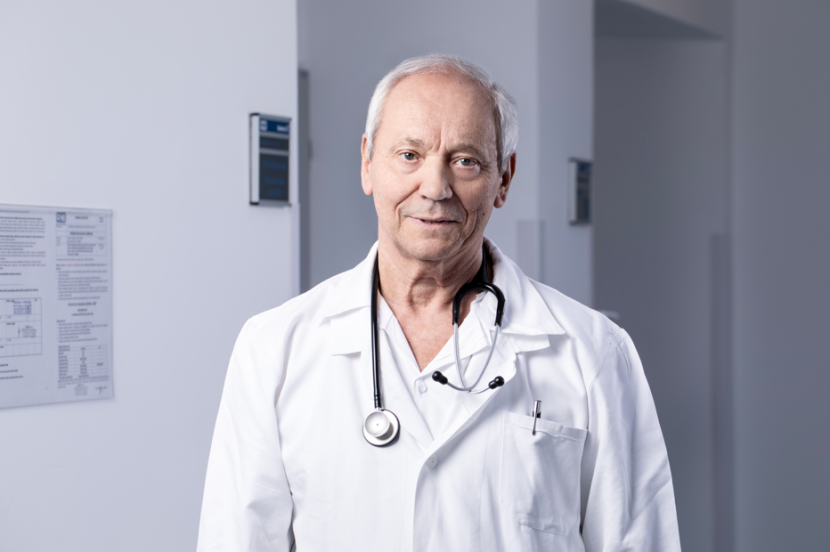
Thanks to his excellent academic results at the then eleven-year-old school, he first wanted to pursue a career as an engineer in the automotive industry and so he sent his application to the Czech Technical University in Prague. However, the day before the deadline, he succumbed to pressure not only from his mother, but also from his class professor and his then girlfriend (who later became his wife) and changed his application to the Faculty of Hygiene at Charles University in Prague (today's 3rd Medical Faculty). As a result, medicine, especially heart treatment, eventually became his life's mission.
You changed your career choice from technical to medical practically at the last minute. But your love of technology remained - especially with trolleybuses.
Cars grew on me for an obvious reason - when I was a kid, there weren't that many of them. But I wanted to be a trolleybus driver even more. There was a line in our neighbourhood in Smíchov that was driven by a driver who often took me and my friend to the front. I always liked the way trolleybuses were designed, so they ended up being a hobby of mine to this day, which I very much enjoy cultivating with my older grandson. He himself is studying for a degree in transport engineering and I'm delighted that he is as big a fan of trolleybuses as I am. Together we can have long and interesting discussions about them. In fact, I had a hard time at the time when they were abolished in Prague in the 1970s. Fortunately, I lived to see them return to the capital. However, of course I do not regret that I finally decided to go into medicine, because it is a beloved occupation for me and also a hobby. A big thank you certainly goes to my family for always being so tolerant, as I spent the vast majority of my time in hospitals.
You have devoted your career to acute conditions, especially in cardiology. How did you get into cardiac treatment?
After graduation, I was deciding between neurology and internal medicine. Then, in 1973, as an internist after attestation, I had the opportunity to establish the coronary unit at the Na Míčánkách Hospital (originally a separate internal department of the University Hospital in Prague) under the direction of the head of Prof. MUDr. František Prokšan, CSc. We dealt mainly with intensive care of patients after acute heart attack or cardiac arrhythmia.
At that time, you were only 27 years old and you were already a senior physician.
That's right, I had the responsibility of leading a small team in a six-bed ward. I was just out of my first internal medicine residency and I had an excellent chief. He was already habilitated in cardiology, so he supervised me impeccably. But I also had my teachers at the nearby Hospital Na Vinohradech, headed by the famous cardiologist Prof. MUDr. Vratislav Jonáš, DrSc. MUDr. Vlastimil Víšek, DrSc., with whom I worked closely. It was also thanks to him that I was able to do so well. I must certainly not forget doc. MUDr. Václav Dejmal, CSc., who taught me at the faculty and was a great mentor for me even after my studies. When I was a young chief at that time, we often met for consultations.
What aspects of medicine have impressed you most during your career?
It was the kind of fast-paced acute medicine where you would bring in a patient in a miserable condition and, thanks to our work, he would improve and start communicating with you after a few hours. In a few days you can put him in a standard room and a little later even discharge him to home treatment. That's what has stayed with me to this day.
You've been working at the hospital in Beroun for 30 years. So you've seen not only several directors, but also its privatisation. How has the facility changed in that time?
The owner, Ing. Sotirios Zavalianis, had pictures of what the hospital looked like before he bought it and renovated it placed on the wall in various places along the corridors. That's probably the most telling sign of how the place has changed. The environment also heals, and in this case it is good to note that this saying is 100% true here. But what has remained constant in our department, for example, is the wonderful team of people. Even most of the nurses who joined us when I was just a few years out of graduate school still work here. That's how dedicated they are to their mission. Of course, as I've gotten older, the team has blended. But what has remained constant is the excellent team that fulfils the important role that keeps our care at a very high level. I must say in this context that I have always been fortunate in my life to have been surrounded by great people for the vast majority of my life. Which was, of course, a pleasure, because when a problem arose, it was always resolved calmly and professionally.
Is there anything that didn't happen during your time as a primary care physician?
There is always room for improvement. In this respect, our department is still waiting for the modernization of the emergency room. There is even a nice project already in place and my personal wish was to make it happen during my tenure. However, the hospital has been going through the stages of modernisation for a number of years, so this project is still to come.
Can you look back at your medical career, evaluate it and perhaps highlight an interesting milestone?
I consider one of the greatest achievements of my career to be that my colleague Dr Janoušek and I were one of the first so-called peripheral hospitals in our department to participate in experimental treatment of acute cardiac events in the setting of international studies led by Prof. Petr Widimský, MD, DrSc., FESC., FACC. This was the catheterisation treatment of acute heart attacks, which was very revolutionary at the end of the 1990s. However, it did not initially find favour with the Ministry of Health at that time. Yet today it is a common practice that is not only a diagnostic technique, but also a treatment method. Internal medicine has changed considerably in my more than 50 years of practice. For example, we have experienced, and are still going through, a huge expansion of diagnostic methods that the professors who taught me never dreamed of. Back then, the most they had in internal medicine was an EKG machine. At the same time, I bow to them personally. I consider myself very lucky to have been able to learn from such respected doctors from the period of the First Republic, whether it was the aforementioned Professor Jonáš, then Prof. MUDr. Jiří Syllaba, DrSc. MUDr. Josef Charvát, DrSc.
With the reduction of your working hours you will have more free time. What will you do with it?
I will use my time mainly for more rest so that I can take care of my body as well as my soul. I like travelling and hiking, so I often go to the Krkonoše Mountains and also to the Bohemian Karst, Brda and Křivoklátsko. I am looking forward to doing more of these trips. Then I like books, so I'll definitely catch up on what I've missed in this respect. And of course I look forward to spending more time with my family and grandchildren.