Česky
Česky


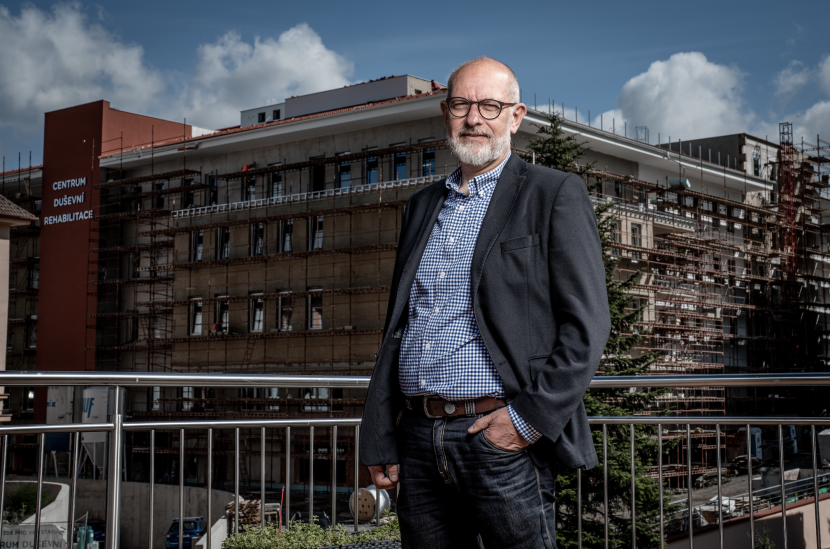
Since 2008 you have been the director of the Bohnice Psychiatric Hospital, what made you leave?
I wanted change, I needed it. I don't have exact statistics, but directors usually end either by dismissal or retirement. I am convinced that the directorship of such a large institution should have a limited limit, for example ten years. The first five years are a period of advocacy, when one has enough time and drive to create something, and the other years are long enough for one not to remain in the thrall of broken projects, but to complete most of the projects. Of course, I had internal questions about whether this was the right time to hand it all over and start elsewhere. The Mental Health Rehabilitation Centre was a very interesting project for me in terms of what possibilities it could offer for creating good psychiatric care in the country. It was important for me that we agreed with the management that we were not building a high threshold facility, a wellness facility for the rich, but that we were creating something that would be based on a regionally accessible psychiatric care facility that would be part of a network of inpatient psychiatric facilities. Our effort will be to link as much as possible with outpatient or non-hospital services, including so-called community services.
What area will you be responsible for at the Mental Health Rehabilitation Centre in Beroun?
After 14 years as director, I am more of a director than a doctor (laughs). Officially, within the organizational structure, I am the deputy director for mental health. I want to focus mainly on building the organisation and on the links with other units. This includes working closely with the Rehabilitation Hospital Beroun, the inclusion of the Centre within the AKESO holding and the connection to the health system as a whole. I think that what is a great weakness of the Czech health care system is the lack of continuity, the lack of cooperation between the individual components. In this case, we have the opportunity to build on good foundations, and prospectively I hope that, if we succeed, we can put the network of quality psychiatric care into working order, including care in the field of sexology, which I consider to be very leaky in the Czech Republic.
Do you already know what kind of care the Centre should provide?
The content of the project is still partly under development. It is clear that a significant part of the capacity will be devoted to a regionally based acute psychiatric ward. However, we already know that the location of the Centre on the premises of the Beroun hospital offers the opportunity to cultivate the idea of psychosomatic care. We would like to create a space for the care of children, adolescents, some compromise solution that will help the care system. The situation in paedopsychiatric care is very complicated, not only because of the lack of access to care, but also in view of the increasing growth of mental health-related problems in children and adolescents. A specific area is the issue of addiction, where I am currently asking myself how to actually enter into this issue. We already know that within the catchment area we will be addressing this area, and we do not want these people to be referred to just basic first aid. It's also a programme for older people with cognitive impairments that are in the aftercare unit. The very fact that these people will be able to have a psychiatric consult service will improve the quality of their care.
Do you see any pitfalls to the project now?
The complexity of the whole project is human resources, which means we are doomed to a gradual start and ramp-up, which is fine in a way because this project is unique and unique projects tend to tread dead ends. We need to test very carefully which organisational forms and forms of care are not worth investing a lot of energy in, which from my point of view can only be discovered through gradual growth. We don't want to cannibalise the labour market, but we would like to convince students early on in their studies, for example, that the field of psychiatry makes a lot of sense.
What is the state of psychiatric care in the Czech Republic?
Psychiatric care in the Czech Republic is difficult to organise because the network of service providers is relatively sparse. This means that there are regions where acute inpatient care is difficult to access. In order to be able to provide sufficient mental health care, in the vast majority of cases we need to be in contact with a person's home environment and natural social ties. For this reason, regional provision of care is very important. My ambition is that we are very closely networked with all the out-of-hospital services so that when we discharge a patient we know where they are going and what further follow-up care they will receive.
You have been part of the team preparing and working on the reform of psychiatric care in the country since 2012, what has changed in that time?
A lot has been done in that time. I consider the biggest achievements to be the destigmatisation of the topic of psychiatric care, the development of community centres, which are now embedded in reimbursement systems. A third of those patients who were placed there for a long time have been discharged from psychiatric hospitals (as of 1 January 2018, 10% of patients in the Czech Republic had been in psychiatric hospitals for more than 10 years), most of whom were planned to be transferred to social services. The carrier of this change is the great development of the so-called multidisciplinary approach in psychiatric hospitals, which also significantly affects the treatment atmosphere there. And of course there are many more successes. However, I must admit that the list of problems has also grown. It's like learning something and discovering how much you don't know.
What do you think about the use of digital therapies in treatment?
It's a very strong trend. I personally see technology from both sides of the coin. It certainly has clear uses for a certain generation, but I would find it difficult to present them as a panacea. We would also like to create programmes that by their nature encompass a wider region so that we can provide psychiatric care where it is not available. Innovative new technologies could provide long-term follow-up and support for people undergoing special psychotherapy programmes. Here there is a strong link with an online application and other programmes that are being created that will add value to the care we provide, where we can rise above the distance of at least the Czech Republic.
How many people in the Czech Republic need psychiatric care?
In general, it could be said that one in four people will encounter a condition that can be diagnosed as a mental disorder during their lifetime.
Does a person know for himself or herself that he or she should seek help?
I am of the opinion that unnecessary consultation is preferable to late consultation. Sometimes the added value of the professionalism of the conversation is wiped out with the idea of "I know how I feel". Talking to a clinical psychologist is different than talking to a friend. If I sleep badly most days out of the week for two weeks and there is no medical explanation for it, it may be an indication to think about a mental disorder. The overwhelming majority of people should seek help if they are waking up without energy, questioning the meaningfulness of their own existence, if the ability to experience joy is not the same as it was six months ago. All of this should be an impetus to consider counselling. The prototype of the patient as a crazy being still prevails in the minds of the public, but the most common issues today are anxiety and depression.
Is there any mental health prevention?
The sometimes over-fanned "In a healthy body, a healthy mind" should experience a renaissance. With exercise, a moderately healthy diet and some basic rhythm to the day that is not completely disrupted, with an emphasis on sleep. All this is very important to prevent the most common disorders, which are anxiety depression, and dementia-related problems in old age.
How do you look after your mental health?
I ride a motorcycle. Although it's probably not the most sensible way to deal with the stress load. I try to play sports, ride a bike and rarely ride a horse. I think what's important is relationship grounding, and my patient wife plays a big part in that.