Česky
Česky


What brought you to healthcare? Was it a childhood dream?
No, not at all. More of a personal experience. We had serious illnesses in my family with older relatives and when I was fifteen my grandfather died of an aortic dissection. It hit me hard. That's when I realized I wanted to work with sick people, especially the elderly. Plus, I always got along with them. They have life experience, humility and the need for human contact. And this is what definitely led me to healthcare, even though my parents had envisioned a completely different career path.
What was it?
My dad wanted me to be an engineer because he was in nuclear power himself. But I finally had my way.
You never doubted your choice?
No, I didn't. Although I did try other fields I studied, such as scientific nutrition, and later crisis management and leadership. I also worked in septic surgery and as an international paramedic, accompanying patients on transports around the world. Each experience, however, has reinforced my belief that working directly with the patient is what makes the most sense to me. I don't use the titles I have. What really matters is the work behind the person.
"Today we are able to return up to 80% of patients to life, and that is a huge motivation."
You've been through a lot of big faculties. Why Beroun and aftercare in the end?
Because that's where you see the result of your work the most. In the acute wards, the patient often leaves very quickly. In aftercare, you spend weeks with them. You see the beginning, the crisis, the progress and the return to life. In Beroun, I was impressed by the attitude of the whole team and the management. The effort to really get patients back on their feet. Today, we are able to return up to eighty percent of patients to normal life, which is a huge motivation to continue working.
But you are also involved in educational and scientific activities...
Yes, since last autumn I have been involved in scientific international research on healing of acute, chronic wounds and I am involved in scientific activities in the creation of new materials for moist wound healing. I also give presentations at symposia conducted in this field.
What makes the work in the aftercare department specific?
We care for patients with multiple diagnoses, after surgery or in palliative care. It is a combination of high expertise and very human care. Working with the elderly is sometimes unfairly underestimated; in fact, it is extremely complex. One has to understand several disciplines, which include internal medicine, rehabilitation, psychology and, last but not least, communication with the family.
"When a patient feels that you take them seriously, small and big miracles happen"
How important is communication with patients?
Essential. Geriatric and palliative patients don't just need injections and dressings, they need someone to listen to them. Often they cannot share their emotions with their family. Either they don't want to burden them or they feel that the family doesn't understand. I think of a young cancer patient, for example, after repeated brain surgeries. I used to sit with her, we would drink coffee, talk about fear, about life, about injustice. When a patient feels that you take them seriously, small and big miracles start to happen.
What's one moment from your work here in the aftercare unit that sticks in your mind?
When we admitted a patient who had severe necrosis in both legs and deep decubitus. I honestly didn't believe he could ever walk again. Rehabilitation was extremely painful for him. However, thanks to an intensive moist wound healing system and the tremendous efforts of the entire team, his condition improved significantly within a few weeks and he is now walking. These are the moments when you feel a huge satisfaction that can hardly be replaced by anything else.
"The students who come to us for practice often leave surprised at how much they enjoyed the work"
But aftercare is still perceived as a less attractive field. What would you say to young nurses?
Not to be afraid of it. Yes, it's challenging work, but it's also extremely meaningful. You see a real shift in patients and you are part of it. The students who come to us for practice often leave surprised at how much they enjoyed the work. When they handle their first situation independently, you see their tremendous professional growth. And that's a joy for us, too.
How would you describe your work team?
Like a dream team (laughs). Despite the occasional challenging period, which probably happens to everyone at work, we are a great team and we stick together. I think of us as a family. The nurses help each other, they communicate with each other and they can clear things up openly. I think that's the foundation of a well-functioning workplace.
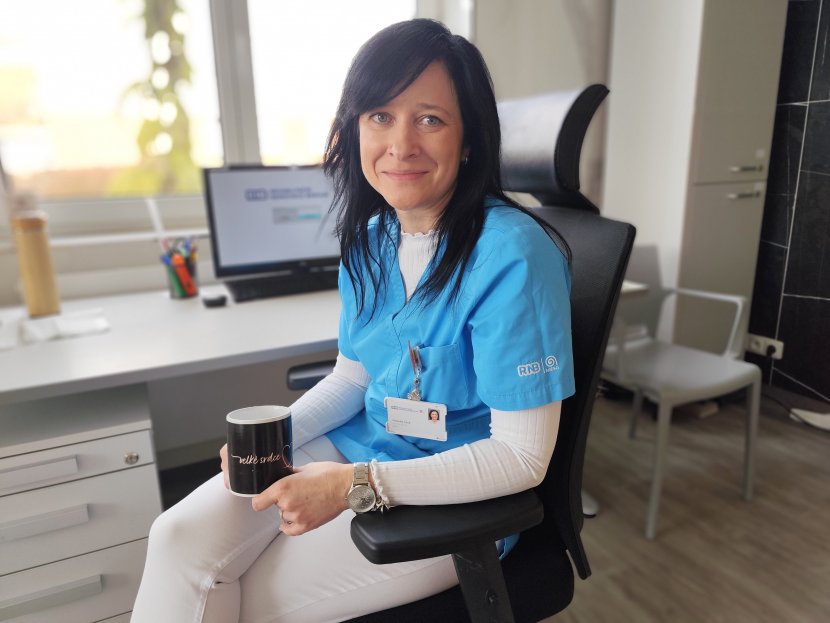
Veronika Irová
She was born in Slovakia and now lives with her children in Tman, Beroun. Professionally, she specializes in healing chronic wounds and has long been involved in the education of medical staff and students. She has worked in large Czech hospitals and has also worked as an international paramedic transporting patients around the world. She speaks several world languages. In her spare time, she enjoys running, studying new techniques in wound care, and is a self-described "coffeeholic".