Česky
Česky


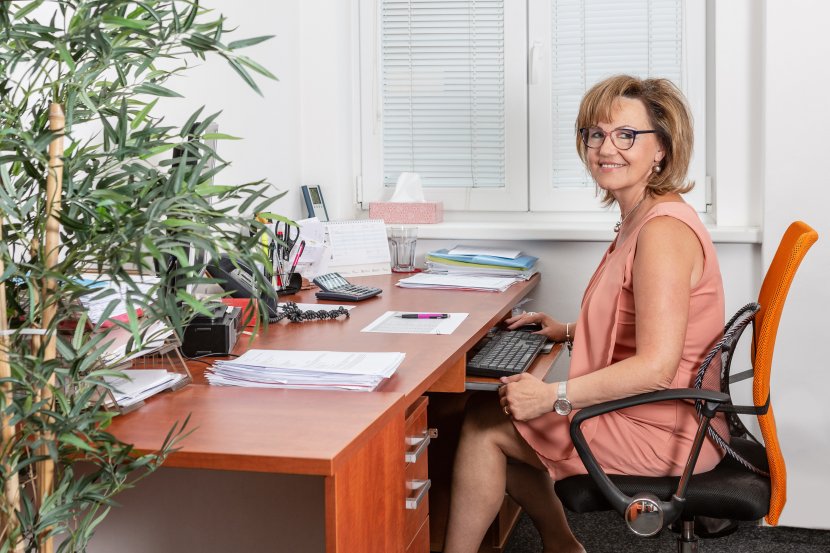
You were awarded Employee of the Year, what do you think?
It's beautiful. I'm very happy and I take it as a gift for my 40th anniversary. It made me very happy. I started here in 1982 as a line accountant, then I was a supply clerk and head of material and technical supply. I started after maternity leave as a line bookkeeper, but was soon offered the position of chief bookkeeper, which I have held for over 20 years.
How would you explain to a complete layman what your job is?
I'm the head of the accounting and finance department. Some people associate our department with HR, but it operates separately. We deal with cash flow. We manage all the invoices the hospital receives and issues. We also process bank statements, pay salaries, deal with taxes and tax returns or work on annual settlements. Our work includes everything related to the hospital's finances. The bulk of our income comes from health insurance companies.
What was it like when you started here?
The hospital had a history back then. It looked the same for years until Mr. Sotirios Zavalianis bought the hospital and renovations took place. When I started, Beroun Hospital had a good reputation, especially its surgery, people came here for operations. There were indescribable changes in my field. Accounting was then done on punch tapes that we took to the computer department in town. My colleagues can't imagine that today, but that's life. Today, everything is modernised. From the District Institute of National Health to the hospital here today, it really makes a huge difference.
So you were glad you came here?
It was more of a coincidence, my cousin was supposed to come here, but she didn't because of health problems, so they offered me the job. I knew the place because my mum had worked here for years as a nurse. When I started on the ward, all my colleagues were older than me and they were quite strict with me, so I would go home crying (laughs). Except for the head of financial accounting, Mrs Lukášová, who took me under her wing, we are still friends and in touch. But eventually I got used to it, I stayed here. I only left for maternity leave and then came back. After a while, I auditioned for a supply and warehouse manager and won. I then travelled all over the country to source goods directly from suppliers. Everything was sourced directly, it was a completely different system than today. That was actually just after the revolution.
It's quite a complicated business, getting all the goods you need. What did you procure?
Pretty much everything. Medical supplies, clothes and so on. But I must say I enjoyed the work. Whatever I needed, I'd go and get it. There were very few companies here, especially in the medical clothing business. For that we had to go all the way to Moravia where there was an exchange combined with a show. Clothes always had to be booked in advance so that they had enough for the hospital.
Was there anything you couldn't get at all?
Probably not, at that time there was only a certain kind of range that was used. The things that were used were usually available because I had contacts with a lot of companies.
So there were no shortages?
No, on the contrary. Today it is the case that what is bought is consumed. But we used to have goods in stock all the time.
That sounds like a big change from 1982.
I've experienced the improvement rather gradually. The biggest progress I see is in IT. When we started, we didn't work on computers, we worked on typewriters and calculators. We didn't start working on computers until 2005. Until then, we had only one common computer in one room, which we called Mechanisation. We each got a personal computer only in 2007, because the owner let us buy them. This also came with new accounting programs. Even the supply side changed drastically. Sometime after the revolution, the District Institute of National Health disappeared and only two hospitals remained, Hořovice and Beroun. Furthermore, the districts were abolished and we began to fall directly under the Central Bohemian Region and started to function as independent hospitals.
What other changes were associated with this?
We stopped receiving subsidies, the equipment became outdated and inadequate, and this led to the partial closure of, for example, operating theatres. We were in a pretty bad way then. In 2005, the Beroun hospital was taken over from the Central Bohemian Region by the Kladno Hospital. Then in 2007, Jessenia bought it as part of the privatisation.
How do you evaluate the transition from the public sector to private hands?
The change is huge. The owner is interested in improving the place visually and with equipment. It is true that several departments have closed, such as the maternity ward, gynaecology and others. However, these departments are still available in the nearby hospital in Hořovice, which is also part of the AKESO holding.
What do you like most about the hospital?
I like our cafeteria, which is amazing. We have always had a canteen here, our own kitchen, which cooked in the style of factory catering. By cooking for the patients, it cooks for the staff. I'm definitely most proud of the Beroun rehabilitation. It has excellent feedback from patients and is well equipped. When I tell someone that I work in Beroun, they immediately think of rehabilitation. It wasn't like that before.
Do you remember any notable personalities in the time you've been here?
Yes, especially in the field of surgery. I think of Dr. Holický and his team. Dr. Dvořák, Dr. Ropková and Mrs. Frauzová, they were wonderful surgeons. They had a great reputation and were successful, especially in cancer. Dr Dvořák also served as director of the hospital, and he was a truly great man. Then I would also like to highlight Dr Povolny, the current deputy for curative and preventive care. He is a personality for me, and it was very good to work with him and, in fact, he is still working with me. I worked with him the most when he was the director of the hospital, it was when we went under ON Kladno and then when the Central Bohemian Region sold us to Jessenia. Because of the sale, we went to Prague for meetings at the region, where we got to know the owner and his team.
Today there are many young doctors who often think of us as administration and unfortunately don't know us very well. It used to be more family-like.
So you wish people in the hospital knew each other more?
Maybe so, just to make them more friendly to each other. It's mostly because of the predatory and competitive times we're in nowadays.
What are your hobbies?
At the moment, it's mainly spending time with my granddaughter and with my family in general.
What is your view of the Czech healthcare system, do you think it is evolving for the better?
Of course, it is definitely evolving for the better. Unfortunately, a lot of services are charged for, whereas all care used to be free. But again, there was no investment in modern equipment. Our management is really keen on modernising the equipment and improving the environment of the hospital and its surroundings. You can see it at every step.