Česky
Česky


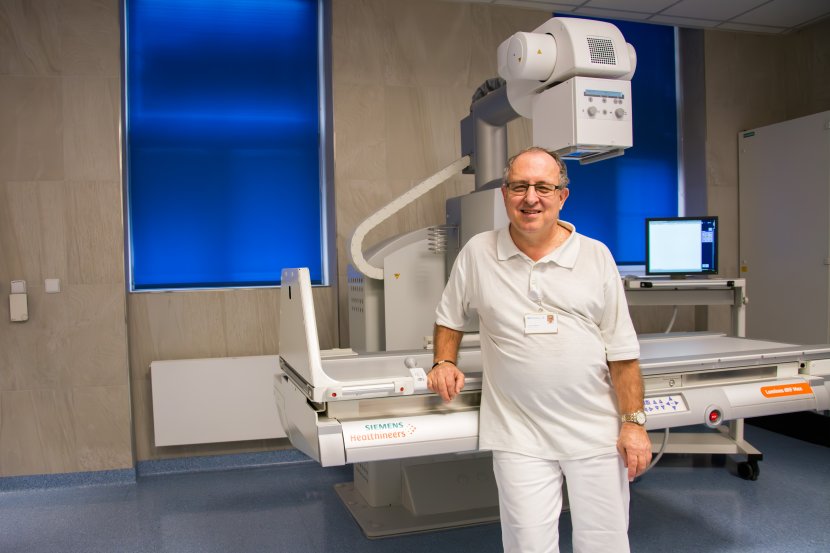
How did you get into X-rays and why?
I've always enjoyed working and interacting with people. Plus, through what I do, I can help them in some way. When a patient comes to our department, I am always happy to talk to them. Paradoxically, right after the war in 1980, I first joined Kladno Ironworks, then SNP Kladno, as an industrial X-ray technician in defectoscopy. We examined surface and internal material defects. I come from Stochov, so working in a district town was an obvious choice; and also because of finances, because heavy industry was of course very heavily subsidised under the previous regime. You earned more in those days than in a hospital - but I was still drawn there. I eventually spent five and a half years in Poldovka. Then I got married and moved to King's Court to join my wife. Then, in the 1960s, I found a job here in the hospital.
Let's stay in Poldovka for a moment. Can you tell us more about what you were in charge of?
We used X-rays and ultrasound to detect possible cracks or microcracks on various steel products. These were various pistons and cylinders and other steel parts - some were as much as three-quarters of a metre in diameter. Exposure times to radiation were several minutes. Just for comparison, a few seconds is enough for a human being. As soon as we found a defect that exceeded very strict standards, one or another product was marked and had to be made again. In those days, Kladno produced very high quality steel. It was a great pity when the company closed down after the revolution.
Then when you joined the hospital in Beroun, you suddenly stopped taking pictures of steel and went into the human body. How big a change was that?
I had graduated as a radiological assistant, but as I hadn't worked in it for six years (eight with the army), I had to relearn almost everything. However, I was glad that I was able to get into healthcare eventually because it was what I always wanted to do. The less than six years in the industry were more out of necessity - and also for a better income, as I said. I was out of the army, so more money came in handy then.
So you got the opportunity you wanted in Beroun. Tell us about your beginning.
I would call it a kind of a wooden time (laughs). We used to develop classically by hand in frames, with the help of a developer, intermediate, fixer and water. Then we dried the frames in a special cabinet. It took about half an hour to get the image to the doctor.
That wasn't bad at all, was it?
I don't think so, but that's incredibly long for today. Worse, though, was when you found out after it was developed that it was a failure. If it overexposed, for example, there was still something to be done about taking it out of the developer a little earlier. On the other hand, when under-exposure was used, there was nothing you could do about it. Likewise when the image was blurry and we had to repeat the X-ray. But fortunately it didn't happen very often. It must be added that we had very good machines for the time, for example the Chirana ones. At the end of the 1980s we switched from a wet process to a developing machine using special cartridges - something like a Polaroid. The waiting time was reduced to five minutes.
When did the first computer appear in your department?
In the 1980s, there were only computer stations - it was mostly a room occupied by one big computer. The first desktop PC didn't arrive until sometime in the mid-90s. This was available exclusively to the lab manager and only monthly patient performances were entered into it. It wasn't even connected to any network.
When did the first digital X-ray come along, marking the end of the analogue age?
Since 2002, we have had new Phillips machines. They were upgraded about six years later. This was a kind of indirect digitisation, which took place with the major refurbishment of the department shortly after the hospital was bought by Ing. Zavalianis. However, we still used the special cassette mentioned above. It could handle about two thousand images and after each new exposure we inserted it into a special reader connected to a computer. Only then could we see the image on the monitor. Purely digital devices are only these current Siemens, which we have since 2019.
How does today's digital X-ray work?
The imaging process is very automated. We used to set the exposure level according to experience. Now, you just have to tell the machine in the protocol whether it's a leg or a lung, for example, and in which position. The computer then adjusts everything with the utmost precision so that the lowest level of radiation is used.
What do patients most often come in for X-rays with?
A lot of times it's the lungs. Then leg injuries - mainly ankles. On the hands, it's wrists and elbows. We also see orthopaedic patients who have joint problems.
Is there anything curious in radiology? Have you ever had anything unusual x-rayed?
There are thousands of stories in almost forty years. For example, we once had two brothers come in and fight, and one of them ended up with a knife in his back. I ask him what happened to him. "You won't believe me, I was cutting bread," he replied. Those were the wild nineties right after the revolution - everyone was doing business and everyone was armed somehow (laughs). I also remember a period when I encountered several times a young boy who came in with a broken arm bone after he had tugged on someone's lever. Once I even shot a dog, a cat and also a predator. Back then, x-ray equipment for animals was not common. And if it was, it was only in a clinic somewhere, and it was terribly expensive. We'd always do it in secret for one of the staff. This was back in the 90s, but of course it was still not allowed.
That must have been quite a challenge because the animal can't be very calm.
The cat and the dog had something wrong with their legs and the predator had a wounded wing. Those animals needed help, and to this day I'm still very glad that I was able to do that then, because we really helped them.
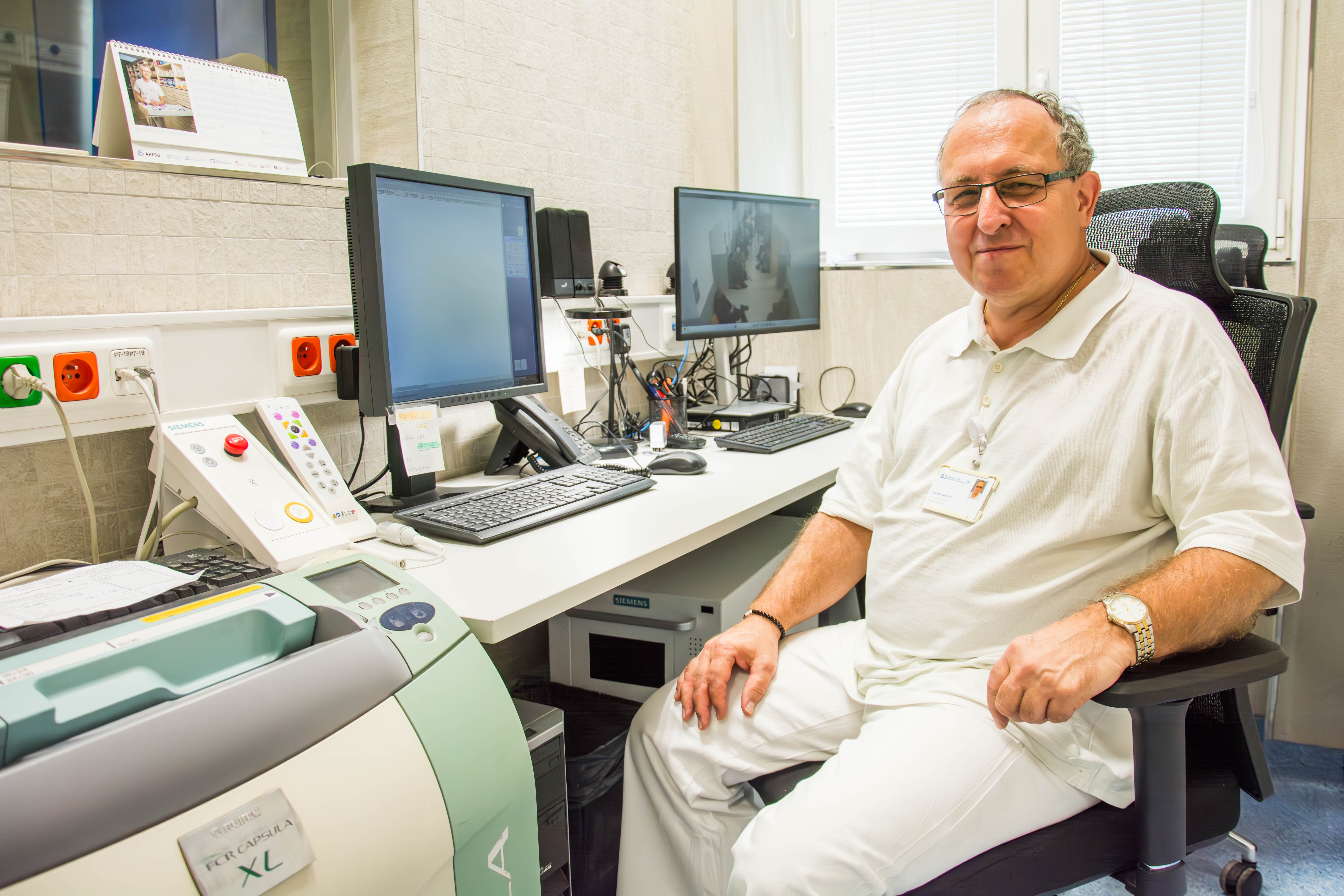
Radiology assistant Lubomír Balenčin
He has been working in radiology all his professional life. As he says, he enjoys his work so much that he does not want to retire yet. He has one daughter with his wife, lives in Králov Dvůr and is very fond of his granddaughter. He is interested in non-fiction, history, archaeology and other human activities, not least all kinds of mysteries. His other passion is travel.