Česky
Česky


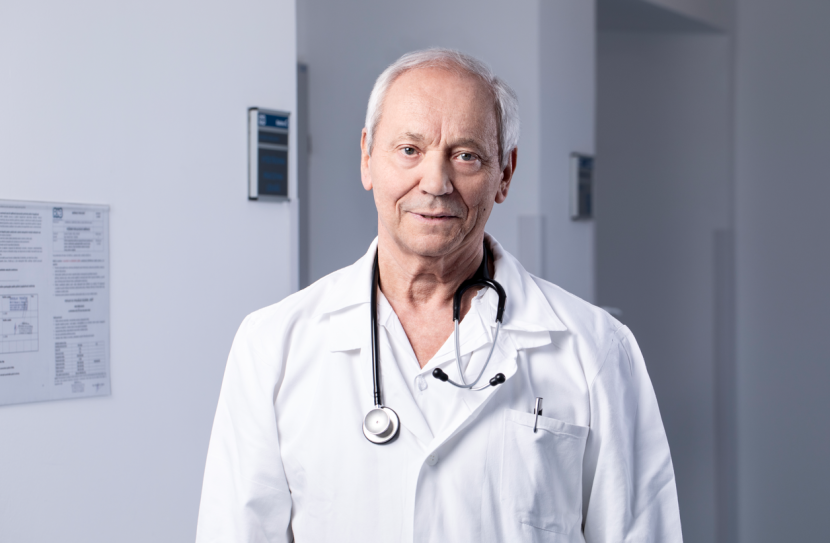
You recently received the Medal of Honour of the Medical Chamber for your lifetime work. How do you feel about that? Was it a long wait?
On the one hand, after fifty years of working in a hospital, you begin to realize that the working candle is burning out. On the other hand, I feel a sense of a job well done. Just in the 28 years I have been here in Beroun, many of the young doctors we started training right after graduation have become experienced general practitioners. I chose medicine, and more specifically internal medicine, as a hobby. I followed the motto of my teachers, Professor Syllaba and Professor Jonáš, who graduated in medicine during the First Republic. In the 1960s, they stressed to us that if a young doctor wanted to learn something, he or she had to basically live in a hospital for the first few years. Nowadays, the Labour Code has to be observed and you cannot live in a hospital.
So when you evaluate your long and very successful career, did you ever have a dream of becoming something other than a doctor?
Looking back on my professional life, I have no regrets. But yes, I had another dream. I also applied to a mechanical engineering college, for a degree in automotive engineering. Back then in the 60s, I was very interested in cars, and my high school dream was to work in an automobile factory.
So mankind lost Sochor the engineer, but gained Sochor the chief...
That's when my mother and my class professor convinced me to go to medical school. My future wife, who had a brother who was an internist in the frontier, was also a decisive factor. She said to me at the time, "You're stupid not to go." So I changed to medicine the day before the applications were due.
In some ways, medicine has changed in the fifty years since then. What hasn't changed?
Yes, medicine, as a whole, has made tremendous strides. Technology has made significant inroads. What should never go away is the human approach to the patient and communication: treat the patient as if they were your father or mother. Nowadays, often without a technological background, you are unable to make a major decision without putting yourself at risk. Even for patients who are not located in large cities but live in the periphery, we are able to provide and arrange care and examinations in state-of-the-art facilities. I see this as a big plus. And it's not just us elders who have to arrange specialised care. Our younger colleagues already know that certain medical conditions are better investigated and consulted at a specific specialist unit. I have to complain, too, because some patients and their relatives take it for granted. I would expect people to appreciate it when a doctor tries to provide specialised care for a patient, but sometimes they wonder why they are being taken somewhere. Fortunately, this is the exception.
The Czechs are such a complaining nation.
I don't want to say that. I recently experienced a family having to wait for treatment over the weekend because four ambulances had just arrived. The mother's condition did not warrant priority treatment. They decided not to wait and went home. But as my mother's condition did not improve, the next day they took her to the central reception in Motol. In Motol, of course, they also had to wait, but eventually they examined her and sent her to us for hospitalization. I am referring to the former minister, the director of Motol, who spoke about this problem. He says that they are unnecessarily overworked at the central admissions, because people seek care directly and not at their place of residence. There is always room for improvement.
As a doctor you make very difficult decisions as they relate to a person's health or life and death issues. How have you coped with this difficult task in your life?
I didn't want to go to medical school because I had an invalid, very ill brother. I felt like I couldn't treat people because I would be too much of an experience with each patient. Any doctor who has some experience and works conscientiously experiences that with a patient. That's a healthy experience. You can't get down about your patient's condition, that would prevent you from thinking rationally. That is why I have not treated my loved ones my entire professional life. I had a severely ill brother, my mother had a severe valvular defect, even my wife had severe illnesses. I didn't treat either of them.
So doctors often underestimate their mental hygiene?
They certainly do. The outlook on life is different today than when I was young. Young people today want to be good doctors, but they also want to live. I recognize that, but I don't think living should take precedence over working. Especially in our field, rest and the contrast of mental strain is terribly important. Many young doctors used to live in hospitals. When a senior doctor on duty needed something, it was no problem to call a young doctor from the hospital dormitory. This can work in the short term, but it cannot be a system of work. Today the young person has many wonderful opportunities that we did not have. We didn't worry about where I was going to fly to, if I was going to fly there just for a long weekend. It's a product of the times and information technology. Life has to mark us, it has marked my generation. And it's hard to compare. I grew up hiking, riding a bike brand favorite, going cross-country skiing and swimming. I still swim today. I always had the best rest in our Czech mountains. But, for example, turning off the phone is something I had to learn for many years.
Do you have any keys to making the right decisions when it comes to life and death? Is it something between reason and emotion?
There's more than one option. Emotions must be suppressed. There is a difference if you are faced with an acute decision, specifically, in the context of, for example, resuscitation, for a person who has a terminal illness. When you are the attending physician, and life suddenly goes out of the patient, you cannot wave your hand and move on. You have to make a decision that is unquestionable. For patients with a terminal illness, it's relatively simple, but the doctor has no right to end the life. I recently had a nurse's mother on her deathbed and she said, "I've said goodbye, just don't torture her." But the patient is still alive and the doctor cannot end the patient's life. You have to maintain humanity. It's our duty to make decisions that cause the patient as little suffering as possible.
I'll give you a second example, pacemaker implantation. Age is not a factor in this procedure. With the help of the family, it is important to consider whether pacing is appropriate for the patient's health. When a patient in the ICU is connected to a machine in artificial sleep and ventilated by a machine, another situation arises. There are certain criteria that determine when the machine can be turned off. Such a decision is made together with the family; it is a collective decision. Today, there are also so-called indication seminars. The population is getting older, but thanks to modern technology, people are getting older and therefore sicker. The worst is when the brain gets old and the person as such ceases to exist, but the body continues to function. This is where the legal aspect comes in. I have seen in my practice that a patient has given me a notarised letter stating that she does not wish to be resuscitated if necessary. I think these cases will occur more frequently. It will make it easier for us doctors to make a decision, as it is not only a medical issue, but also an ethical and legal one.
You're a cardiologist and you specialize in the heart, right?
I was mainly involved in cardiology in the 1970s, when I was also publishing and lecturing. But otherwise I remained faithful to internal medicine. The middle generation of doctors doesn't forget internal medicine. It is a field that evaluates the patient from head to toe. Once you're stuck with cardiology, you're only examining the heart. And even within cardiology, there are many specialties, focusing, for example, on heart rhythm disorders and so on. When I was about thirty or forty years old, patients often died within a year after having a heart attack. Modern cardiology can treat them so that they survive and have a good life ahead of them. Especially those who call the emergency services immediately after the onset of trouble. Getting to the catheterization room as quickly as possible is the most important thing in a heart attack. The examining physician not only examines the artery, but also makes it passable. The individual goes home after a few days with no sign of any damage. The problem is when patients hesitate and put off seeing a doctor.
What treatment is preferred in the Czech Republic?
My colleagues and I were once involved in an international study that treated half of the patients with acute heart attacks with a drug to dissolve the blood clot and the other half with catheterisation. Today, no one doubts that catheterisation with angioplasty is the better option. The Czech Republic has priority in treating acute infarction with catheterisation, it is recognised in the world. In the Czech Republic, doctors were enthusiastic about this method. They attended 24-hour services to treat heart attack patients because a heart attack does not wait for a working day. If you want to do medicine properly, you have to sacrifice your life. Whether it's cardiology, internal medicine or other specialties, it applies everywhere. A former colleague of mine left us to work at IKEM. But he still comes on duty at least once a month to keep in touch with us. He was originally only supposed to stay with us until the strain was met (note: 24 months), and ended up staying for more than four years. And he has called me several times since then to say that he is glad he didn't leave us right away because it helps him now in his work. His enthusiasm makes me happy.
What are some interesting facts about the human heart that people don't normally know?
Many people assume that the heart is in the left side of the chest. If a person feels pain in a different area of the chest than the left, they don't associate it with a heart attack. At the same time, if there is pain in the left half of the chest, they run to us with the idea that they are having a heart attack. The public is being led down the wrong path. Young patients will start looking on the internet for their problems, which is wrong. When you have a car malfunction, you can't navigate that yourself. The heart is a special muscle that can withstand incredible stress. It works all its life, without rest. A tropical tortoise, for example, has six to eight beats a minute. Humans have between 60 and 90 beats. Interestingly, the results of one international study suggest that the higher a person's resting heart rate, the more likely they are to have a shorter life. Conversely, if one has a slower heart rate, one has a longer life.
A drug has been developed that ensures that the heart rate stays steadily around 75 beats per minute. Such drugs are called beta-blockers and are often added to the palette of drugs a person takes after a heart attack. A higher resting heart rate has an adverse prognostic factor. Nothing in medicine is absolute. I tell my relatives that. Sometimes a patient comes into the office and monitors his or her own heart rate, collects the results, compares them, and asks me about the causes of particular drops or fluctuations. It's the same with home blood pressure measurements. I and many of my colleagues think it's not ideal for everyone. In my country it is popular to buy home blood pressure monitors for family members for birthdays and Christmas, but then that leads to exactly what I am talking about. The whole family starts taking their blood pressure, starts living it. That's extreme, it sounds like a joke, but it's not that rare. These meters weren't developed to replace the doctor's office. Especially not in interpretation. If the patients had the same readings over and over, they'd be dead by now.
What can everyone do to keep their heart as healthy as possible, and what are you doing?
Genetic background influences heart health, but it's obviously not the only factor. Nor is it just a matter of weight, as people often think. It's a whole range of factors that we can analyze today from a drop of blood. There is no single pill or single recipe for a healthy heart. But in general, with sporting activity we reduce our cardiovascular risk. But in general, I caution against putting a one-sided load on the body. Always apply that you should use the whole body, for example, when walking. Just running or just cycling is not optimal. As far as diet is concerned, I am a post-war child, yet no one in my family was overweight. I've never been on a diet either. I eat what I like, but I don't overeat. I never even smoked, because it didn't bring me anything. I fondly recall an article in a professional journal where a doctor from Havířov published a case study of the director of a deep mine. He was fat, had a heart attack by the age of 40. Then he took it firmly in hand and started running. As it is in Ostrava and the surrounding area, he ran in the park on asphalt paths. And finally within a year he ended up in disability retirement because he couldn't get on his feet, on his knees. There were no knee replacements then.
The balance between physical and mental stress is important, isn't it?
Yes, especially if one is in a managerial position. Heart attacks are common in those people. But everyone has to organise their lives so that they have time for themselves. The mental health of all of us has taken a beating as a result of the epidemic of covid-19. And the doctors especially. I think in a few years we'll have a lot of data on diagnosis, treatment and precautions. In many cases we were naive, even in prevention. In medicine, mistakes are often made where it's unexplored.
So it could be said that if we don't take a healthy lifestyle as a priority, we have to reckon with the possible development of problems not only with the heart...
Exactly. I tell patients to write their own death certificate. Nowadays, I see people deliberately harming their health. Sometimes I even feel that patients laugh at me. People are mainly afraid of cancer, but cardiovascular diseases are also very insidious. And the general public's knowledge of the risk factors for dangerous diseases is unfortunately limited.