Česky
Česky


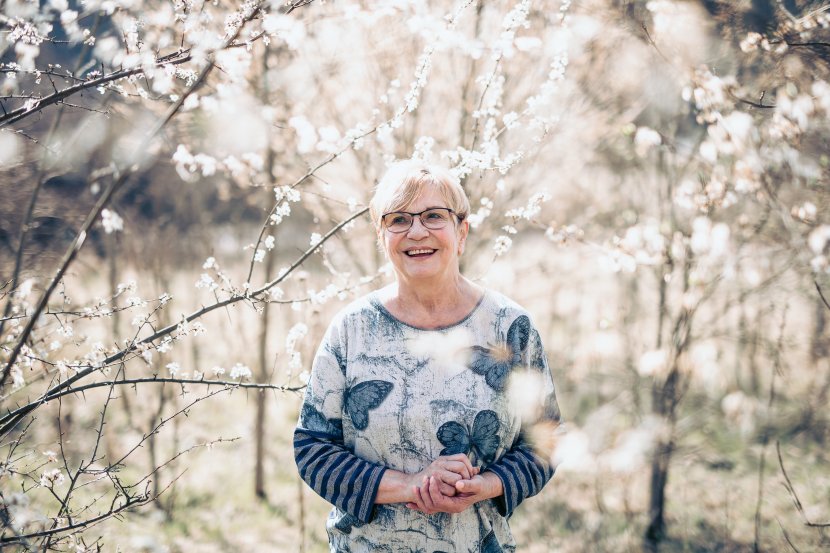
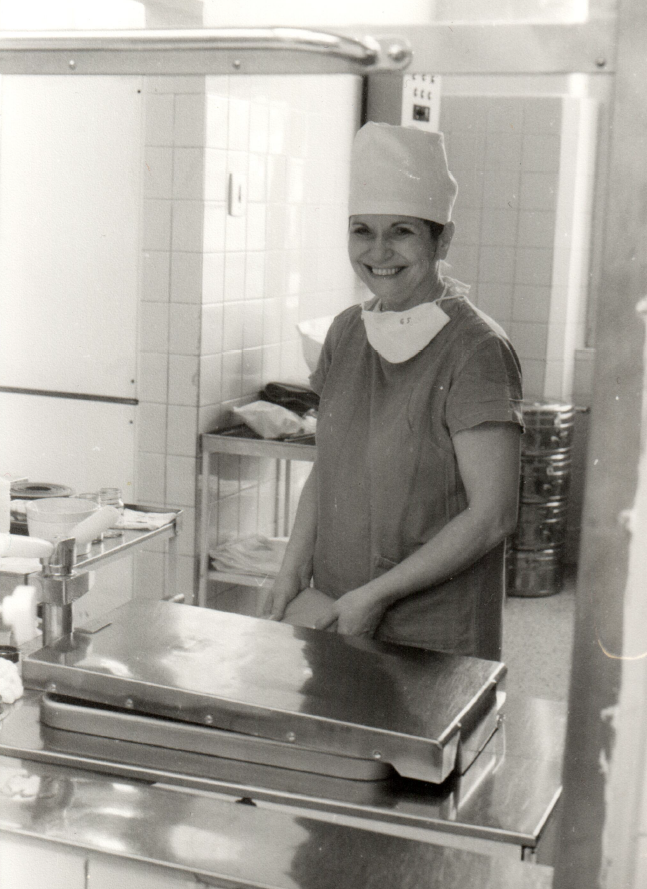
"Simply put, I make sure that the doctors have all the instruments and that the instruments are sterile. My job is also to empathize with the surgeon's feelings. To anticipate what he or she will need in a few seconds," he tells me in a few sentences about his or her profession.
We meet at the hospital in Beroun. A modern facility for its time, it received its first patients in the late 1930s. Today it serves mainly as a rehabilitation facility. Among other things, joint surgery is performed here. Mrs Dejdarová came here at a time when the first republic's halls and equipment were still fully functional. "But as time went on, it got worse and worse. Money for repairs was missing for a long time," she says matter-of-factly, adding that the real modernisation of the complex came after a private investor bought it. But that's another story altogether...
Where would I go?
She says she hadn't thought about becoming a nurse for a long time. She didn't want to go into economics and then into an office after primary school, she had no ear for music, so working with children was out of the question, and she didn't want to go to a grammar school with a more complicated curriculum. "My health kind of came out of everything. I don't regret it."
Since she has lived in Beroun since she was a child, she naturally joined the local hospital after graduation. And I didn't want to live anywhere else either." In addition, morning shifts used to start at six o'clock and moving to Prague would mean leaving home around four o'clock.
I didn't mind the blood.
With a laugh, she adds that she has always been connected to this hospital: "I was born there, on the second floor. Today it's Hall C." She points to the former maternity ward.
So when she entered the premises in July 1968, she says she was looking forward to it, even if she was a little scared. She knew that she would not go to the children's ward or the neonatal ward (she lacked a specialisation), and the gynaecology ward was "a bit of a stretch". Her specialty was then decided quickly. "My classmates and I stood in line and the head nurse pointed to one after the other and said: You go there, you go there. She sent me to surgery," she says, adding that she didn't mind at all. She had the basic prerequisite for it - she tolerates the sight of blood well. Suddenly, she found herself in a ward with over 70 patients. "I was injecting, making beds, changing linen... It took about a year before I got to the ward. I replaced a colleague who became pregnant," she says. "My first boss was a determined woman. She liked order. And I thought she was very old, too - she was almost 40!"
At the mention of her "advanced" age, she laughs again. He knows that forty is no age at all. And she herself is living proof that it is possible to work in the health sector and stand at operations even after seventy. The important thing, she says, is not to lose focus, precision and the desire to learn about new things and people.
For her, being in the operating room is a mixture of love, adrenaline and a mission. Those attributes, she says, don't change in the industry. "Even the number of people in the operating room, give or take, stays the same."
Thousands of operations
It may surprise Laika that although she has been involved in thousands and thousands of surgeries, her face is not one that patients are likely to remember. They only see it briefly, just before they fall asleep. "At that point, there are more people around them," she notes. Usually it's the surgeon, two of his assistants, an instrument technician, and a nurse, her assistant, who is called a circulator. Plus the anaesthesiologist, his nurse, the orderly... Mrs Dejdar's main task during the procedure is to keep an eye on the instruments ready for surgery, they must remain completely sterile. "I'm like a hawk. I'm always looking at the table where they are lying so that someone doesn't touch them, even by mistake. But everyone involved knows how to behave," he says. If asked to describe briefly what is the most important thing about being an instrument maker, besides the sense of order, she replies that there are many things, including a sense of humour: "We are not machines, but people."
For her, it is the human side of health care, the appropriately pronounced words, that is one of the essential prerequisites for a patient to eventually get well. And having worked not only in the operating room but also in the outpatient clinic during her career, she has listened to and seen many incidents or, if you like, cases.
The boy under the train
Before 1989, Beroun surgery was in full swing. Acute cases, injuries, heavy abdominal and lung operations were dealt with several times a day. A few of them stuck in her mind. One of them was the fall of a 15-year-old boy under a train at the nearby station. She had worked in surgery for a relatively short time when he was being treated for a seriously injured arm and had to have his leg amputated.
"I was only a few years older than him. Maybe that's why I remember him so well. But gradually I learned to forget most of the cases, the operations. I didn't bring the work home with me."
She also notes that there were completely different responsibilities, family ones: a husband, two children, just a normal life. In general, she considers professional perception to be the key to doing good work with people, for a long time: "It was sometimes a quality, I won't lie to you. Nowadays it's easier for me. I'm retired, I go to the hospital once a week. We mainly do elective surgeries. Patients come in almost healthy. They just need to get rid of the joint pain."
Her husband also supports her in continuing her career. "It's a welcome change. I feel needed, I'm still a valid force in the operating room, and I'm happy to see my colleagues. And he, in turn, has his peace of mind when I'm in the hospital. Maybe that's why we get along so well," he jokes.
Retirement? Not yet.
More seriously, he adds that a profession as demanding as that of a nurse cannot be done without the support of loved ones: "I returned to the operating room several times during my career. After my first parental leave, I went straight there. After the second one I was on the ward for a while, but then the ward won out." Her son and daughter said they never complained significantly about their mother being at work at night sometimes too. Today, they are long grown. "Healthcare didn't attract them, they have completely different careers. I'm a multiple grandmother now, too. We have another grandchild coming soon," she looks forward.
She says that thanks to her profession, she can also enjoy the little things. A chat with her friends or a stay in the sauna is enough to put her in a good mood. And since such occasions have diminished in the past year and a half because of covida, she is looking forward to the end of the pandemic. In her opinion, it has had the most significant impact on the healthcare system in the last half-century. Preventive measures have been unprecedentedly extensive. They included not only restrictions on visitors, constant disinfection of practically everything, but also a complete halt to all scheduled operations for several weeks. Mrs. Emilie stayed at home and looked forward to getting everything back to normal in Beroun.
I'm not wiping anymore
She looks back on the distant past without undue sentimentality. When comparing "now and then", she recalls above all the enormous progress she has actively witnessed in the field. "There have been many technological changes. In the beginning, for example, we sterilised the surgical instruments in boilers. Distilled water was poured into them and everything was boiled for twenty minutes. Today, an autoclave, a device on which you dial in exactly what you want, does this."
She has seen a number of similar improvements over the decades. She's also taken away the hassle of boiling cloth drapes; disposable ones, like the blades, have long been used. "And I don't have to pick up a cloth or a bucket of water after surgery to wipe it down, to prepare the room for the next operation," she points out, adding that while instrumentation used to be the "icing on the cake", today it is the main thing. Especially after the introduction of cameras. Thanks to them, the surgeon can see exactly where he is going without cutting anywhere unnecessarily. So he doesn't need so many instruments," he adds.
And has she ever thought that she could do a better job as an operator with her experience? She replies with a laugh, "I have seen a lot of things. But I'm old school. The doctor is above me in the hierarchy. That I would pick up a scalpel and go do the procedure for him? No, I've never thought about that."
Lenka Hloušková, Právo, 8 June 2021