Česky
Česky


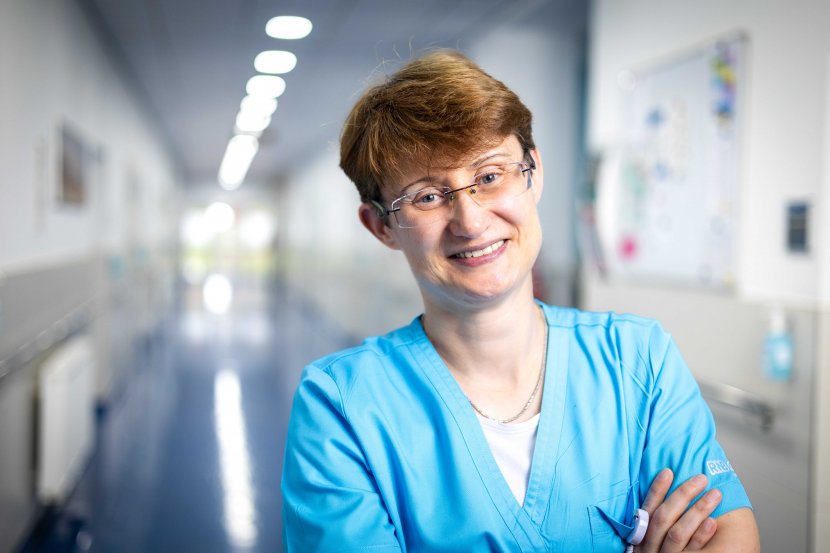
Why did you decide to become a nurse? Was it your childhood dream, as it is in many cases?
Not at all (laughs). I always wanted to be a teacher. But unfortunately or fortunately life had other plans for me, for which I am very grateful today. I've always been interested in human biology, I've played sports, and I've always been interested in how the human body works in general. So after high school, I started a post-secondary qualification in general nursing and it was then that I resolved that one day I would save a human life.
And did I?
Yes. It's not that hard, provided you know exactly what to do. You have to know the resuscitation trolley perfectly and know when and what to reach for. I'm currently training paramedics and the public in cardiopulmonary resuscitation.
We'll get to that, I'm sure. Tell me, where did your steps lead after your studies?
I started in surgery, specifically septic surgery. There I was able to observe a wide range of diagnoses, from inflamed wounds, open wounds to amputations. Although I enjoyed it very much, the situation in North Bohemia, where I come from, was not easy for aspiring nurses at that time. It just didn't feed you. That's why I moved to Tereza Spa near Teplice, which has a long tradition there and was already private at that time in the 1990s, so there were better pay conditions. There I got acquainted with rehabilitation, I helped as a nurse to the rehabilitation workers. Then I moved to Prague, to the Institute of Haematology and Blood Transfusion, where I worked in the ICU with the transplant unit. This was a very action-packed period and during this time I gained further skills and abilities while completing the necessary education.
What do you enjoy most about your job?
It fulfills me to see the results of my work. Even if not immediately. But when a patient comes in broken and sore, they leave here unscathed and much better disposed. He comes back to life. You also have the opportunity to keep pushing your limits and learning new things. I also like the fact that it's such a peaceful way of life here, which I like compared to the acute medicine I've been used to. The humanity and togetherness is pervasive here, and I haven't experienced that anywhere else right away either. I'm basically working in a happy field.
What plans did you take over your department with?
First and foremost, I would like to achieve satisfaction with both staff and patients, which is a very ambitious goal. To make sure that all my girls, from nurses to orderlies, always have all the equipment they need to do their job. And at the same time, to be prepared for any situation that may arise. There is a risk of various embolisms in the operated limbs, which are not related to age at all and can occur at any time. So that the nurses know how to provide help correctly and in time, contact the resuscitation team, know where the manual defibrillator is and know how to use it if necessary. I would be very happy if I could also be involved in educating the staff here in this area.
You said you were training paramedics, so you have fulfilled your teaching dreams.
I guess so. I educate doctors in proper intubation techniques and I teach nurses how to assist doctors properly. At the same time, I teach paramedics how to work with artificial lung ventilation and the so-called cleansing method, which is basically dialysis. In addition, I also train the public in first aid both in and out of the hospital setting.
What surprised you in your new position as a station nurse in rehabilitation?
I was pleasantly surprised by the attitude of the Deputy of Nursing Mgr. Radka Zinková, who has been very helpful and accommodating to me. I like people who realise that for the desired result they also have to add their hand to the work, they support you and are open to meaningful cooperation. However, I was pleasantly surprised by the reception from the whole team.
What do you consider to be the most important things in the nursing field?
The most important thing to remember right from the start is that you will be working with people. The pleasant and the unpleasant. Day, night, Saturday and Sunday, holidays. Nursing is first and foremost about serving people, their needs. You'll encounter people's pain, suffering, anguish. If, in spite of it all, you answer that you want to do it, it's okay. But if you doubt one of those things, it's probably not the job for you. Still, it is a deeply meaningful activity, and in many cases, it will reward you. Just by those visible results, a healed patient. This field is not going to go away, I dare say, ever. In this respect, you have a job secured.