Česky
Česky


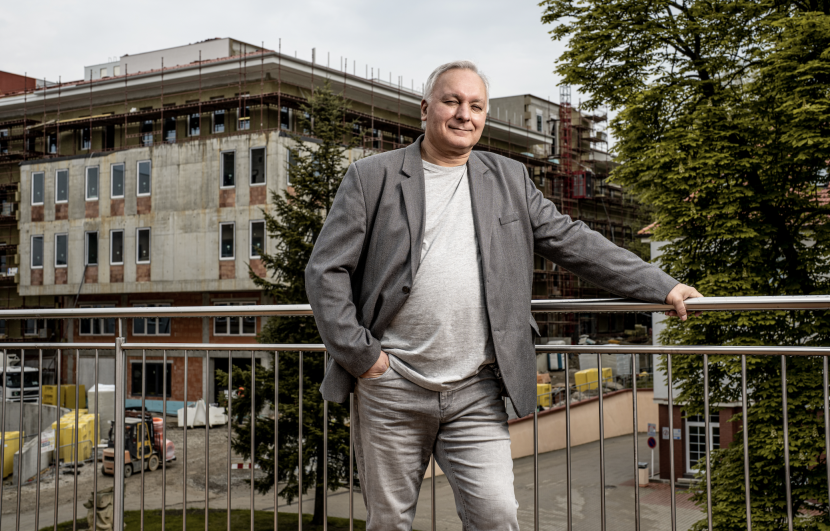
Professor, what role will the Mental Health Rehabilitation Centre play in the current system of psychiatric care?
There is a lack of a sufficient system of acute outpatient beds in the Czech Republic. So this will be our first task at the Centre - to concentrate on acute inpatient care. The second commitment is that we want to link this acute care with what we call outpatient care. This means that the patient should be able to attend, for example, an inpatient unit. We are therefore designing medical programmes not only to cover acute needs, but also to focus on the process of healing. The third thing we want to focus on are disorders that are not given much attention in the Czech Republic. Typically, this is obsessive-compulsive disorder, where our ambition is to make the Centre work not only for the region but for the whole country. This is a common practice in the world, in the Czech Republic there has been little and insufficient capacity to do so.
You often mention the state of Czech psychiatric care. Given your experience abroad, how do you assess mental health care in the Czech Republic and its reform?
I am convinced that many things have been achieved. However, the problem with the reform is that it was only intended for about 30 000 patients, but we have 750 000 patients in the system every year. The reform has helped the most stigmatised patients who have been in hospitals for a long time. They have, for example, been given the opportunity to obtain sheltered housing. This is commendable, but it needs further development. The changes have not affected all those in need - children or the field of gerontopsychiatry, for example.
What will care look like in the CDR?
The key will be that the care a patient receives will be comprehensive. The patient will therefore have pharmacotherapy and psychotherapy, but also a range of other activities such as drama therapy, art therapy or music therapy. All these parts need to be linked and complement each other. This is often lacking in today's care. The aim of the Centre will be to piece together care so that each part makes sense in the patient's story. Specifically, this means that the programme will be full-day and the patient will have group therapy, follow-up programmes, and then individual therapy as needed. But unlike usual care, we want the programme to be designed specifically for a particular problem. The care in the CDR will be followed by long-term care for the patient in inpatient, outpatient and outreach settings.
"It is essential that the patient receives comprehensive care in Beroun."
Do you think this approach can reduce the length of hospitalisation?
Shortening hospital stays has its limits. The patient needs a sufficient amount of therapy. If I compare it with psychiatric hospitals, the hospital stay at the Centre will probably be shorter. However, the patient will spend more time here than in a regular outpatient department. We don't want to shorten care at the expense of the patients' condition.
Psychological problems often affect the patient's immediate environment. Do you expect to educate families at the Centre?
Yes. The family is the closest circle of people to the patient, so we count on their involvement. Firstly, those relatives can be invited to therapy, but we also envisage setting up a programme for family members. The Centre will also have an outpatient clinic for paediatric and adolescent patients adapted to work with the whole family. From the beginning we will cooperate with Hospital Hořovice, which has an excellent paediatric department.
Will the Centre's activities be linked to science and education?
Absolutely. The Centre is being built with science and research in mind. We are establishing contacts with medical faculties and psychology departments and their students, and we anticipate internships and teaching of students - for this, among other things, our Centre is optimally suited. The Centre will include a professional library linking experts with scientific resources.
A therapeutic and medical team of up to 160 people should be available to patients. Is it difficult to staff?
There is a general shortage of workers in this field. In the Czech Republic we have a shortage of psychiatrists, psychiatric nurses and psychologists. It's logical. It is easy to get burnt out in this field, the demands on this profession are simply extreme. And we will keep this in mind when training colleagues. Our aim will be to train the team in advance so that their work is cohesive. A lot of the work of healing will be done by the kindness and tolerance of the staff. In fact, it's also a way of working that contributes to patient healing. We also want to look at staff care to prevent burnout. The entire facility is built to be a welcoming environment, creating a sense of safety and tolerance both structurally and through the programmes built.
"The centre is built to be welcoming and create a sense of safety and tolerance."
You say the conditions for this work are challenging. You're still at the top of your field, can anything else surprise you? And what do you enjoy most about it?
Psychiatry is a field that is evolving incredibly fast, offering a synthesis of science, creative work and human approaches, and sometimes it is also an art. Research yields a huge amount of knowledge. Over the course of my professional career, I have founded several psychiatric departments that have integrated scientific and humanistic approaches and, as a result, have become a magnet for the entire country. My colleagues and I published over 40 books for patients because literature was scarce and they were thirsty for information. I am also dedicated to connecting work with people who are struggling with science, research and teaching. I enjoy guiding professionals in the psychotherapy training I run in five countries in Europe. Poland for 20 years, Lithuania for 17 years, Latvia for 12 years. I'm happy to be able to do this and to help educate the next generation.
Prof. MUDr. Ján Praško Pavlov, CSc.
Ján Praško is a leading Czech psychiatrist and psychotherapist. From 2008 to 2018 he was the head of the Department of Psychiatry at the Faculty of Medicine of Palacký University in Olomouc and the Olomouc University Hospital. Since 2018 he has been the Head of the Department of Psychotherapy at the Institute for Postgraduate Education in Health Care in Prague. He is also the President of the Czech Psychotherapy Society and ex-president of the European Association for Cognitive Behavioural Therapy. He is engaged in psychotherapeutic work, training of medical doctors, psychologists and postgraduate teaching of psychotherapy and psychopharmacology. He conducts systematic training in cognitive-behavioural psychotherapy and supervision in five European countries. He is the author of more than 650 scientific articles (361 of them in English) and 80 monographs on psychiatry and psychotherapy. His work has been cited countless times in the world literature.
"I have been studying psychiatry and psychotherapy with curiosity, enthusiasm and deep thought for 40 years. I have managed to build several good psychotherapy departments which have been sought after by patients from all over the country. I have spent many years building, refining and researching psychotherapeutic approaches. I have succeeded in training hundreds of good psychotherapists and would like to continue to do so. I would now like to work with my co-workers to build a facility that will offer the highest quality care to people with mental health problems. So that they feel comfortable there and can find a meaningful path. I think I can create an authentic atmosphere of safety, acceptance and true appreciation, as well as accompany people on their journeys towards fulfilling their best selves. I mean that for patients, as well as for the nurses, doctors and psychologists who care for patients."
She specialises in working with people with borderline personality disorder. She also works in the treatment of anxiety disorders, particularly obsessive-compulsive disorder.
In his spare time he enjoys literature, film, theatre and sailing. He became national champion in judo in the junior national team.

Source: Jan Vlček