Česky
Česky


Mrs. Chief Surgeon, with what health problems do patients most often come to you?
We have a very diverse range of patients. From neurological after stroke, for whom we provide early inpatient rehabilitation, to chronic cases such as those with amyotrophic lateral sclerosis, multiple sclerosis, peripheral nerve disorders or patients with Charcot - Marie - Tooth (CMT) disease. We also receive patients after limb injuries, traumas or craniotraumas and polytraumas - these are most often car or motorcycle accidents.
However, you also deal with patients after internal organ surgery...
Yes, we rehabilitate patients after heart surgery or lung transplants, but these are only units. Another group is patients who come to us for painful conditions, such as neuropathic pain resulting from nerve damage like complex regional pain syndrome or classic back pain. There are also a lot of patients after spinal surgeries.
Who else can you help?
We also work with patients after septic shock, pneumonia, and amputations. In these cases, we work with our prosthetist, who we have on site at the hospital. And I mustn't forget orthopedic patients after major joint replacements and arthroscopic surgeries. In this case, we most often work with our Arthroscopy Center, where the patient is transferred directly to our department after the surgery. In our outpatient clinics, we care for patients with musculoskeletal pain or after injuries that do not require hospitalization, as well as pediatric patients.
Let's take a closer look at the topic of rehabilitation. What do you think is essential in this field?
It is still, and I think it will continue to be, the human factor. A good physiotherapist and his hands are still the most valuable commodity, if you can say so. Of course, a team of experts is also essential to establish the diagnosis and the best treatment. We still cannot do without occupational therapists, speech therapists and other specialists who spend most of their time with the patient and provide them with some psychological encouragement in addition to rehabilitation care. We also function to some extent as psychotherapists, because the patient can improve or worsen his illness by his experience and perception. But perhaps you wanted to hear that modern technology is essential, right?
Well, I was counting on you to tell me that the future of rehabilitation is linked to modern devices.
I'm sure it's the future, but there still has to be someone who knows how to use the machines. Someone who can oversee the entire treatment program, and so far only a flesh-and-blood specialist can do that, which is also the most expensive. You buy a machine and it pays for itself over time. But a quality person is still expensive. On the other hand, the move towards telerehabilitation could be interesting for the emerging young generation, it could make them more interested. I see another possible benefit of modern technology in rehabilitation for geriatric patients, where they are simulating a certain environment through virtual reality, and this can motivate them. This builds on some previous methods that rely on brain plasticity, which is the basis of all methods. It used to be mirror therapy, now it's going to be replaced by computer technology.
What do I mean by "brain plasticity"?
Brain plasticity means the ability to change the brain. The formation of new brain cells instead of damaged ones can take place in older individuals, according to studies. Above all, however, new brain connections are formed, and this makes learning possible, but it needs some stimulation to do so. And the patient knows, through computer technology, that he is working with his hand, even though he may not be working with it. It comes to him as an impulse to start working with that limb, to start feeling it. That's where it's very interesting. But we'll have to consider who it's appropriate for. I see the advantage in the number of people that can be served, the disadvantage in the lack of person-to-person contact.
Your centre is equipped with state-of-the-art equipment. Describe what you're working with.
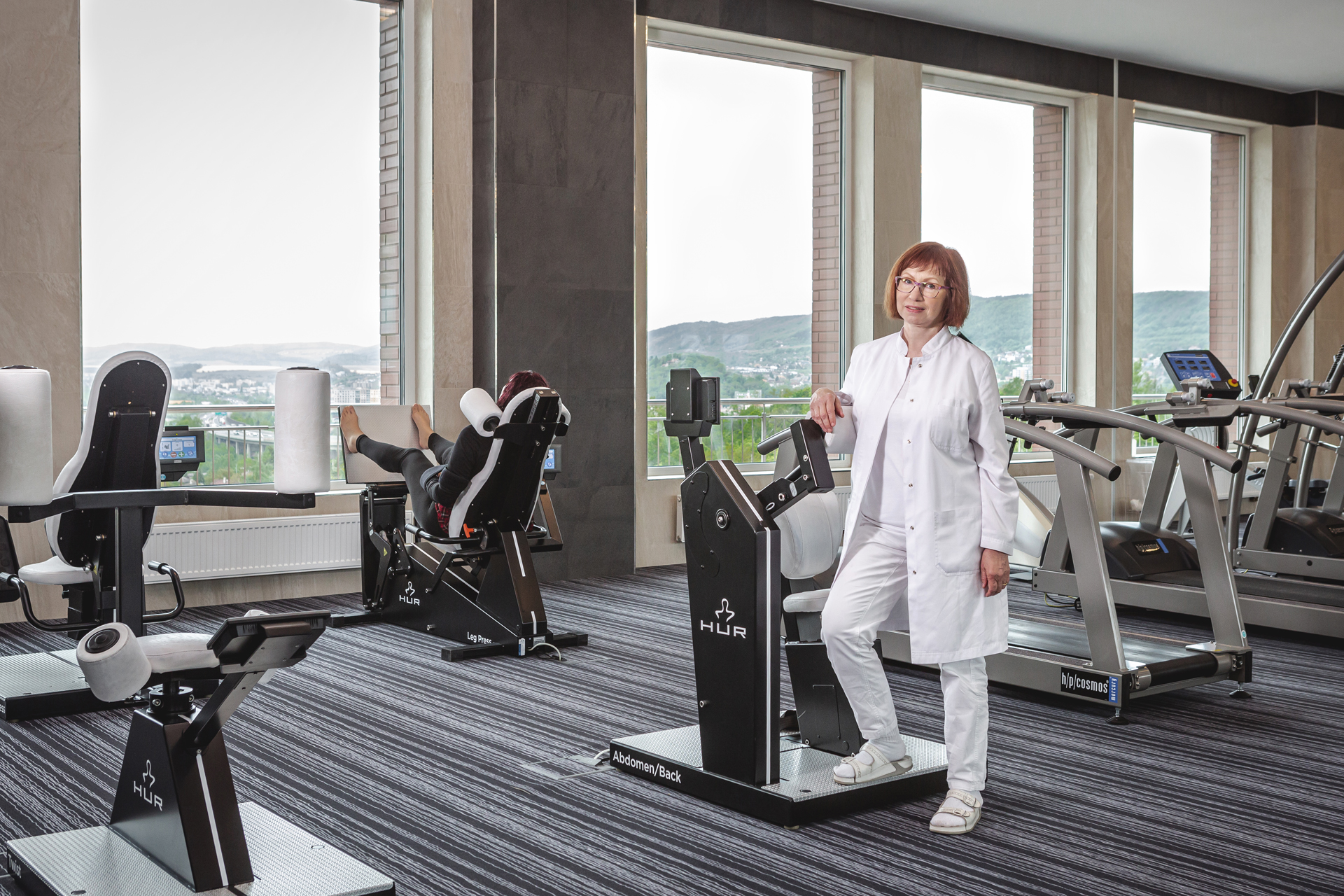
We have very modern equipment in our centre. For example, a well-equipped fitness center, but it's not used as a traditional gym. We have DAVID machines that are connected to a computer, and the computer shows you what strength you have, what range of motion you have, and in conjunction with the physiotherapist, the patient can learn how to exercise properly so that they don't hurt themselves. Another well-equipped workstation is the cardiozone, where they also exercise under the supervision and control of an ECG, which correctly adjusts the physical load. In occupational therapy, we use the Gloreh artificial glove to help the patient with mobility or the MYRO and MediTutor systems to train fine motor and cognitive functions. Of course, we also follow and are inspired by the latest trends in rehabilitation.
Which ones are they?
For example, the kinesiology lab, where we find out how much you are loading which side of your body. Or physical therapy, here we use shockwave, a high-powered laser that works well on tendon-muscle issues and pain conditions. We'll also have a special walkway that the patient is strapped to and they practice walking, stability.
What else do you have planned for rehabilitation care?
We are starting with transcranial direct current stimulation, we want to use this to treat cervical syndromes, migraines and post-stroke conditions. We want to see if the exercise improves the patient's mobility. Then we are planning a new decompression therapy, which helps spinal traction. We are developing rehabilitation for neurological patients - antispastic stimulation, stretching methods according to Prof. Gracies, suspension exercises and more.
There is a long-standing shortage of staff in the health sector. I suppose that this problem does not avoid rehabilitation either.
You're right. The shortage of personnel is also felt in our field. Doctors, physiotherapists, occupational therapists, nurses, orderlies, they are all essential to the smooth running of the department. They perform physically demanding work on a daily basis that simply cannot be done by everyone. We certainly have a lot to offer our new colleagues. Doctors have the opportunity to take a strain here, to become certified, and even after certification they can further develop and specialise. We make courses available and reimburse them, and we would also like to give new colleagues the opportunity to give lectures and do research and publish their work.
What is the interest in rehabilitation medicine among medical professionals in general?
The disadvantage of rehabilitation medicine is that it is still taught on a small scale. A lot of students are more interested in the acute disciplines, rehabilitation is lagging behind. Yet it's a field that can connect. Medicine, as it improves and specialises, it's also becoming a bit detached. And rehabilitation is bringing it back together. Because just by being used to working in a multi-specialty team, we can't lose sight of the patient as a whole. We have to take into account their overall health, their psychological state, we have to work together sometimes with social workers. That's the nice thing about the field. But probably one has to grow into rehabilitation.
Like you? Or have you always wanted to do rehabilitation?
Like me, yes. I had to grow into the field over time. I originally thought about acupuncture, which I was interested in. Subsequently, I also got into pain management; I have a certificate in algesiology, among other things. And then I broadened my professional horizons towards neurology, orthopaedics
and rehabilitation.
What advice would you give to future rehabilitation physicians?
To give it a try, preferably in Beroun. It's a nice field, it's not as adrenaline-filled as orthopaedics or surgery, which may suit some people. If they want a field that connects and at the same time they want to be educated in new technologies, rehabilitation is the right field for them.