Česky
Česky


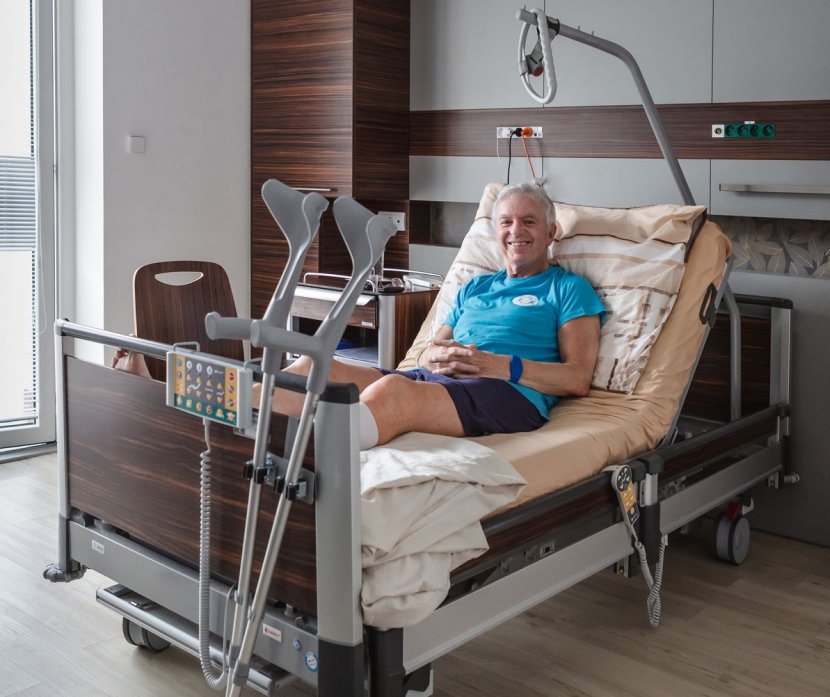
The associate professor of plastic surgery recently underwent orthopaedic surgery in České Budějovice with associate professor Jiří Stehlík and was recommended rehabilitation. He could have chosen any rehabilitation clinic in the country. He considered Malvazinky, Slapy, but after the first phone call he decided to go to Beroun. "I was lured here by my friend Jadran Šetlík, a photographer, who told me that it was amazing here, and I have to give him credit for that," explained the plastic surgeon why he chose our hospital. "Everywhere I advocate that the most important thing is the first impression. I met the lovely Mrs. Müller here on the first phone call and we laughed together on the phone. Then I called the chief physician, Ondřej Horáček, and this phone call also radiated humanity. So it was decided." The meeting with nurse Monika from the orthopaedics department in České Budějovice was equally positive. "She gave me an injection at night and stroked me so that it wouldn't hurt, but the operation didn't hurt me at all!"
For Associate Professor Měšt'ák, the human approach is simply very important and he also liked the way the Beroun rehabilitation clinic is professionally organised. "First impressions and humanity are the most important and I teach this to all medics and nurses," he stressed.
The eyes are the most important
During our conversation, the topic of plastic surgery could not but be discussed. Assistant Professor Měšt'ák makes no secret of the fact that if he thinks a woman does not need plastic surgery, he tries to talk her out of the procedure or simply throws her out. He will refuse some of them repeatedly. Even if she offers millions, he'll send her to his colleagues. "I fire 40 to 60 percent of people a year who say they don't need plastic surgery." On the other hand, if she sees that someone needs it and doesn't have the money for surgery, she operates for free. His frugality has also made him friends with Count Henry Kolowrat-Krakovsky. And as fate would have it, his private clinic Esthé is located in the former Kolowrat Palace in Prague's Na Příkopě Street. At the same time that he was building this clinic, he also became co-founder and head of the Department of Plastic Surgery at the 1st Faculty of Medicine at Prague's Na Bulovka Hospital. He still works at both places today.
Although he is an incredible gentleman, he admits that he often utters bad words. But he uses them quite purposefully. They help him to break down the shyness and shame of others. "In a serious situation, I'll say one of the simplest words. "They all shut up, but then they start laughing unbelievably. The nurses at Bulovka already know this tactic. When women without breasts come to see me at Bulovka, they say they want breast reconstruction, and they don't want to undress in front of me. I'll say something incredibly weird, sometimes sexual. For a while there is complete silence, but then the atmosphere relaxes." Laughter helps to overcome stress and shame.
Often described as a beauty expert, he sat on the Miss pageant jury for 20 years. Despite his profession, the inner beauty is always more important to him. "Whether you have, excuse me, tits like this or poppy seed, it doesn't matter. The most important thing is what you exude. Even with a guy, you don't care what's in his pants, you're more impressed by his charisma. Outer beauty is fleeting or can be artificially enhanced, but the inner beauty is not, it wins."
Natural beauty is a subjective feeling that everyone has. In Miss judging, he often promoted girls who were not primordially beautiful. "Once, me and fellow judge photographer Peter Škvrnja were attracted to the same girl. She had charisma, she could talk, she had a beautiful smile, posture... She was just beautiful, where were the others looking at her. But she had a big nose. We were able to push her through to the next rounds for a long time, but unfortunately she didn't win. But she shone out there."
He sees the beauty of a woman primarily in her eyes. "Her eyes are the window to her soul and her heart, where love resides. For me, that's an attribute of a woman's beauty."
She has been helping all her life
He exudes tremendous positivity and modesty as we talk. He has been a college educator for 45 years and always asks his students what is important to them. He is clear about that himself. "Children always come first, then partners, and then everything else. When something happens to a child, that's the worst." He has seen so much suffering in his lifetime. He lectures his students about paediatric burn surgery, the most horrible birth defects, injuries, tumours, but he sees the world positively. "If someone hurts me, it's usually not their fault. There could be genes. The person is hurt himself, and that's why he's kicking around, and I feel sorry for him. I try to see the good in people, then I suppress any disappointment. Because if we weren't down sometimes, we wouldn't know what happiness is, and I can safely say that we can't appreciate it."
Years ago, at the urging of his former patient, he began working with the Give Children a Chance Foundation. "Once they brought a ten-year-old girl with a serious facial injury to the Plastic Surgery Clinic in Prague Vinohrady, where I worked. Her family had been in a serious accident somewhere in Poland. Her mother died in it. Daddy was badly injured and so was she, in the face. I operated on her and she came to me years later. She worked with the founder of the foundation, Mischa Chovancova, and she introduced me to their work and I started working with them." She stays in touch with her patrons and supports them financially.
Associate Professor Měšt'ák is known to sleep only 3.5 hours a day and to live an incredibly modest life. He doesn't drink, he doesn't smoke, he plays sports. He considers social networks to be time-suckers. "Wise people don't have Facebook, Instagram, they avoid them."
He often lectures and writes about ethics, especially medical ethics, where plastic surgery is now quite difficult. And it is in modesty and ethics that he shares a note with his role model, Professor of Surgery Pavel Pafek.
He could have a villa with a swimming pool, lots of cars, but he still lives in a "rabbit hutch" and it suits him. "I am not a gold digger, I have provided for all my children, and the others. I don't need to accumulate assets. One of my motivations for still doing this is that I make women laugh and help them. I motivate women to see themselves as beautiful."
And make me laugh and get me to think seriously, the docent really succeeded. On behalf of our hospital, we wish Associate Professor Jan Měšt'ák a speedy full recovery, lots of strength for work and sport, and above all, continued good health.