Česky
Česky


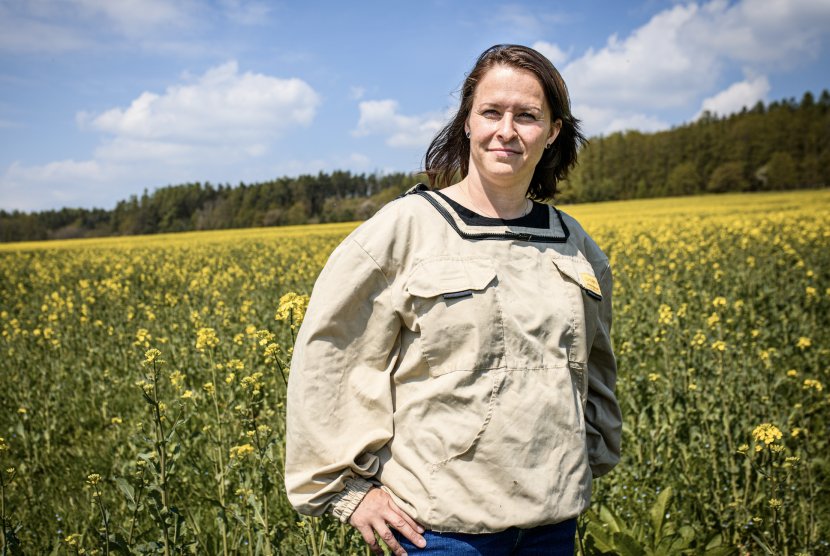
Adéla Šubertová (35)
A native of Plzeň, after studying at the Secondary Medical School in Beroun she joined Hospital Hořovice, where she worked in the internal medicine department for three quarters of a year. Then she accepted the position of head nurse, and after proving herself in charge of the covid unit during the harsh times of the pandemic, she became the head nurse of the entire hospital. Her remit also included recruiting new nurses.
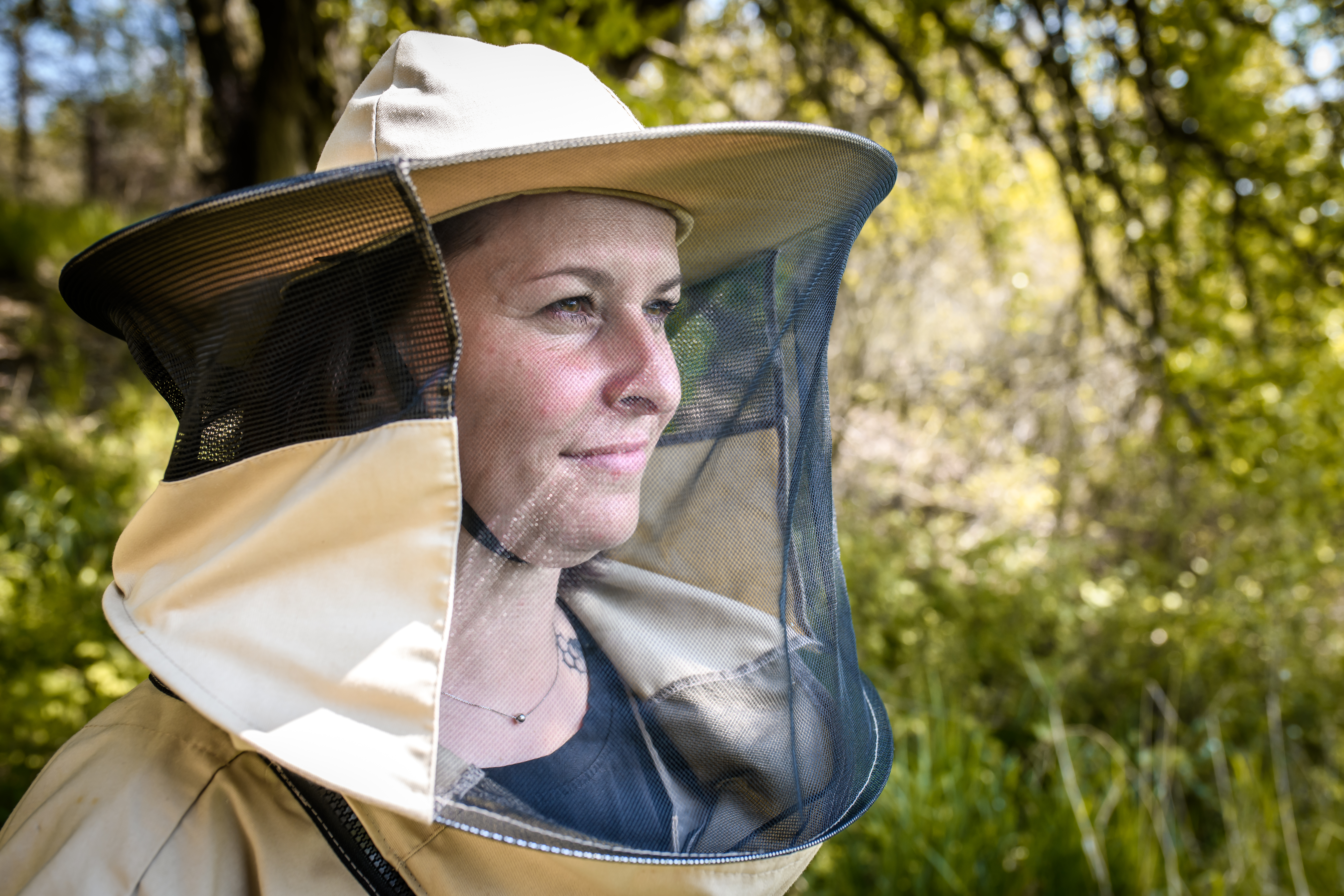
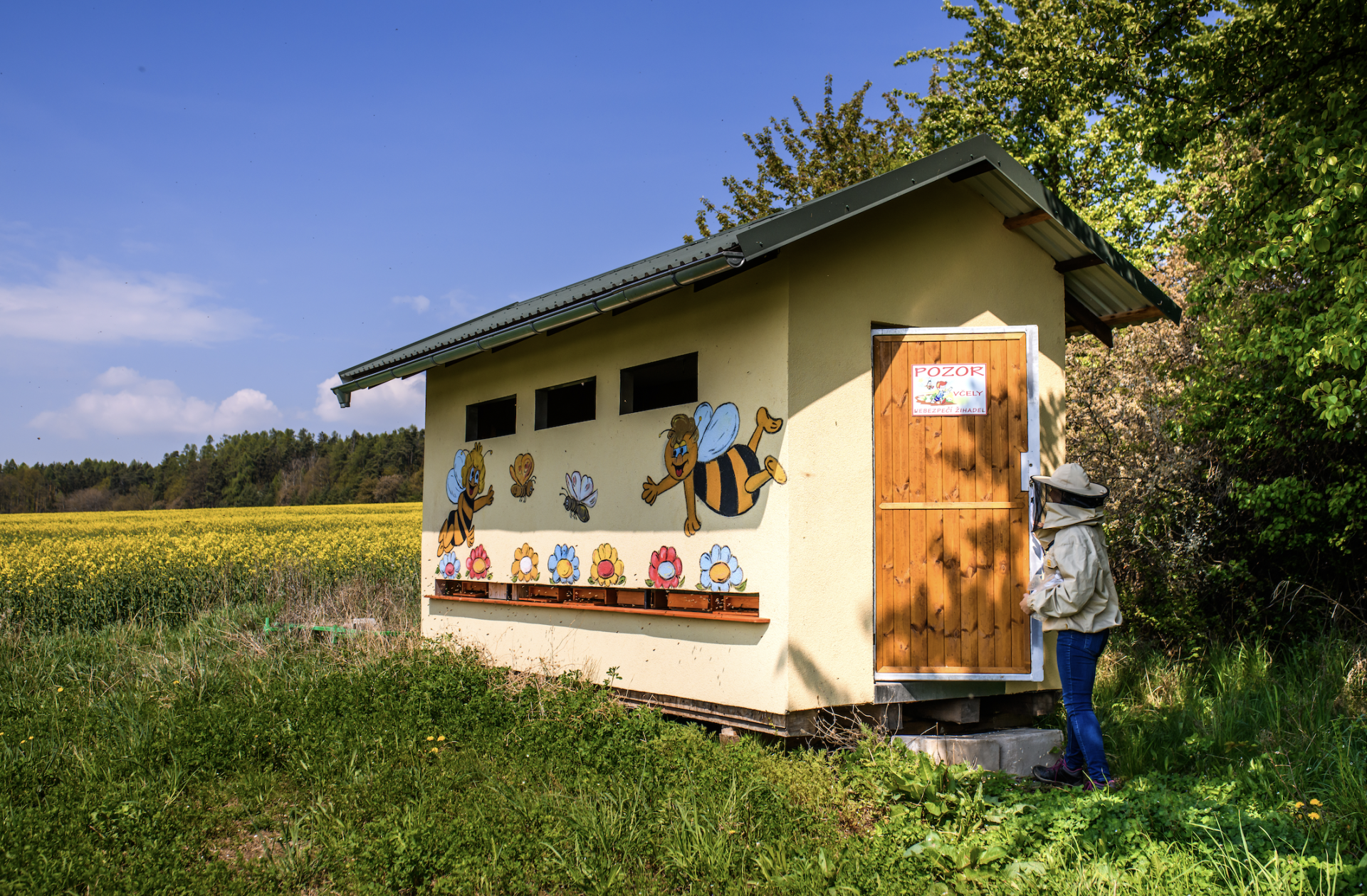
"And do I really have to wear that bee hat even if we're taking pictures outside before we open the hive for them?" I try to break Adele. She has just picked me up by car at the station in Hořovice and we are heading to her apiary. "It's necessary, the bees will come after you," the young woman doesn't give up. "Twenty of them won't come after you, just one that wants to give you the sting and will." Before I can think about how I'm going to focus the camera through the mesh of my hat, we're almost there. At a wooden house painted with bees. By a meadow with a field where three days ago the canola blossomed.
Don't wiggle, but squeeze.
Adele is changing her shoes and I realise that she is serious about protecting herself against unexpected bee stings. I've photographed with bees before without any protection, only it was a blistering summer when the bee turns into a lamb. After some advice, I pull my long hair into a bun, even in warm weather I finish my sweatshirt up to my neck and have Adele check the tightness of my wide-brimmed hat with the mesh over the visor. I absorb the information that the sting will easily pierce my jeans.
A patch of meadow with green alfalfa from which naughty dandelions peek out. The buzzing intensifies and I receive further advice not to walk through the corridor just outside the comb where the bees enter the hives. I'm told that would increase my likelihood of being stung to 1000%.
"I've been beekeeping for five years. It's nice, look at it," Adela opens her arms. "How many times do I make a coffee to go and sit here. It's quiet here. Why did I start this? I guess to have something other than a household and a job. It's a pleasure to spin honey and fill jars after a year's work," says the mother of two, who, in addition to honey, can also make candles from wax and her own mead. Original handmade gifts are thus taken care of.
I wonder how many bee stings she's had. "Countless. I tell you, a bee sting doesn't hurt, it burns. If you get more than that, it's like burning your feet from nettles. But you get used to it. It hurts most under the fingernail on my hand," smiles Adela and adds a recommendation, "Never pull a bee out of your hair. If you get it tangled in there, just clap your hands and pinch it. It's better to kill it than to get hysterical. Then it will certainly sting you, and it's not very pleasant in the head."
And what does he say about someone getting a sore elbow from bees on purpose? "They're crazy, but I don 't think I'd totally condone it. Even if it's bee venom, it's still nature. There's something to it."
Swarms, frames, attachments, beehive
"The beehives are hidden in a wooden house from my husband's workshop."
While you'll often see beehives standing alone outside in gardens and meadows, these are hidden in a wooden house smaller than a marquee. It's her husband's creation so she can have better facilities and leave things she needs. Also to keep the woods out of her back yard, because it's not very pleasant when it gets dark. Thanks to the windows on the side and the skylights under the roof, there's plenty of light inside and she can still enjoy the views. The place is a ready-made gas station to recharge.
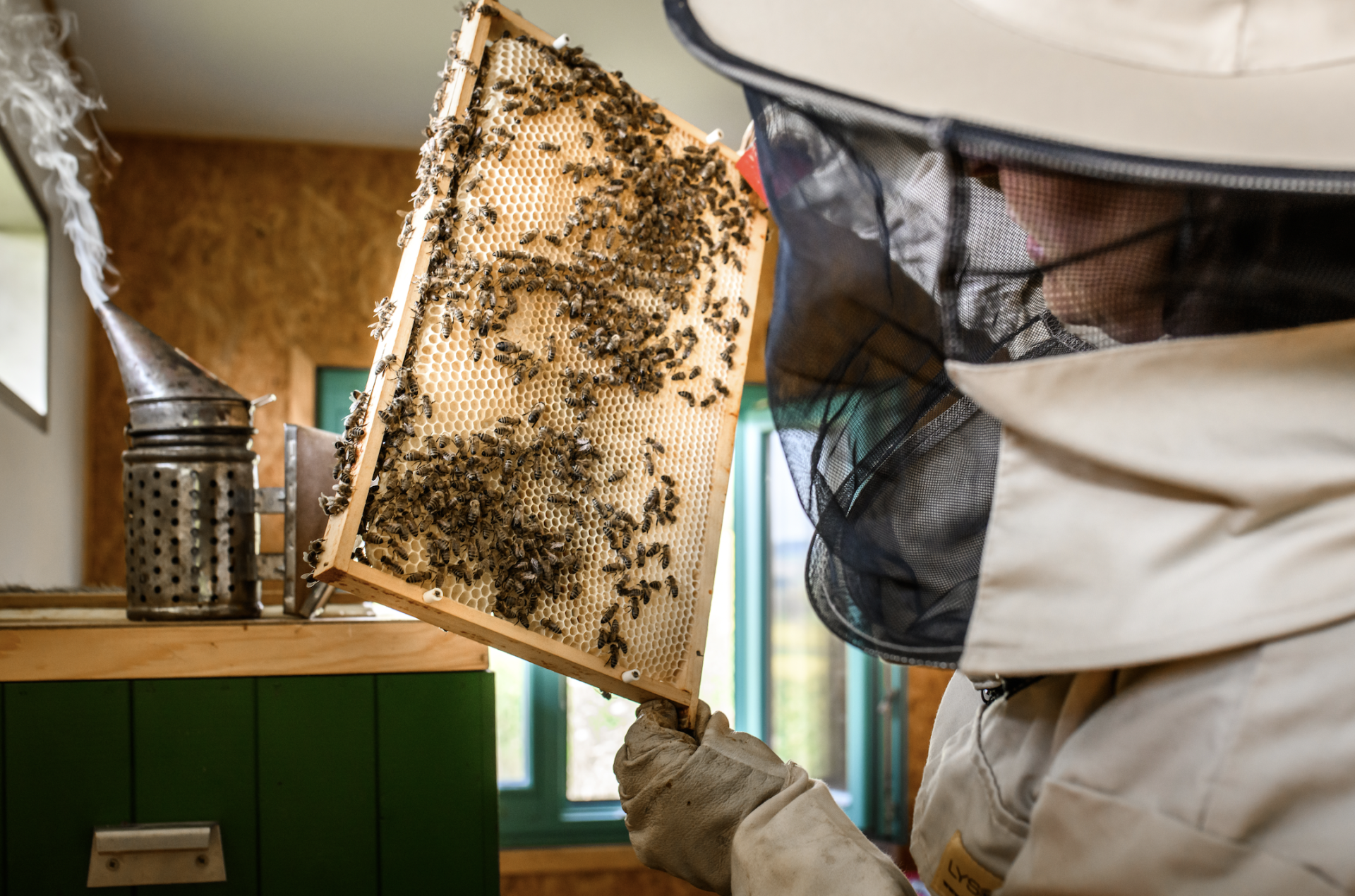
"Ittook me a year to understand the bee hierarchy. Before I picked it up from books," admits the self-taught beekeeper as she lights the tinder in her smoker. Smoke is the enemy of bees, and once they smell it, they assume there's a fire somewhere and retreat to the hive out of an instinct for self-preservation. They're calmer, and that's what we need now. For in a moment, Adele will open one of their hives.
She starts pulling out frame after frame and explains the secrets. "This is propolis, they use it to fill their various holes so they don't leak," she points to the brown spots. "It's not honey in these coats, it's eggs. Millimetre-long worms. When the adult bees come out of the honeycomb, they fill them with honey. And this frame is pollen again. See how this bee has yellow bumps on its legs? That's the pollen she's been mashing into the honeycomb. It's called a swarm." I stare, rapt, at the honeycomb covered in bees, which I examine at close range.
Adele is putting new frames into the hive, which have only a flat grid of beeswax with cells outlined. "She's going to build a honeycomb out of that flat board. They pull the cells out to the sides. But even better are the land frames, which are old frames that have been rolled out and the beeswax honeycombs are already built. And see how it broke off in the corner here? They'll get it right, they're clever girls! They know exactly what to do."
And how did bees do it before, when there was no hive? They just built a wild work of art. They can build a honeycomb without a template, it just takes them a little longer.
Queen's World
While Adela adds a third extension to the hive to give the bees somewhere to put their honey, I realise that I haven't seen a single bee foray. "It's really a great coincidence that the weather is this beautiful. It's rained a lot here now. And thanks to the weather, the bees are calm and good," the beekeeper shakes her head. But I'm clear, we had it booked!
Inside we have finished our work, we take off our protective hats, I take off my gloves, but we continue to discover the bee world. The queen in particular fascinates me. I learn that she has been feeding on royal jelly all her life and has 5 or 6 maid workers around her at all times to care for her. Even with her special diet, she can lay up to 2,000 eggs a day. It takes 16 days to develop, compared to 21 days for a worker hatchling, while drones take 24 days to spread their wings.
"The freshly raised mother flies up to a height of 30 metres for a nuptial flight, when she is fertilised by several drones in flight. After mating, they fall to the ground because they practically rip their own asses off. The queen mother then returns to the hive and begins to lay. When I notice this, I mark her with a colored marker to find her faster and clip her wing. That's so that when the bees swarm, they don't fly far away. That way, the queen will fall into the grass after, like, four feet and I don't have to climb trees anywhere. I pick her up in a special cage, put her in the hive and the other bees come back to her," Adéla adds.
And what happens if the queen takes a wrong turn during the nuptial flyby and doesn't return? Or if the queen has to be killed because she is too aggressive and passes on this trait through her genes to the whole colony? "Either a new one can be bred or a new one can be bought. You choose her by pedigree if you want one with a mild temperament, for example. Well, they send it to you in a special plastic key inserted in a bubble envelope. The key is filled with sugar dough inside, so when I put it in the hive, the bees find their way to it by biting through the dough and breaking the key out. This frees the queen and makes her more likely to be accepted."
"Different hives have different moods and the beekeeper is very aware of this. I had to read it all in."
So each colony (hive) always has only one queen and a certain mood. So different hives mean different moods. They are completely different colonies and the beekeeper perceives this. "I had to read this too. When a guy starts beekeeping, he sits down in the pub with the old geezers over a beer and they say 'hey Karl, do it like this'. But I didn't have anyone to ask," grins the passionate beekeeper.
A sticky miracle called honey
In spring, the willow trees in the area start flowering first. Then the fruit trees join in, and only then the plants. Sometimes everything blooms, but when it rains, the bees don't fly and the honey doesn't increase. They are particularly sensitive to cold weather.
The first harvest produces flower honey, and Adela makes me wonder. "Any beekeeper will tell you that it is healthier than forest honey because it is richer in vitamins. The second harvest is from a time when not so much is flowering, so the bees collect tree sap and also the excrement of ants or aphids. This makes the forest honey darker and rich in minerals. People want it more because it doesn't crystallise so quickly. It has less sugar." Oh, and I thought the darker the better.
Forest honey is taken away from the bees at the end of the season because they can't overwinter on it. They wouldn't be able to digest it as well as flower honey. Therefore, the bees are given a sugar solution for the winter, which requires about 15 to 17 kg per hive and is their winter food.
Honey cannot be taken from the bees at any time. It must be ripe. And it is ripe when the combs are full and waxed, which the bees will take care of themselves in due course. If honey that is not ripe, not waxed, is spun, it will have more water in it and will ferment in the jar.
Usually the honey is ready for bottling at the end of June, but here too - as always when working with nature - the weather matters. It is said that one frame can yield up to 2 kg of honey and one bee colony up to 30 kg of honey! When Adéla had seven colonies, she spun a whopping 170 kg of honey. And by the way, the expression "as busy as a bee" is not for nothing. A bee lives only a few weeks and dies on the job. Even at night, they say, she doesn't stop.
When bees need a doctor
Although many people might think that a beekeeper's job consists only of collecting honey, there is much more to it. "It's not just closing and opening the hive, it's a year-round job. Even in the winter and especially in the autumn," Adéla explains the beekeeper's year. "After the honey is spun, you have to prepare the frames for the bees again. You have to boil the old ones and clean the hive boxes. In October and December, you go to treat them and in January you come here for more samples, which are obligatory to be submitted to the vet for examination."
And that's how I learn that the bees are infested by the tick mite, a tick-like bug with the apt Latin name Varroa destructor. It came to us from abroad in the 1960s and we have not got rid of it. It practically sucks the bee. But even more dangerous is bee plague, where all bee colonies within a 5km radius have to be burned under veterinary supervision.
"If I've ever failed at anything, it was two years ago when I didn't catch the interval of their treatment against the tick-borer. It's just that at that time the covid craze had just started and I was in charge of the covid ward at our hospital. I didn't have time to run to the bees regularly and didn't get the second dose in on time. Several colonies died and I am still suffering the consequences," says Adéla, who has only five of her seven colonies left. She considers this a great lesson. "It punished me a lot and I was very sorry. You sacrifice a whole year and then you don't catch up." But then he lifts his head and adds enthusiastically: "Beekeeping will take its time, but I would definitely recommend it to anyone who has a relationship with nature. It just has to be done with respect and humility. Don't just come in and say, 'I'm going to milk this for honey. You have to enjoy it! If you don't give it love and care, there's no point in doing it. As with everything else."
Text and photo: Lenka Požárová