Česky
Česky


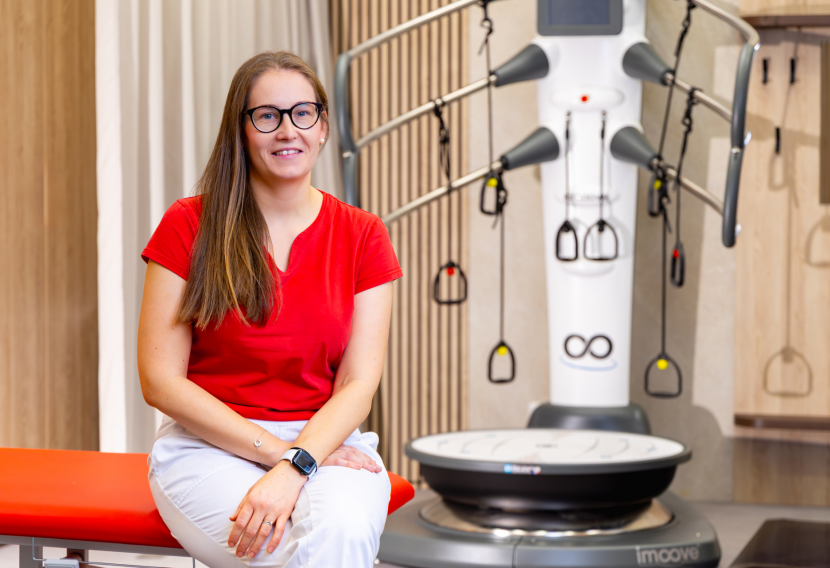
Mrs. Engineer, what brought you to physiotherapy?
I was led to physiotherapy by my own experience when I suffered facial nerve palsy in my childhood and adolescence. The physiotherapist who treated me then was a huge inspiration to me. Thanks to this experience, I decided to make physiotherapy my career. What attracted me to it was not only the opportunity to help others, but also the hospital environment itself, which has always attracted me in a special way.
What was your path to leadership?
Already during my studies at the 1st Faculty of Medicine at Charles University I had the opportunity to move around in a large university hospital, where I also stayed after school and joined the Department of Rehabilitation Medicine as a physiotherapist. For six years I was in charge of the outpatient department and I remember these years very fondly. After my maternity leave I accepted the offer to become the head of physiotherapy at the Rehabilitation Hospital Beroun, which was so attractive that I could not refuse. Beroun was already known for its great reputation during my studies, and to join such a renowned company was a great honour and challenge at the same time.
What did you expect in your new role?
My initial task was to stabilise the operation, which I think I managed to do during my first six months in the role. However, I am still getting to know in detail the functioning of the hospital, which is completely different in the private sector than in the public sphere. Beroun is characterised by a specific combination of inpatient and relatively large outpatient areas, which places high demands on the organisation. My task is to ensure the day-to-day running, to increase efficiency, the level of care and to promote good communication between colleagues, which I see as a significant shift.
"I appreciate everyone who comes up with ideas, suggestions for improvement. It shows that they care about our work."
How do you work with the motivation and development of your team?
I appreciate people who come with ideas, suggestions for improvement. It's a signal to me that he thinks about the work and cares about what we're building together. We also encourage motivation with a wide range of benefits such as flexible working hours, the ability to combine outpatient and inpatient, financial rewards and modern working facilities. Compared to other hospitals, Beroun is a truly exceptional environment.
Are you a strict boss or do you prefer a friendly approach?
I try to be primarily human, which corresponds with the motto of AKESO Holding, with which I fully agree. I want to be sympathetic to my colleagues and I always try to come up with a compromise solution when we discuss anything. Their work is demanding and they deserve admiration for how they manage it every single day. I have a great sense of responsibility, reliability and fair play, which I believe is reflected in the way I run the department. My team consists of about 120 people and I believe that the key is to talk to each other. Open communication can eliminate a lot of problems. That's why I make time for anyone who wants to talk to me, even if it's not always right away. The day-to-day agenda often overwhelms me, but I have a strong inner engine that keeps me going. A big thank you to my assistant, who does an incredible job and without whom I can no longer imagine running the office.
What kind of patients do you see most often?
Within the inpatient area, the predominant patients are orthopaedic and trauma patients after surgeries or injuries. At AKESO Holding, we have our own orthopaedic surgery, so the continuity with rehabilitation at AKESO is logical and allows for a smooth and efficient passage of the patient through the healthcare system. A large proportion of our patients are also neurological patients, whether after strokes, with multiple sclerosis or Parkinson's disease. We also run a specialised programme for these patients, of which we are rightly proud, and colleagues present it at various professional events. The outpatient clinics are then very varied - from back pain and other orthopaedic diagnoses to paediatric physiotherapy and pelvic floor. We also organise group sessions for children, sporty individuals or the elderly, so we can provide physiotherapy across generations and the diagnostic spectrum.
Do you connect with other disciplines as well?
This is an integral part of our work. Physiotherapists attend other departments in the hospital, such as the day care unit, the aftercare unit or the internal medicine department. They work closely with occupational therapists, psychologists and speech therapists. We are currently working with cardiologists to modernise our cardiac programme, where we want to strengthen the role of individual and group physiotherapy.
"I want to develop specialised programmes for neurological or urogynaecological patients. I can also imagine preventive movement programmes for children."
What does your long-term vision for physiotherapy in Beroun look like?
I want to strengthen the use of modern technologies so that their implementation into operation is faster and more efficient. As a result, they will strengthen the therapeutic effect and make the work of physiotherapists easier, which is also a worldwide trend. I also want to develop specialised programmes - not only for Parkinson's disease or cardiac patients, but also for neurological and urogynaecological patients. At the same time, I can also imagine preventive programmes for children and adolescents, where physiotherapy should play an indispensable role.
In the next line, I cannot forget the satisfaction of the employees, because, as our owner says - they are our driving force and I cannot but agree. So I would like to continue to work on retaining existing employees and attracting new ones, because we have the potential to grow. We have a very interesting benefits system, but I would like to use or introduce other tools that will lead to maximum satisfaction of our employees.
You are also dedicated to the education of students and graduates. What can you offer them?
I dare say we can offer them a lot. But before I start listing, I must say one thing that is closely related: I am fundamentally opposed to the professional dehumanisation of students or young colleagues. Even during my own studies, I was very hurt by the attitude of some of the lecturers on work placements for whom we were a 'nuisance'. They refused to give us the time, let alone to give us the experience we so much wanted as students.
When, a few years later, I had the opportunity to become a lecturer at the 1st Faculty of Medicine, I decided that my approach would be different. I have always given the students my utmost responsibility and effort to pass on everything I know. At the same time, I had my demands and I was definitely not the type to "give something for free" to students. On the contrary. However, the internships conducted at my workplace were very positively evaluated in the long run - the students sensed my approach and appreciated it. The same was true in theoretical teaching.
Students and young colleagues can expect the same principle here, no "slacking off and slacking off" awaits them (laughs). On the other hand, we offer them active work with patients, a wide range of diagnoses, modern technology and robotic systems, scholarship programmes and, last but not least, a pleasant, modern workplace.
"The world does not wait. We must continually educate ourselves in the field of medicine and science. That is why Beroun is a leader in the field."
Do you take the same approach to educating your colleagues?
You could say yes, although the form is of course different. The education of healthcare professionals is a process that never ends. We have to constantly adapt to advances in science and medicine in order to provide patients with the best possible, and most importantly, evidence-based medicine.
The physiotherapists at our Rehabilitation Centre are educated on an individual basis according to their specialisation, using the educational budget they are entitled to under the benefits system. As far as general education is concerned, once a month we have a scheduled clinical seminar on a specific topic, which is attended not only by physiotherapists but also by other colleagues from our centre. On a weekly basis there are micro-seminars for physiotherapists, which are led by our methodologist.
Since we have started operating new outpatient clinics since June, there have also been a lot of training sessions recently on the use of the technology available in these clinics. These include spinal decompression, TR therapy, Imoove and the VRRS system, which serves as a biofeedback system.
How do you see the development of physiotherapy in the Czech Republic?
The development of physiotherapy in the Czech Republic is influenced by many factors. At the moment there are about 8,000 of us in the register, so there are about 80 physiotherapists per 100,000 inhabitants. We know from demographic data that the population is ageing and at the same time, younger people are increasingly in need of physiotherapy, which was not so common before. This clearly puts pressure on work efficiency and also on the use of modern technology so that we can see more patients and at the same time maximise the effect of therapy. This is also linked to the transformation of care towards telerehabilitation. We are trying to respond to these trends in Beroun, but we must not underestimate the quality of treatment, which is crucial for us.
Patients come to us from far and wide, we have a very good reputation in the long term, and we do not want to jeopardise this in any way. However, there are a number of other challenges facing Czech physiotherapy that we will have to deal with as a society. These include a widespread shortage of physiotherapists in hospitals, below-average salaries, inconsistent competences and the outflow of graduates to private practice.
What fulfils you most about your work?
The fact that it's meaningful. Physiotherapy is a wonderful field that allows people to get back to normal life. Even though the work is physically and often mentally demanding. After all, we were told early on in our studies at the faculty that we all have a saviour complex and there's probably something to it (laughs). But the feeling you get when you get someone on their feet is priceless.
Ing. Marie Plecháčová
She joined the Rehabilitation Hospital in Beroun as head physiotherapist in February 2025. She lives in Prague with her family, and she and her husband are raising their twins. Her hobbies include travelling, sports, music, gastronomy and self-development. Her life motto, which is closest to her heart, is: "It doesn't matter how many times you fall, but how many times you get up and keep going".