Česky


QUALITY DEPARTMENT

The immediate line manager is the Director of the Rehabilitation Hospital Beroun, who monitors and evaluates work in the area of quality management, which is included in the hospital’s strategic plan and objectives. The organisational framework for quality and safety management of the care provided corresponds to the hospital’s organisational structure so as to cover all activities. Staff are briefed on quality management procedures by members of the quality team and their managers.
The Quality Team is responsible for the organisational implementation of quality management:
- It actively participates in the preparation of internal standards relating to quality and safety, the provision of medical and nursing care, and the formulation of the organisation’s social responsibility and patient protection policies
- It contributes to the development of the hospital’s strategic objectives in the areas of quality and safety
- It carries out monitoring activities relating to the quality of medical records, medical and nursing care, and the safety of the care and services provided
Quality Policy
The Quality Policy assists the Rehabilitation Hospital Beroun in:
- Develop strategies to prevent errors by healthcare professionals
- Use resources effectively
- Develop a programme for the continuous improvement of patient satisfaction
- To continuously improve the quality and safety management system in order to strengthen credibility and achieve the hospital’s prosperity and stability
- Manage key processes
- Ensure staff training and education to meet all requirements and established standards
- Ensure cooperation in the field of disease prevention and health promotion
Accreditation
This is a tool for the external assessment of quality and safety in the provision of healthcare services. The commission assesses the extent to which a healthcare facility complies with the requirements for improving the quality of care and safety. It is an official recognition (verification and guarantee) of the facility’s competence to provide healthcare and services whilst maintaining quality. It is not about equipment, but about the quality of processes. National accreditation is based on methodological guidelines from the Czech Ministry of Health, but is voluntary.
By applying for accreditation, a healthcare facility commits to improving patient care, ensuring a safe environment and endeavouring to minimise potential risks to patients and staff. It is a tool for quality assessment and management, carried out using the accreditation standards of the SAK (United Accreditation Commission):
SAK CZ ACCREDITATION STANDARDS:
- Ministry safety objectives
- Patients’ rights and patient education
- Accessibility and continuity of care
- Diagnostic care
- Therapeutic care
- Anaesthetic and surgical care
- Ordering, prescribing and administering medicines and drugs
- Hospital hygiene and anti-epidemic measures
- Management and administration
- Quality and safety management
- Environmental safety
- Information and communication
- Human Resources Management
An accredited hospital guarantees patients safety and quality of care through the continuous monitoring, analysis and improvement of quality indicators across all areas of hospital operations. These indicators are included in the hospital’s accreditation standards and regulations for all areas of management and healthcare provision.
Accreditation surveys take place periodically every three years, at which point the hospital must reapply for accreditation.
The Rehabilitation Hospital Beroun has been awarded SAK accreditation and an external quality certificate in accordance with Act No. 372/2011 Coll. and Ministry of Health Decree No. 102/2012 Coll. following an accreditation assessment carried out at the end of 2024.

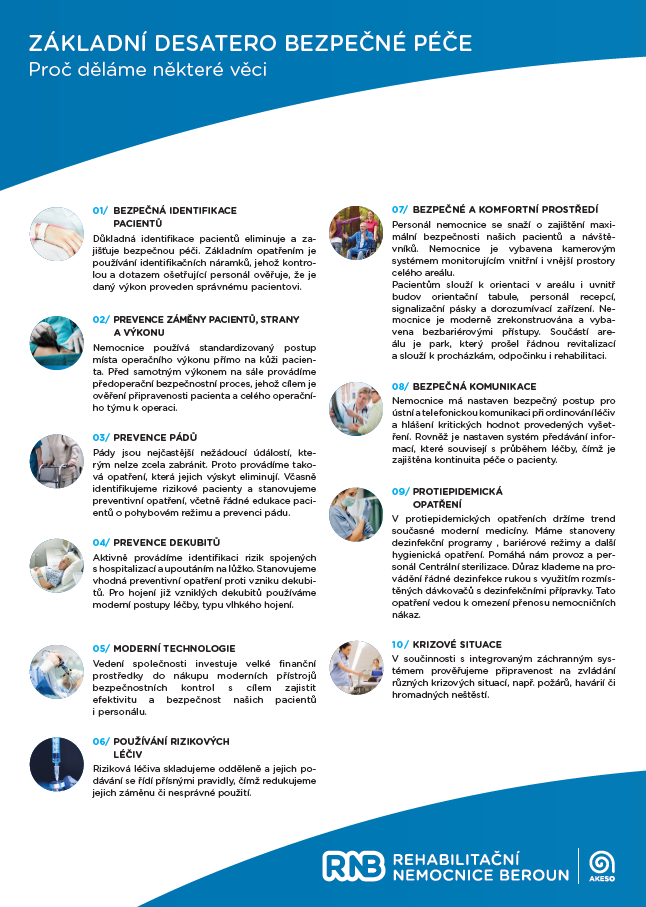
Ministry-level safety objectives
Upon admission to hospital, the admissions nurse will attach an identification wristband to your wrist. This serves to ensure your safe identification, prevent mix-ups before any diagnostic or therapeutic procedures are carried out, and ensure your safety. The wristband bears your first name, surname, date of birth and the abbreviation of the department to which you have been admitted.
1. Safe patient identification
We verify the identity of hospitalised patients by asking for their name and checking their identification wristband and medical records.
We verify the identity of outpatients by asking for their name and date of birth and by checking their insurance card (passport, identity card, etc.).
2. Safety when using higher-risk medicines
Higher-risk medicines (addictive substances, insulins, undiluted heparins, concentrated electrolytes – KCl) are stored separately from commonly used medicines. This is to prevent incorrect administration or misuse of the medicine.
3. Prevention of patient, procedure and side mix-ups
A standardised procedure is used to ensure that the correct procedure is performed on the correct patient at the correct location, including procedures carried out outside operating theatres, such as punctures. A standardised method is used, and the patient’s involvement (where possible given their medical condition) is ensured in marking the site of the surgical procedure. A safety procedure is also in place and documented immediately prior to the start of the surgical procedure, the aim of which is to verify the correctness of the patient, the procedure, the surgical site, implants, instruments and anaesthetics. The implementation and effectiveness of these procedures are verified through the hospital’s internal audits.
4. Prevention of patient falls
Falls are the most common adverse event among hospitalised patients, and the hospital’s aim is to minimise their number. As part of the initial assessment carried out by a nurse, a fall risk assessment is performed on all hospitalised patients. Patients identified as being at risk of falling are advised on safe mobility and fall prevention.
5. Optimal hand hygiene procedures in the provision of healthcare
Proper hand hygiene during the provision of healthcare reduces the risk of healthcare-associated infections and prevents their spread. Hand sanitiser dispensers located in wards and outpatient departments are available to staff, patients and all members of the public visiting the ward. By using them, you protect yourself and your loved ones.
6. Safe communication
The hospital has established a standard procedure for verbal and telephone communication when prescribing medicines and reporting critical test results. A standard procedure is also in place for providing information over the telephone about a patient’s condition to their relatives and loved ones.
7. Safe handover of patients
This is carried out by staff at the Rehabilitation Hospital Beroun who have been designated for this task. A standardised system is set out in the hospital’s guidelines.
8. Prevention of pressure ulcers in hospitalised patients
The hospital has established a system for the initial assessment of the risk of pressure ulcers, the prevention of pressure ulcers in inpatients, and the procedure to follow should pressure ulcers develop. The hospital maintains an electronic record-keeping and assessment system for pressure ulcers.