Česky
Česky


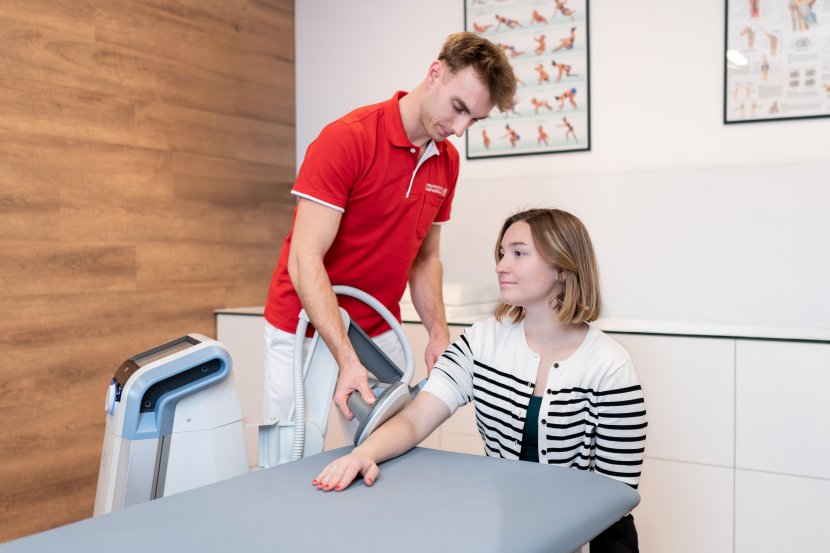
The principle of electromagnetic induction
The principle behind this technology is based on fundamental laws of physics. “This is an advanced technology in the field of physiotherapy that operates on the principle of electromagnetic induction. A magnetic field penetrates the body and, in accordance with Faraday’s law, induces electric currents in the tissues. This triggers a series of subsequent processes that have a positive effect on the human body,” explains Marie Plecháčová, Head Physiotherapist at Rehabilitation Hospital Beroun .
The Power of 3T
Although both magnetotherapy and electrotherapy are common rehabilitation procedures, SIS differs from them in many respects. “The main difference lies in the intensity and method of energy transfer to the tissues. Conventional low-frequency magnetotherapy uses a significantly weaker magnetic field, whereas SIS uses up to 3T, which means the intensity can be up to 100 times higher than with conventional magnetotherapy,” explains the head physiotherapist, adding: “SIS also utilises a more rapidly changing electromagnetic field, which makes it possible to induce electrical activity directly in the deeper neuromuscular structures without the need to place electrodes on the skin. Furthermore, unlike conventional magnetotherapy, SIS can be applied through clothing and even over certain types of immobilisation devices.”
Rapid relief and support for bone healing
Patients often expect immediate pain relief. However, the actual effect depends on the specific medical condition. “Some patients may experience a reduction in pain as early as the first session or shortly afterwards, but this is not the norm and the same effect cannot be assumed for all conditions,” points out Plecháčová. The effect varies between acute and chronic conditions. In the case of acute pain, the primary aim may be rapid pain modulation and a reduction in muscle spasm, whilst for chronic conditions, repeated application combined with active rehabilitation is more important. However, more recent studies suggest that high-induction magnetic stimulation in particular may provide a faster analgesic effect.
One of the method’s greatest advantages is also its support for fracture healing. “SIS can, through electromagnetic stimulation, influence the biological processes associated with bone metabolism and repair. Experimental research points to a possible influence on cellular processes related to bone formation, such as proliferation, osteoblast differentiation and the activity of mesenchymal stem cells. Put simply, the cells needed for bone formation first multiply, then specialise in the formation of new bone tissue, thereby promoting its regeneration, which can accelerate the entire healing process,” explains Marie Plecháčová.
Use for muscle and joint problems
The Super Inductive System offers a wide range of applications, from muscle relaxation to joint mobilisation. When the parameters of electromagnetic stimulation are set appropriately, it can influence muscle tone and thus reduce tension in muscle tissue. The effects of SIS are therefore being investigated, for example, in patients with spasticity resulting from damage to the central nervous system.
Conversely, when muscle strengthening is required, a higher intensity of the electromagnetic field is beneficial. “This can activate motor nerves and induce muscle contraction. Stimulation controlled in this way can be used, for example, in cases of muscle weakness, to prevent muscle atrophy, or when attempting to restore activity in a specific muscle group,” adds Plecháčová. In the case of joint problems, repeated muscle contractions induce a rhythmic movement that mechanically affects the area surrounding the joint.
Treatment procedure and contraindications
Although the method is highly effective, there are certain contraindications and restrictions due to the high intensity of the electromagnetic field. “These include, for example, pacemakers, implanted defibrillators, pregnancy and certain metal implants,” emphasises Marie Plecháčová, adding that this treatment is also unsuitable for patients with active cancer, decompensated internal conditions, acute conditions accompanied by fever, or blood clotting disorders.
The procedure itself is comfortable and painless for the patient. “The treatment is relatively simple. The patient usually sits or lies down, and the therapist places the applicator above the area to be treated. The advantage is that the applicator does not need to make direct contact with this area,” explains the head physiotherapist. The experience of the therapy varies from person to person. Depending on the selected programme and intensity, the patient may feel a gentle to more pronounced pulsation, muscle twitches, repeated muscle contractions, vibrations or a ‘tapping’ sensation in the treated area. When correctly adjusted, the procedure should not be painful.
Wide range of applications
Where is this method used? It is particularly useful as a complementary treatment for musculoskeletal and certain neurological conditions. Potential indications include, for example, acute and chronic back pain, muscle spasms, myofascial pain, certain forms of tendinopathy, osteoarthritis and joint pain, muscle weakness and atrophy, and other selected conditions following injuries and operations.
An indispensable complement to active exercise
To achieve long-term results, a series of 6 to 10 sessions is usually recommended, although the exact number is always tailored to the patient’s response. However, the overall approach to treatment remains the key factor for success.
“We use SIS primarily as a complement to active rehabilitation. Using it on its own may bring about short-term pain relief or affect muscle tone, but for a long-term effect, the most important thing is to combine it with manual therapy. It is important to note that SIS does not replace conventional physiotherapy. Ideally, it should be seen as a tool that can reduce pain or improve muscle activation, thereby enabling the patient to undergo more effective active rehabilitation,” concludes Plecháčová.
How to book an appointment?
You can book an appointment by calling 311 745 000.